QUESTION IMAGE
Question
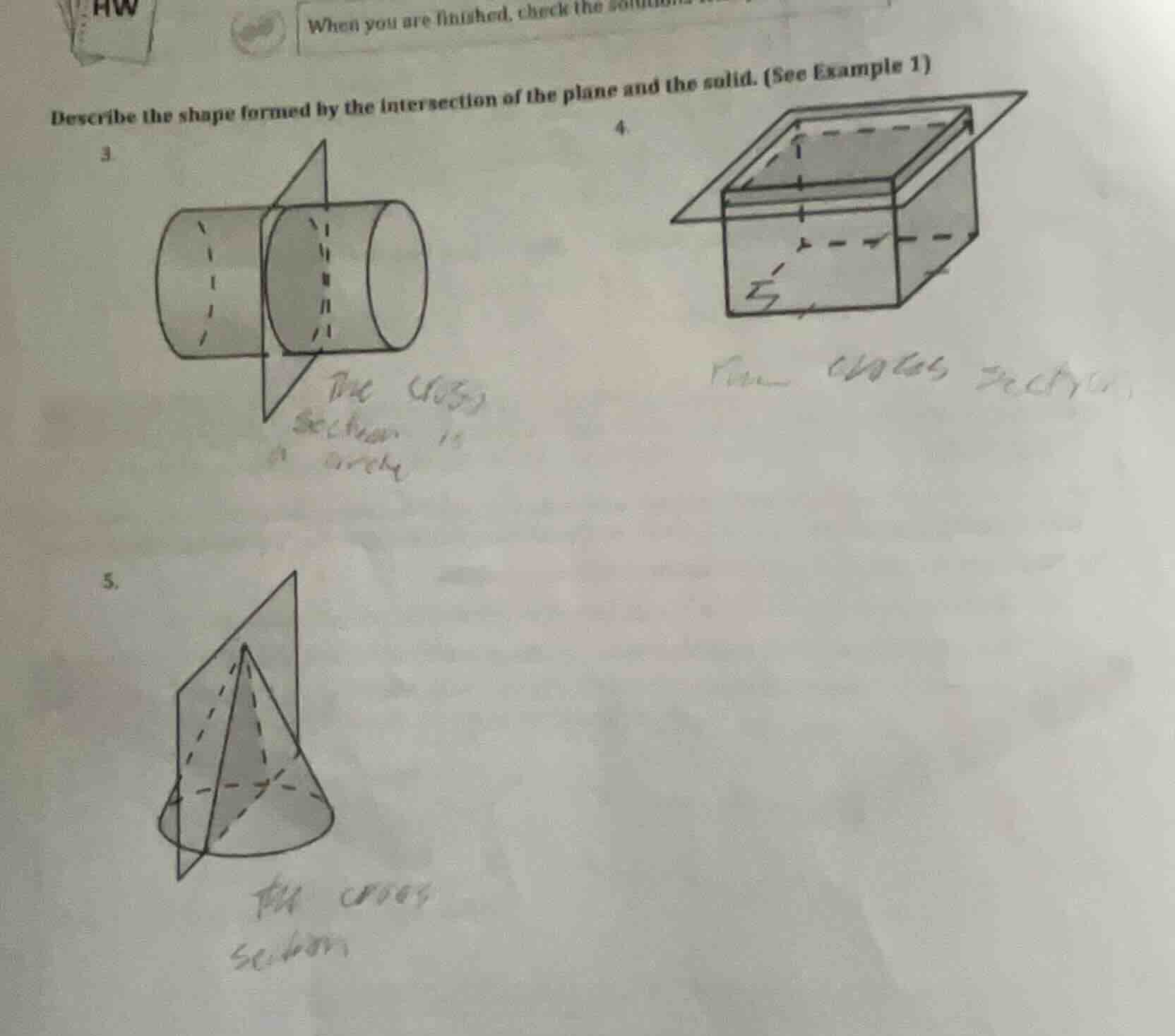
describe the shape formed by the intersection of the plane and the solid. (see example 1)
3.
4.
5.
Problem 3:
Step1: Identify the solid and plane orientation
The solid is a cylinder, and the plane is perpendicular to the axis of the cylinder (since it's cutting through the circular faces' diameter - like a cross - section that's parallel to the circular ends' orientation? Wait, no, the plane here is cutting the cylinder such that it's perpendicular to the length (axis) of the cylinder. Wait, actually, when a plane cuts a cylinder perpendicular to its axis, the intersection is a circle? Wait, no, the cylinder's axis is along its length. If the plane is perpendicular to the axis (so cutting across the circular ends), the intersection should be a circle? Wait, no, looking at the diagram, the plane is like a vertical plane (if the cylinder is horizontal) cutting through the circular face. Wait, the cylinder has circular bases. If the plane is perpendicular to the axis (so parallel to the circular bases' normal), then the intersection is a circle? Wait, no, maybe I missee. Wait, the cylinder: when you cut a cylinder with a plane perpendicular to its axis, the cross - section is a circle. Wait, but in the diagram, the plane is cutting the cylinder such that it's passing through the center, perpendicular to the axis. So the intersection shape is a circle? Wait, no, maybe a rectangle? No, no. Wait, the cylinder's lateral surface and the two circular bases. If the plane is perpendicular to the axis (so along the diameter of the circular bases), then the intersection with the lateral surface: the cylinder's lateral surface is a rectangle when unrolled, but when cut perpendicular to the axis, the intersection with the lateral surface and the two bases: the shape is a circle? Wait, no, let's think again. A cylinder has a circular base. If you cut it with a plane perpendicular to its axis (the line through the centers of the two circular bases), then the cross - section is a circle, because the plane will intersect the circular base (a circle) and the lateral surface will form a circle as well. Wait, maybe the initial thought was wrong. Wait, no, if the plane is parallel to the axis, the cross - section is a rectangle. If perpendicular, it's a circle. So in problem 3, the solid is a cylinder, plane is perpendicular to axis, so intersection is a circle? Wait, the diagram shows the plane cutting through the circular face (the end) and the lateral surface. Wait, maybe the cross - section is a circle.
Wait, maybe I made a mistake. Let's correct: when a plane cuts a cylinder perpendicular to its axis, the cross - section is a circle. When parallel to the axis, it's a rectangle. So in problem 3, the plane is perpendicular to the axis (since it's cutting through the circular end's diameter - like a vertical cut if the cylinder is horizontal), so the intersection shape is a circle.
Step2: Confirm the shape
The cylinder's axis is horizontal. The plane is vertical (perpendicular to the axis). So the intersection with the cylinder: the two circular bases are intersected as circles, and the lateral surface is intersected in a way that the overall shape is a circle. Wait, no, the lateral surface, when cut perpendicular to the axis, will have a circular arc? No, the lateral surface of a cylinder is a surface of revolution. The equation of a cylinder is \(x^{2}+y^{2}=r^{2}\) (in 3D, \(x^{2}+y^{2}=r^{2}, z\in [a,b]\)). If we take a plane \(z = c\) (perpendicular to the z - axis, which is the axis of the cylinder), then the intersection is \(x^{2}+y^{2}=r^{2}, z = c\), which is a circle. So yes, the shape is a circle.
Step1: Identify the solid and plane orientation
The solid is a rectangular prism (a box). The plane is parallel to the top and bottom faces (since it's cutting through the middle, horizontally, if the box is standing vertically). A rectangular prism has rectangular faces. When a plane cuts a rectangular prism parallel to one of its faces (in this case, the top face, which is a rectangle), the intersection will be a rectangle (or a square, if the top face is a square). Looking at the diagram, the plane is cutting the box such that it's parallel to the top and bottom faces (the horizontal faces). So the intersection with the four lateral faces and the top/bottom (but since it's in the middle, it's cutting through the lateral faces) will form a rectangle (or a square, depending on the box's dimensions). But since it's a rectangular prism, the cross - section parallel to the top face is a rectangle (or square, if the top is square).
Step2: Confirm the shape
The rectangular prism has six rectangular faces. A plane parallel to the top face (which is a rectangle) will intersect the four vertical (lateral) faces and form a rectangle (the same shape as the top face, just in the middle of the prism). So the intersection shape is a rectangle (or square, but generally a rectangle for a rectangular prism).
Step1: Identify the solid and plane orientation
The solid is a cone. The plane is passing through the vertex of the cone and cutting through the base (the circular base) along a diameter (since it's a plane that includes the axis of the cone - the line from the vertex to the center of the circular base). A cone has a circular base and a lateral surface that tapers to a vertex. When a plane passes through the vertex and the axis of the cone (a plane of symmetry), the intersection with the cone is a triangle. The plane will intersect the vertex, and two points on the circular base (along a diameter), forming a triangle with the vertex and the two points on the base.
Step2: Confirm the shape
The cone's axis is the line from vertex to center of base. The plane contains this axis, so it cuts the cone into two equal parts (a cross - section through the axis). The intersection with the lateral surface: the lateral surface of the cone is a sector of a circle when unrolled, but when cut by a plane through the axis, the intersection with the lateral surface is two straight lines (from the vertex to the base's edge) and the intersection with the base is a straight line (the diameter of the base). So the overall shape is a triangle (an isosceles triangle, since the two sides from the vertex to the base are equal in length, as the cone is symmetric about its axis).

Snap & solve any problem in the app
Get step-by-step solutions on Sovi AI
Photo-based solutions with guided steps
Explore more problems and detailed explanations
(Problem 3):
The shape formed by the intersection of the plane and the cylinder (the solid) is a circle.