QUESTION IMAGE
Question
describing effects of a change in slope and y - intercept
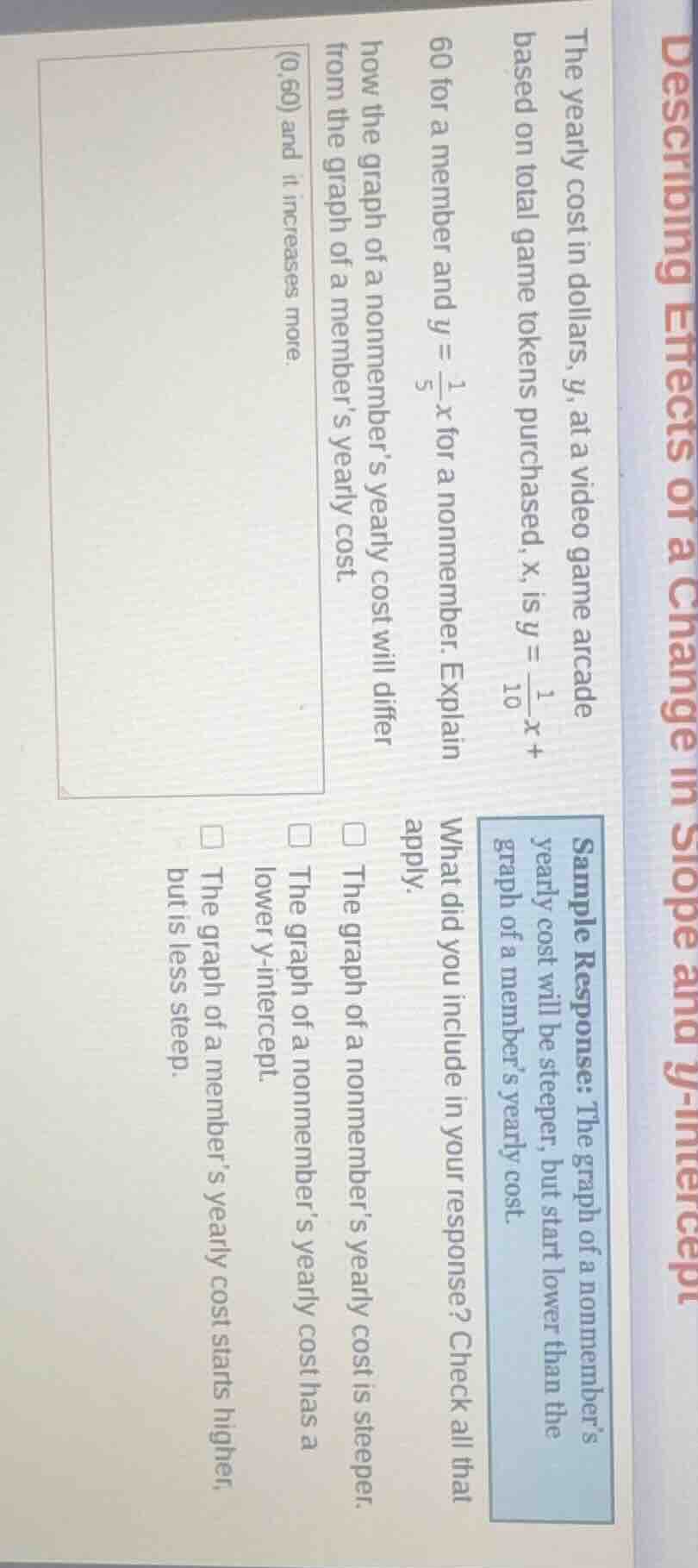
the yearly cost in dollars, y, at a video game arcade based on total game tokens purchased, x, is $y = \frac{1}{10}x + 60$ for a member and $y=\frac{1}{5}x$ for a nonmember. explain how the graph of a nonmember’s yearly cost will differ from the graph of a member’s yearly cost.
sample response: the graph of a nonmember’s yearly cost will be steeper, but start lower than the graph of a member’s yearly cost.
what did you include in your response? check all that apply.
□ the graph of a nonmember’s yearly cost is steeper.
□ the graph of a nonmember’s yearly cost has a lower y - intercept.
□ the graph of a member’s yearly cost starts higher, but is less steep.
To solve this, we analyze the two linear equations for member (\(y = \frac{1}{10}x + 60\)) and non - member (\(y=\frac{1}{5}x\)):
Step 1: Analyze the slope (steepness)
The slope of a linear equation in the form \(y = mx + b\) is given by \(m\).
- For the non - member's cost equation \(y=\frac{1}{5}x\), the slope \(m_{non - member}=\frac{1}{5}=0.2\).
- For the member's cost equation \(y = \frac{1}{10}x+60\), the slope \(m_{member}=\frac{1}{10} = 0.1\).
Since \(0.2>0.1\), the non - member's cost graph has a steeper slope.
Step 2: Analyze the y - intercept (starting point)
The y - intercept of a linear equation \(y=mx + b\) is \(b\) (the value of \(y\) when \(x = 0\)).
- For the non - member's cost equation \(y=\frac{1}{5}x\), when \(x = 0\), \(y=0\). So the y - intercept \(b_{non - member}=0\).
- For the member's cost equation \(y=\frac{1}{10}x + 60\), when \(x = 0\), \(y = 60\). So the y - intercept \(b_{member}=60\).
This means the member's cost graph starts at \((0,60)\) (higher y - intercept) and the non - member's graph starts at \((0,0)\) (lower y - intercept). Also, since the slope of the non - member's graph (\(\frac{1}{5}\)) is greater than the slope of the member's graph (\(\frac{1}{10}\)), the non - member's graph is steeper.
Now, let's check the options:
- "The graph of a nonmember’s yearly cost is steeper." - This is correct because \(\frac{1}{5}>\frac{1}{10}\).
- "The graph of a member’s yearly cost starts higher, but is less steep." - The member's graph has a y - intercept of 60 (starts higher) and a slope of \(\frac{1}{10}\) which is less than \(\frac{1}{5}\) (so less steep). This is correct.
- "The graph of a nonmember’s yearly cost has a lower y - intercept." - The non - member's y - intercept is 0 and the member's is 60, so the non - member's y - intercept is lower. This is correct.
For the check - all - that - apply part:
- The graph of a nonmember’s yearly cost is steeper. (Correct)
- The graph of a nonmember’s yearly cost has a lower y - intercept. (Correct)
- The graph of a member’s yearly cost starts higher, but is less steep. (Correct)

Snap & solve any problem in the app
Get step-by-step solutions on Sovi AI
Photo-based solutions with guided steps
Explore more problems and detailed explanations
- The graph of a nonmember’s yearly cost is steeper.
- The graph of a nonmember’s yearly cost has a lower y - intercept.
- The graph of a member’s yearly cost starts higher, but is less steep.