QUESTION IMAGE
Question
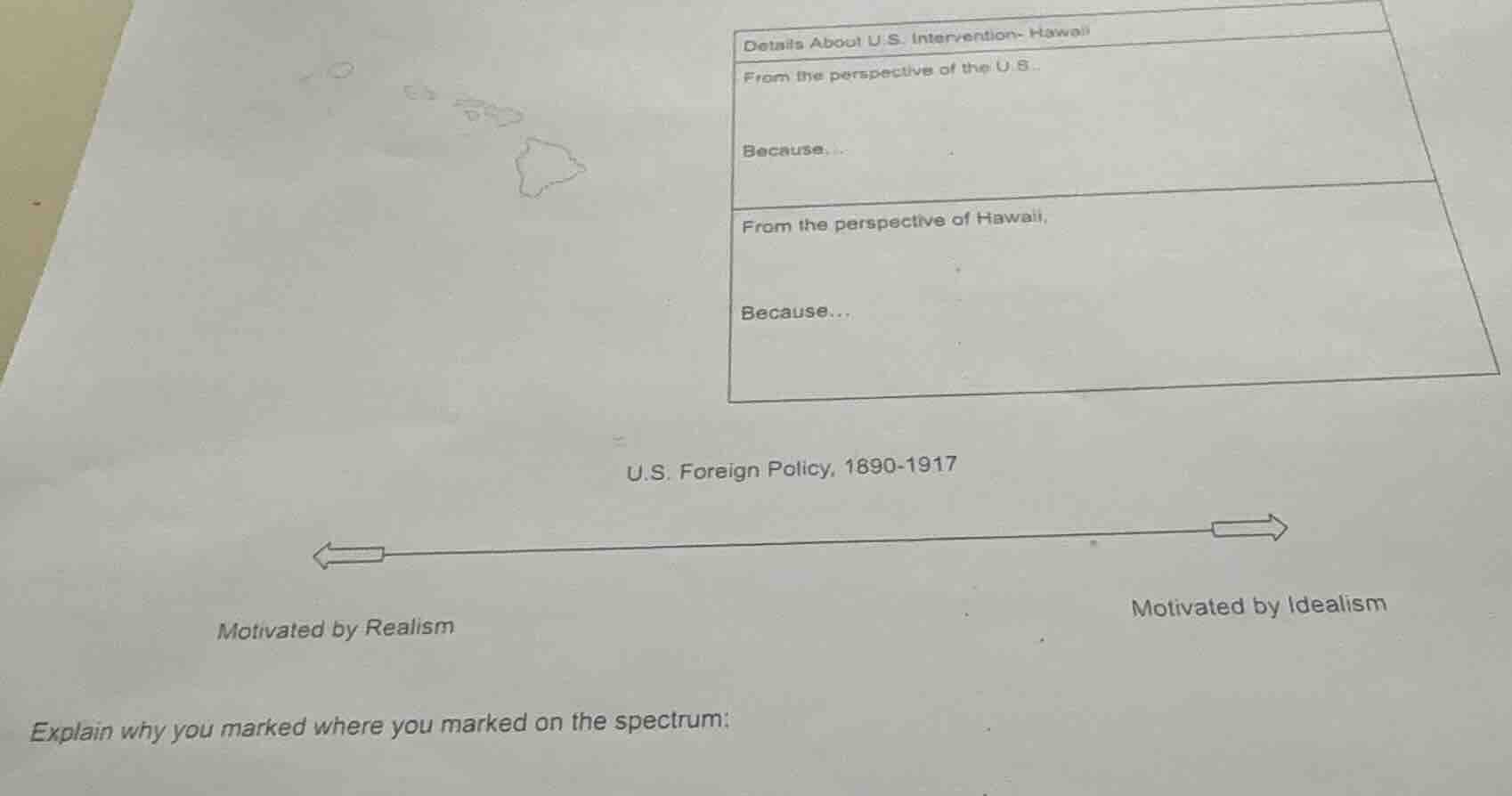
details about u.s. intervention- hawaii
from the perspective of the u.s.
because...
from the perspective of hawaii,
because...
u.s. foreign policy, 1890 - 1917
motivated by realism \t\t\tmotivated by idealism
explain why you marked where you marked on the spectrum:
- U.S. Perspective: The U.S. intervention in Hawaii (1898 annexation) was driven by realist foreign policy goals: securing a strategic Pacific military outpost (Pearl Harbor), protecting American economic interests in sugar and pineapple industries, and expanding U.S. territorial power to compete with other imperial nations.
- Hawaiian Perspective: Native Hawaiians viewed the intervention as an illegal overthrow of their sovereign government (1893 coup backed by U.S. forces), followed by forced annexation. It represented a loss of self-rule, cultural autonomy, and land for the Hawaiian people.
- Spectrum Placement: The intervention falls strongly on the Motivated by Realism end of the spectrum. The U.S. acted solely to advance its tangible national security and economic interests, with no focus on idealistic goals like promoting self-determination or democracy for Hawaii.
of Spectrum Placement:
The intervention was rooted in realist priorities: territorial expansion, military strategic value, and protecting American corporate profits, with no idealistic focus on self-governance for Hawaii.

Snap & solve any problem in the app
Get step-by-step solutions on Sovi AI
Photo-based solutions with guided steps
Explore more problems and detailed explanations
Details About U.S. Intervention- Hawaii
From the perspective of the U.S.
Because... it sought strategic/economic imperial gains.
From the perspective of Hawaii,
Because... it was an illegal loss of sovereignty.
U.S. Foreign Policy, 1890-1917 Spectrum Placement:
Marked closer to Motivated by Realism