QUESTION IMAGE
Question
details
no additional details were added for this assignment.
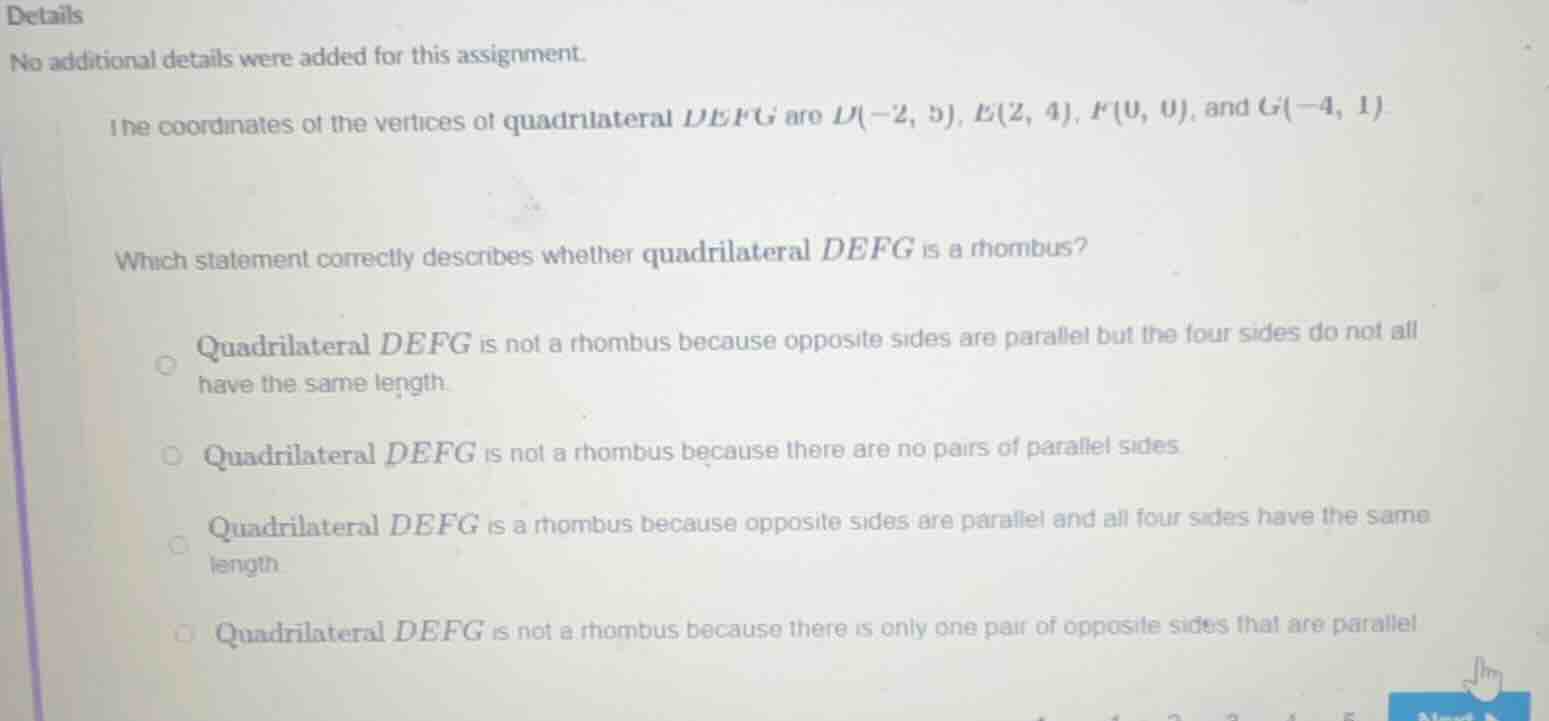
the coordinates of the vertices of quadrilateral defg are d(-2, 5), e(2, 4), f(0, 0), and g(-4, 1).
which statement correctly describes whether quadrilateral defg is a rhombus?
- quadrilateral defg is not a rhombus because opposite sides are parallel but the four sides do not all have the same length.
- quadrilateral defg is not a rhombus because there are no pairs of parallel sides.
- quadrilateral defg is a rhombus because opposite sides are parallel and all four sides have the same length.
- quadrilateral defg is not a rhombus because there is only one pair of opposite sides that are parallel
Step1: Calculate length of DE
Use distance formula: $d=\sqrt{(x_2-x_1)^2+(y_2-y_1)^2}$
$\overline{DE}=\sqrt{(2-(-2))^2+(4-3)^2}=\sqrt{4^2+1^2}=\sqrt{17}$
Step2: Calculate length of EF
$\overline{EF}=\sqrt{(0-2)^2+(0-4)^2}=\sqrt{(-2)^2+(-4)^2}=\sqrt{4+16}=\sqrt{20}=2\sqrt{5}$
Step3: Calculate length of FG
$\overline{FG}=\sqrt{(-4-0)^2+(1-0)^2}=\sqrt{(-4)^2+1^2}=\sqrt{16+1}=\sqrt{17}$
Step4: Calculate length of GD
$\overline{GD}=\sqrt{(-2-(-4))^2+(3-1)^2}=\sqrt{2^2+2^2}=\sqrt{4+4}=\sqrt{8}=2\sqrt{2}$
Step5: Check side parallelism
Calculate slopes:
Slope of $DE$: $m_{DE}=\frac{4-3}{2-(-2)}=\frac{1}{4}$
Slope of $FG$: $m_{FG}=\frac{1-0}{-4-0}=-\frac{1}{4}$
Slope of $EF$: $m_{EF}=\frac{0-4}{0-2}=2$
Slope of $GD$: $m_{GD}=\frac{3-1}{-2-(-4)}=1$
No slopes are equal, so no parallel sides.

Snap & solve any problem in the app
Get step-by-step solutions on Sovi AI
Photo-based solutions with guided steps
Explore more problems and detailed explanations
Quadrilateral DEFG is not a rhombus because there are no pairs of parallel sides