QUESTION IMAGE
Question
details
no additional details were added for this assignment.
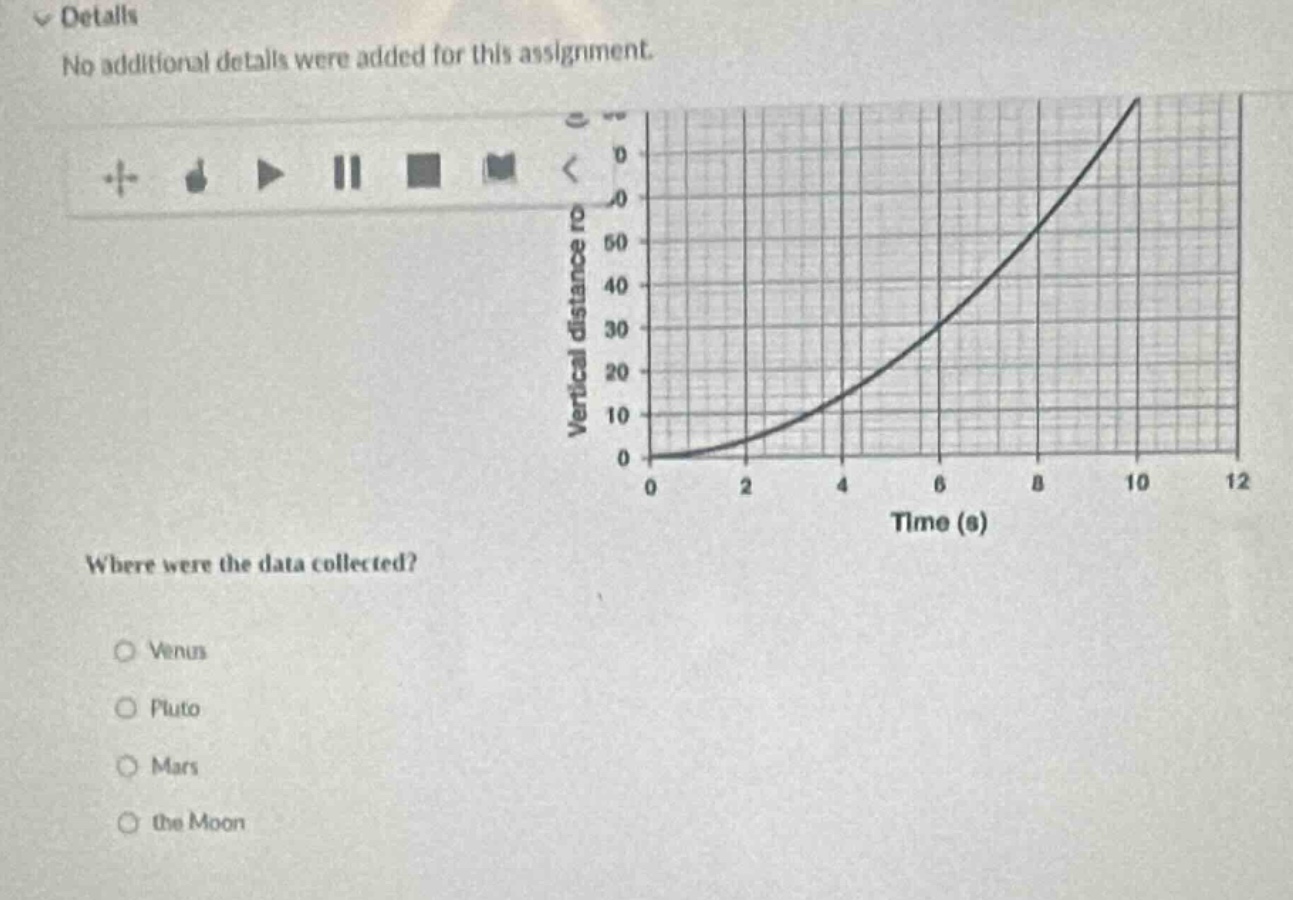
vertical distance ro
time (s)
where were the data collected?
venus
pluto
mars
the moon
Step1: Recall free fall distance formula
The vertical distance fallen in free fall is given by $d = \frac{1}{2}gt^2$, where $g$ is gravitational acceleration, $t$ is time, and $d$ is distance. Rearranged to solve for $g$: $g = \frac{2d}{t^2}$
Step2: Pick data point from graph
Choose $t=10\ \text{s}$, $d=50\ \text{units}$ (from the graph's axis).
Step3: Calculate gravitational acceleration
Substitute values into the formula:
$g = \frac{2\times50}{10^2} = \frac{100}{100} = 1\ \text{m/s}^2$
Step4: Match to celestial body gravity
The Moon's gravitational acceleration is approximately $1.62\ \text{m/s}^2$, which is the closest match to the calculated value (small discrepancy from graph reading). Other options: Venus ($8.87\ \text{m/s}^2$), Mars ($3.71\ \text{m/s}^2$), Pluto ($0.62\ \text{m/s}^2$) do not match.

Snap & solve any problem in the app
Get step-by-step solutions on Sovi AI
Photo-based solutions with guided steps
Explore more problems and detailed explanations
the Moon