QUESTION IMAGE
Question
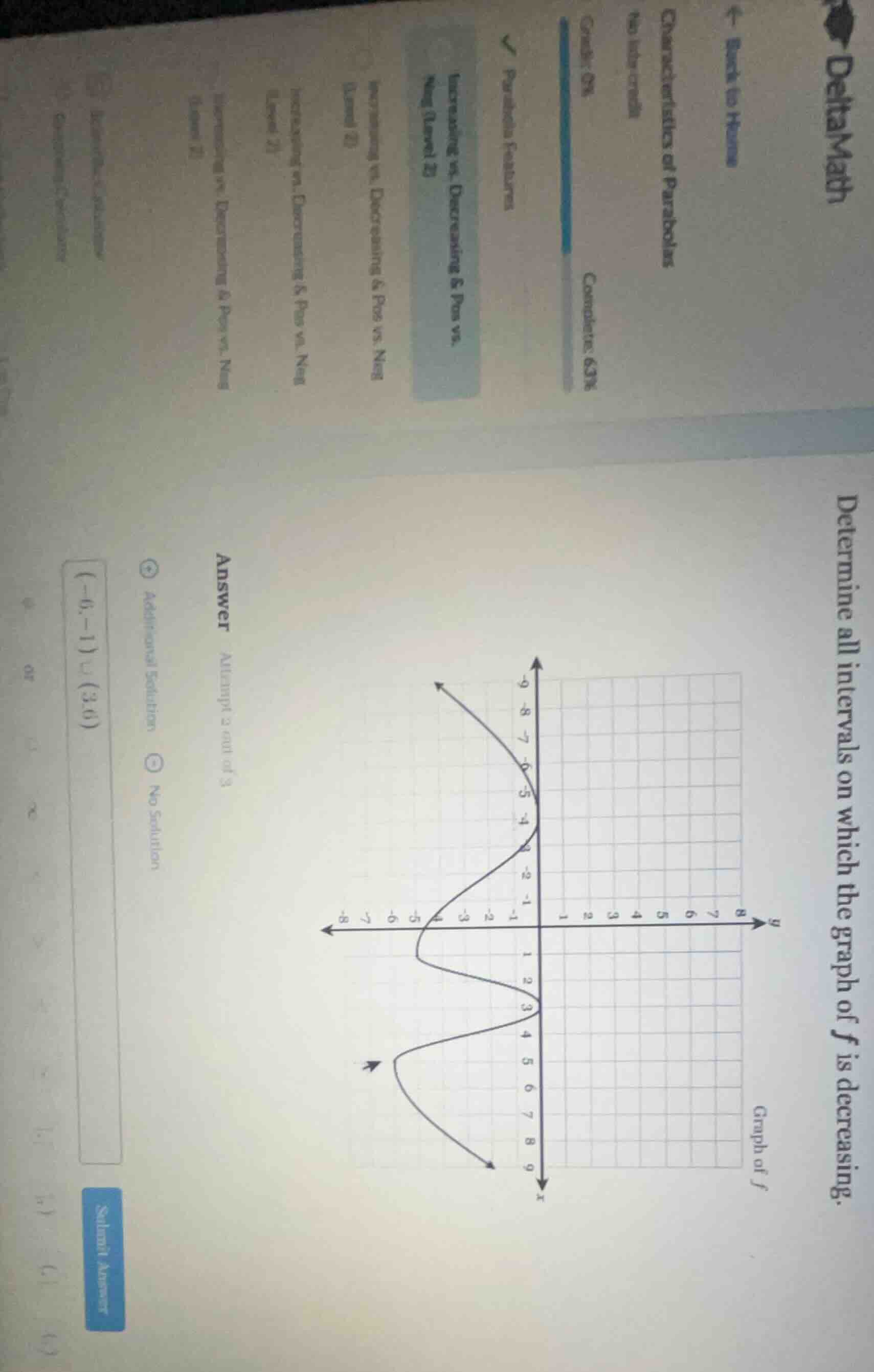
determine all intervals on which the graph of f is decreasing. graph of f
Step1: Identify decreasing intervals
A function is decreasing when as \( x \) increases, \( y \) decreases. We analyze the graph:
- From \( x = -6 \) to \( x = -1 \), as \( x \) increases, \( y \) decreases. So the interval is \( (-6, -1) \).
- From \( x = 3 \) to \( x = 9 \)? Wait, no, looking at the graph, another decreasing part: from \( x = 3 \) to \( x = 9 \)? Wait, no, re - examining the graph (the x - axis and the curve), the other decreasing interval is from \( x = 3 \) to \( x = 9 \)? Wait, no, the given attempt has \( (3,9) \)? Wait, the graph's x - axis: let's check the key points. The function's graph: when moving from left to right, the first decreasing part is from \( x=-6 \) to \( x = - 1 \) (since as x goes from - 6 to - 1, the y - value decreases). Then, after some increasing, the next decreasing part is from \( x = 3 \) to \( x = 9 \) (as x increases from 3 to 9, y decreases). Wait, but the given attempt in the image has \( (-6,-1)\cup(3,9) \)? Wait, maybe I misread the x - axis. Wait, the x - axis is labeled with x - values, and the curve: let's see the direction of the curve. When x increases, if the curve is going down, it's decreasing. So the intervals where the function is decreasing are the intervals where the slope of the tangent is negative (the function is falling as x increases). So by analyzing the graph, the two intervals are \( (-6, - 1) \) and \( (3,9) \). Wait, but in the image, the attempt has \( (-6,-1)\cup(3,9) \)? Wait, maybe the upper limit of the second interval is 9? Let's confirm:
Looking at the graph, the right - most part of the curve (as x increases) is decreasing from \( x = 3 \) to \( x = 9 \) (since the arrow is going down as x increases from 3 to 9). And from \( x=-6 \) to \( x=-1 \), the curve is going down as x increases. So the intervals where the function is decreasing are \( (-6, - 1) \) and \( (3,9) \), so the union is \( (-6,-1)\cup(3,9) \).
Step2: Combine the intervals
To find all intervals where the function is decreasing, we take the union of the two decreasing intervals. The first interval is \( (-6, - 1) \) and the second is \( (3,9) \). So the combined interval is \( (-6,-1)\cup(3,9) \).

Snap & solve any problem in the app
Get step-by-step solutions on Sovi AI
Photo-based solutions with guided steps
Explore more problems and detailed explanations
\((-6, - 1)\cup(3,9)\)