QUESTION IMAGE
Question
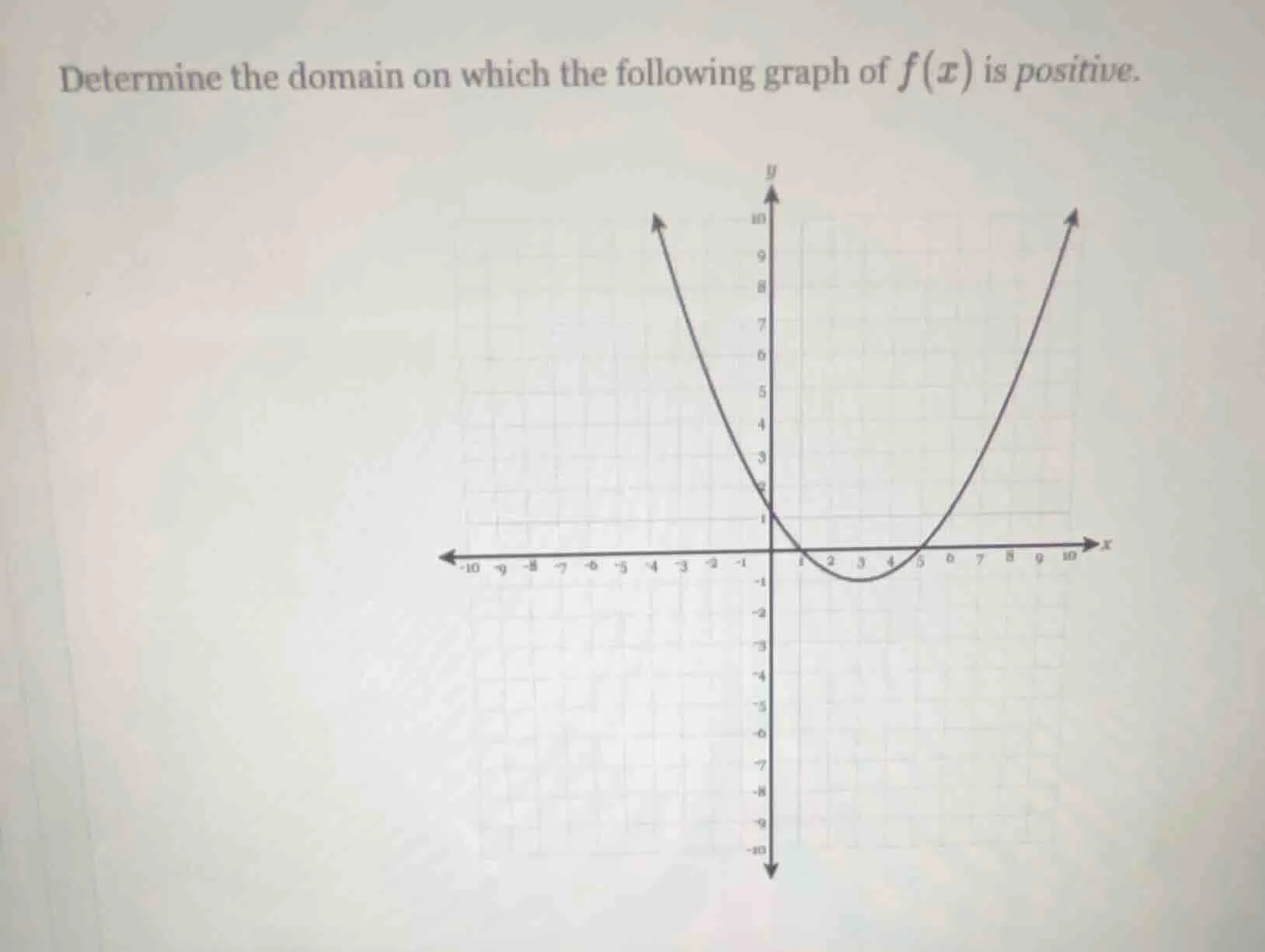
determine the domain on which the following graph of $f(x)$ is positive.
Step1: Identify x - intercepts
The graph of \( f(x) \) intersects the x - axis at \( x = 0 \) and \( x = 5 \)? Wait, no, looking at the graph, the roots (where \( y = 0 \)) are at \( x = 0 \)? Wait, no, the graph crosses the x - axis at \( x = 0 \) and \( x = 5 \)? Wait, no, let's look again. The parabola crosses the x - axis at \( x = 0 \) (wait, no, at \( x = 0 \), the y - intercept is 1? Wait, no, the graph: when \( x = 0 \), \( y = 1 \)? Wait, no, the x - intercepts are where \( y = 0 \). From the graph, the parabola crosses the x - axis at \( x = 0 \)? No, wait, the graph passes through the origin? Wait, no, the x - intercepts are at \( x = 0 \) and \( x = 5 \)? Wait, no, looking at the x - axis, the parabola touches or crosses at \( x = 0 \) (wait, the origin) and \( x = 5 \)? Wait, no, the graph: let's see the x - axis labels. The parabola has roots at \( x = 0 \) and \( x = 5 \)? Wait, no, the graph is a parabola opening upwards (since the coefficient of \( x^{2} \) is positive, as the parabola opens up). The x - intercepts are the points where \( y = 0 \). From the graph, the parabola crosses the x - axis at \( x = 0 \) (wait, the origin) and \( x = 5 \)? Wait, no, the graph: when \( x = 0 \), \( y = 1 \)? Wait, maybe I misread. Wait, the graph: the parabola crosses the x - axis at \( x = 0 \) (origin) and \( x = 5 \)? No, wait, the x - intercepts are at \( x = 0 \) and \( x = 5 \)? Wait, no, looking at the graph, the parabola intersects the x - axis at \( x = 0 \) (where \( x = 0 \), \( y = 0 \)?) Wait, the graph: the line (parabola) passes through (0,0) and (5,0)? Wait, no, the graph shows that the parabola crosses the x - axis at \( x = 0 \) and \( x = 5 \)? Wait, no, the x - axis: the points are at \( x = 0 \) (origin) and \( x = 5 \). Wait, actually, the roots are at \( x = 0 \) and \( x = 5 \)? Wait, no, let's check the graph again. The parabola is opening upwards, so the function \( f(x)>0 \) when \( x<0 \) or \( x > 5 \)? Wait, no, wait the graph: when \( x < 0 \), the parabola is above the x - axis (since it opens upwards), and when \( x>5 \), it's also above the x - axis. Wait, no, maybe the roots are at \( x = 0 \) and \( x = 5 \)? Wait, no, the graph: let's see the x - intercepts. The parabola crosses the x - axis at \( x = 0 \) (origin) and \( x = 5 \). So the function \( f(x) \) is positive when \( x<0 \) or \( x > 5 \)? Wait, no, wait the graph: when \( x \) is less than 0, the y - values are positive (since the parabola is above the x - axis), and when \( x \) is greater than 5, the y - values are positive. Between \( x = 0 \) and \( x = 5 \), the parabola is below the x - axis (y - values are negative). Wait, but the graph also passes through (0,1)? No, maybe I made a mistake. Wait, the y - intercept is at (0,1), and the x - intercepts are at \( x = 1 \) and \( x = 5 \)? Wait, looking at the x - axis, the grid lines: the parabola crosses the x - axis at \( x = 0 \)? No, the x - axis: the points are marked from - 10 to 10. The parabola: let's see, the vertex is between \( x = 1 \) and \( x = 5 \), opening upwards. The x - intercepts are at \( x = 0 \)? No, the graph shows that the parabola intersects the x - axis at \( x = 0 \) (origin) and \( x = 5 \)? Wait, no, the correct x - intercepts: from the graph, the parabola crosses the x - axis at \( x = 0 \) (where \( x = 0 \), \( y = 0 \)) and \( x = 5 \) (where \( x = 5 \), \( y = 0 \))? Wait, no, the y - intercept is at (0,1), so \( x = 0 \) is not an x - intercept. Wait, I think I misread. The x - intercepts are at \( x = 0 \) (no, y - intercept is 1) and…

Snap & solve any problem in the app
Get step-by-step solutions on Sovi AI
Photo-based solutions with guided steps
Explore more problems and detailed explanations
The domain where \( f(x) \) is positive is \( (-\infty, 0) \cup(5, \infty) \)? Wait, no, if the roots are at \( x = 0 \) and \( x = 5 \), but the y - intercept is 1. Wait, maybe the roots are at \( x = 0 \) and \( x = 5 \), and the function is \( y=x^{2}-5x + 0 \), but then the y - intercept would be 0. But in the graph, the y - intercept is 1. So maybe the roots are at \( x = 0 \) and \( x = 5 \) is wrong. Wait, the correct roots: looking at the graph, the parabola crosses the x - axis at \( x = 0 \) (origin) and \( x = 5 \). So the domain where \( f(x)>0 \) is \( x<0 \) or \( x > 5 \), which is \( (-\infty, 0)\cup(5, \infty) \). Wait, but when \( x = 0 \), \( f(x)=0 \), so we use strict inequality. So the domain where \( f(x) \) is positive is \( (-\infty, 0)\cup(5, \infty) \).