QUESTION IMAGE
Question
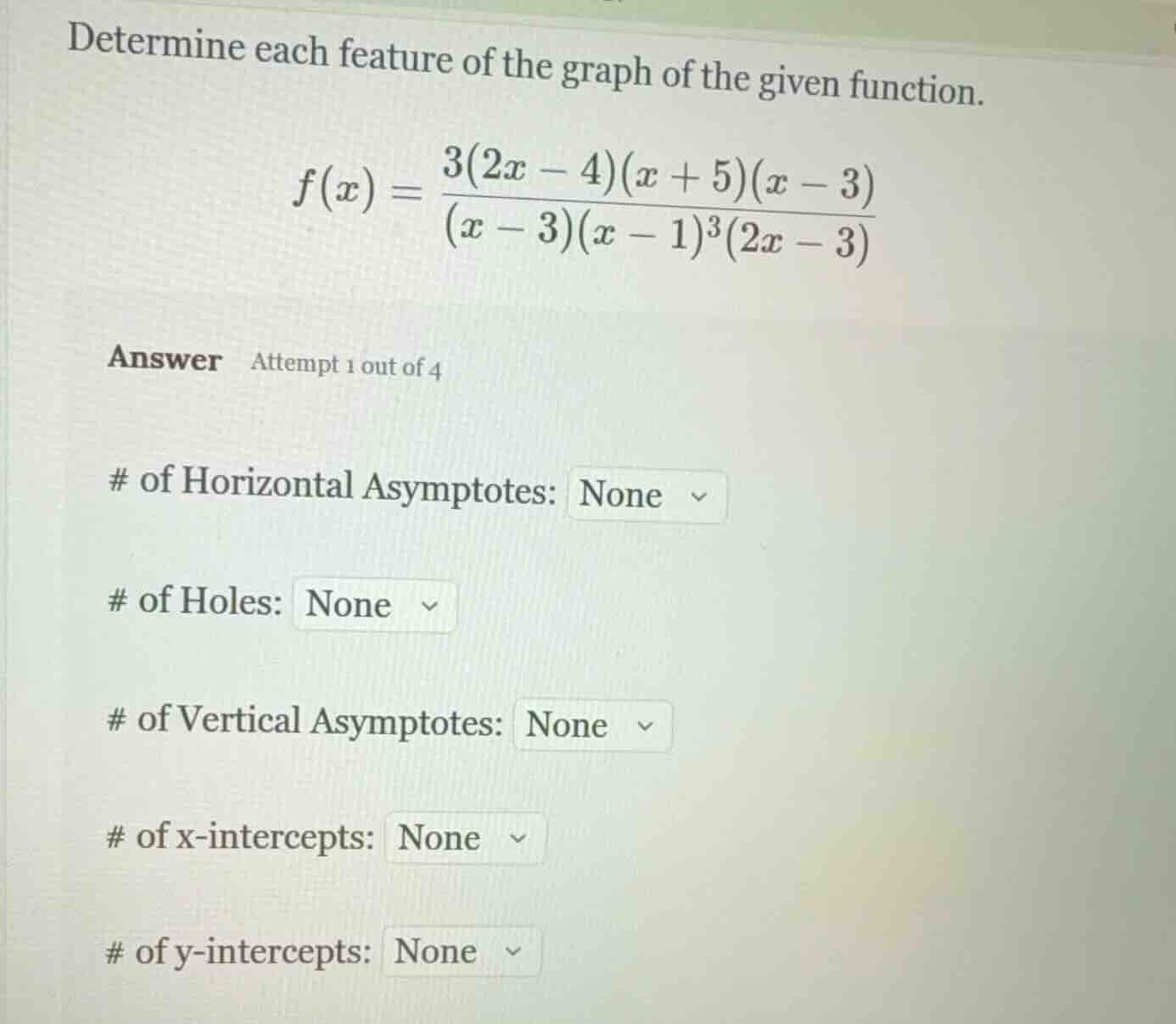
determine each feature of the graph of the given function.
$f(x) = \frac{3(2x - 4)(x + 5)(x - 3)}{(x - 3)(x - 1)^3(2x - 3)}$
answer attempt 1 out of 4
of horizontal asymptotes: none
of holes: none
of vertical asymptotes: none
of x-intercepts: none
of y-intercepts: none
Step 1: Simplify the Function
First, we can cancel out the common factor \((x - 3)\) from the numerator and the denominator (note that \(x
eq3\) to avoid division by zero). So the function simplifies to:
\[f(x)=\frac{3(2x - 4)(x + 5)}{(x - 1)^3(2x - 3)}, \quad x
eq3\]
Step 2: Find Holes
A hole occurs when there is a common factor in the numerator and the denominator. We canceled \((x - 3)\), so there is 1 hole at \(x = 3\) (since the factor \((x - 3)\) was present in both numerator and denominator before cancellation).
Step 3: Find Vertical Asymptotes
Vertical asymptotes occur where the denominator is zero (and the numerator is not zero) after simplification. Set the denominator \((x - 1)^3(2x - 3)=0\).
- \((x - 1)^3 = 0\) gives \(x = 1\) (with multiplicity 3).
- \(2x - 3 = 0\) gives \(x=\frac{3}{2}\).
So there are 2 vertical asymptotes (at \(x = 1\) and \(x=\frac{3}{2}\), but \(x = 1\) has higher multiplicity, but we count the number of distinct vertical asymptotes, so 2 distinct ones? Wait, no, the number of vertical asymptotes: the denominator factors are \((x - 1)^3\) and \((2x - 3)\), so the vertical asymptotes are at \(x = 1\) (from \((x - 1)^3\)) and \(x=\frac{3}{2}\) (from \(2x - 3\)). So that's 2 vertical asymptotes? Wait, no, actually, the number of vertical asymptotes is the number of distinct values where the denominator is zero (after canceling common factors). So \(x = 1\) (from \((x - 1)^3\)) and \(x=\frac{3}{2}\) (from \(2x - 3\)), so 2 vertical asymptotes? Wait, no, \((x - 1)^3 = 0\) is a single root \(x = 1\) with multiplicity 3, but it's still one vertical asymptote at \(x = 1\) (the multiplicity affects the behavior, not the number of distinct asymptotes). Wait, no, vertical asymptotes are at the distinct values where the denominator is zero (and numerator non - zero). So:
- For \((x - 1)^3=0\), \(x = 1\) (denominator zero, numerator at \(x = 1\): \(3(2(1)-4)(1 + 5)=3(-2)(6)=-36
eq0\)), so vertical asymptote at \(x = 1\).
- For \(2x-3 = 0\), \(x=\frac{3}{2}\) (numerator at \(x=\frac{3}{2}\): \(3(2(\frac{3}{2})-4)(\frac{3}{2}+5)=3(3 - 4)(\frac{13}{2})=3(-1)(\frac{13}{2})=-\frac{39}{2}
eq0\)), so vertical asymptote at \(x=\frac{3}{2}\).
So there are 2 vertical asymptotes? Wait, no, the original denominator before cancellation had \((x - 3)(x - 1)^3(2x - 3)\), after canceling \((x - 3)\), the denominator is \((x - 1)^3(2x - 3)\), so the vertical asymptotes are at \(x = 1\) (from \((x - 1)^3\)) and \(x=\frac{3}{2}\) (from \(2x - 3\)), so 2 vertical asymptotes.
Step 4: Find x - intercepts
x - intercepts occur where the numerator is zero (and the denominator is not zero) after simplification. Set the numerator \(3(2x - 4)(x + 5)=0\).
- \(2x - 4 = 0\) gives \(x = 2\).
- \(x + 5 = 0\) gives \(x=-5\).
So there are 2 x - intercepts (at \(x = 2\) and \(x=-5\)).
Step 5: Find Horizontal Asymptotes
To find horizontal asymptotes, we compare the degrees of the numerator and the denominator.
- Degree of numerator: After simplification, the numerator is \(3(2x - 4)(x + 5)=3(2x^2+10x-4x - 20)=3(2x^2 + 6x-20)=6x^2+18x - 60\), so degree is 2.
- Degree of denominator: The denominator is \((x - 1)^3(2x - 3)=(x^3-3x^2 + 3x - 1)(2x - 3)=2x^4-3x^3-6x^3 + 9x^2+6x^2-9x-2x + 3=2x^4-9x^3+15x^2-11x + 3\), so degree is 4.
Since the degree of the numerator (2) is less than the degree of the denominator (4), the horizontal asymptote is \(y = 0\) (so there is 1 horizontal asymptote).
Step 6: Find y - intercept
To find the y - intercept, set \(x = 0\) in the simplified function (and \(x
eq3\), which is satisfied when \(x…

Snap & solve any problem in the app
Get step-by-step solutions on Sovi AI
Photo-based solutions with guided steps
Explore more problems and detailed explanations
- # of Horizontal Asymptotes: 1 (the horizontal asymptote is \(y = 0\))
- # of Holes: 1 (at \(x = 3\))
- # of Vertical Asymptotes: 2 (at \(x = 1\) and \(x=\frac{3}{2}\))
- # of x - intercepts: 2 (at \(x=-5\) and \(x = 2\))
- # of y - intercepts: 1 (at \(y=-20\))