QUESTION IMAGE
Question
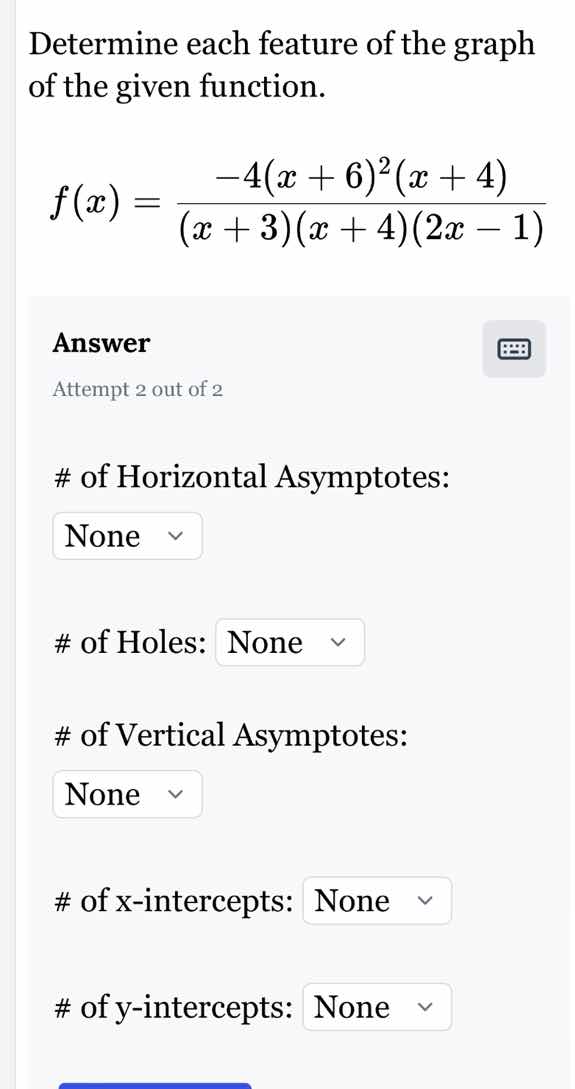
determine each feature of the graph of the given function.
$f(x) = \frac{-4(x + 6)^2(x + 4)}{(x + 3)(x + 4)(2x - 1)}$
answer
attempt 2 out of 2
of horizontal asymptotes:
none
of holes: none
of vertical asymptotes:
none
of x-intercepts: none
of y-intercepts: none
To determine the features of the graph of the function \( f(x) = \frac{-4(x + 6)^2(x + 4)}{(x + 3)(x + 4)(2x - 1)} \), we analyze each component:
Step 1: Simplify the Function
First, we cancel out the common factor \((x + 4)\) in the numerator and the denominator (note that \(x
eq -4\) to avoid division by zero):
\[
f(x) = \frac{-4(x + 6)^2\cancel{(x + 4)}}{(x + 3)\cancel{(x + 4)}(2x - 1)} = \frac{-4(x + 6)^2}{(x + 3)(2x - 1)} \quad \text{(for } x
eq -4\text{)}
\]
Step 2: Number of Holes
A hole occurs when a factor cancels from both the numerator and denominator. Here, \((x + 4)\) cancels, so there is 1 hole at \(x = -4\) (since the canceled factor corresponds to \(x = -4\)).
Step 3: Number of Vertical Asymptotes
Vertical asymptotes occur where the simplified denominator is zero (and the numerator is not zero). The simplified denominator is \((x + 3)(2x - 1)\). Setting each factor to zero:
- \(x + 3 = 0 \implies x = -3\)
- \(2x - 1 = 0 \implies x = \frac{1}{2}\)
For \(x = -3\) and \(x = \frac{1}{2}\), the numerator \(-4(x + 6)^2\) is not zero (since \((x + 6)^2\) is always non - zero, and \(-4
eq0\)). Thus, there are 2 vertical asymptotes.
Step 4: Number of Horizontal Asymptotes
To find horizontal asymptotes, we compare the degrees of the numerator and denominator.
- Degree of numerator: The numerator \(-4(x + 6)^2=-4(x^{2}+12x + 36)=-4x^{2}-48x - 144\) has degree \(2\).
- Degree of denominator: The denominator \((x + 3)(2x - 1)=2x^{2}-x + 6x - 3=2x^{2}+5x - 3\) has degree \(2\).
When the degrees are equal, the horizontal asymptote is the ratio of the leading coefficients.
- Leading coefficient of numerator: \(-4\) (from \(-4x^{2}\) in the expanded numerator).
- Leading coefficient of denominator: \(2\) (from \(2x^{2}\) in the expanded denominator).
So, the horizontal asymptote is \(y=\frac{-4}{2}=-2\). Thus, there is 1 horizontal asymptote.
Step 5: Number of \(x\) - intercepts
The \(x\) - intercepts occur where the numerator of the simplified function is zero (and the function is defined). The simplified numerator is \(-4(x + 6)^2\). Setting the numerator equal to zero:
\(-4(x + 6)^2 = 0\implies(x + 6)^2 = 0\implies x=-6\)
We need to check if \(x = -6\) is in the domain of the simplified function. The domain of the simplified function excludes \(x=-3\), \(x=\frac{1}{2}\), and \(x = -4\) (from the original function). Since \(-6\) is not excluded, there is 1 \(x\) - intercept at \(x=-6\).
Step 6: Number of \(y\) - intercepts
The \(y\) - intercept occurs at \(x = 0\) (if the function is defined at \(x = 0\)). Substitute \(x = 0\) into the simplified function:
\[
f(0)=\frac{-4(0 + 6)^2}{(0 + 3)(2(0)-1)}=\frac{-4\times36}{3\times(-1)}=\frac{-144}{-3}=48
\]
Since the function is defined at \(x = 0\) ( \(0\) is not a vertical asymptote or a hole), there is 1 \(y\) - intercept at \(y = 48\).
Final Answers
- # of Holes: \(1\)
- # of Vertical Asymptotes: \(2\)
- # of Horizontal Asymptotes: \(1\)
- # of \(x\) - intercepts: \(1\)
- # of \(y\) - intercepts: \(1\)
For the original incorrect dropdowns:
- # of Holes: The correct answer is \(1\) (not "None").
- # of Vertical Asymptotes: The correct answer is \(2\) (not "None").
- # of Horizontal Asymptotes: The correct answer is \(1\) (not "None").
- # of \(x\) - intercepts: The correct answer is \(1\) (not "None").
- # of \(y\) - intercepts: The correct answer is \(1\) (not "None").

Snap & solve any problem in the app
Get step-by-step solutions on Sovi AI
Photo-based solutions with guided steps
Explore more problems and detailed explanations
To determine the features of the graph of the function \( f(x) = \frac{-4(x + 6)^2(x + 4)}{(x + 3)(x + 4)(2x - 1)} \), we analyze each component:
Step 1: Simplify the Function
First, we cancel out the common factor \((x + 4)\) in the numerator and the denominator (note that \(x
eq -4\) to avoid division by zero):
\[
f(x) = \frac{-4(x + 6)^2\cancel{(x + 4)}}{(x + 3)\cancel{(x + 4)}(2x - 1)} = \frac{-4(x + 6)^2}{(x + 3)(2x - 1)} \quad \text{(for } x
eq -4\text{)}
\]
Step 2: Number of Holes
A hole occurs when a factor cancels from both the numerator and denominator. Here, \((x + 4)\) cancels, so there is 1 hole at \(x = -4\) (since the canceled factor corresponds to \(x = -4\)).
Step 3: Number of Vertical Asymptotes
Vertical asymptotes occur where the simplified denominator is zero (and the numerator is not zero). The simplified denominator is \((x + 3)(2x - 1)\). Setting each factor to zero:
- \(x + 3 = 0 \implies x = -3\)
- \(2x - 1 = 0 \implies x = \frac{1}{2}\)
For \(x = -3\) and \(x = \frac{1}{2}\), the numerator \(-4(x + 6)^2\) is not zero (since \((x + 6)^2\) is always non - zero, and \(-4
eq0\)). Thus, there are 2 vertical asymptotes.
Step 4: Number of Horizontal Asymptotes
To find horizontal asymptotes, we compare the degrees of the numerator and denominator.
- Degree of numerator: The numerator \(-4(x + 6)^2=-4(x^{2}+12x + 36)=-4x^{2}-48x - 144\) has degree \(2\).
- Degree of denominator: The denominator \((x + 3)(2x - 1)=2x^{2}-x + 6x - 3=2x^{2}+5x - 3\) has degree \(2\).
When the degrees are equal, the horizontal asymptote is the ratio of the leading coefficients.
- Leading coefficient of numerator: \(-4\) (from \(-4x^{2}\) in the expanded numerator).
- Leading coefficient of denominator: \(2\) (from \(2x^{2}\) in the expanded denominator).
So, the horizontal asymptote is \(y=\frac{-4}{2}=-2\). Thus, there is 1 horizontal asymptote.
Step 5: Number of \(x\) - intercepts
The \(x\) - intercepts occur where the numerator of the simplified function is zero (and the function is defined). The simplified numerator is \(-4(x + 6)^2\). Setting the numerator equal to zero:
\(-4(x + 6)^2 = 0\implies(x + 6)^2 = 0\implies x=-6\)
We need to check if \(x = -6\) is in the domain of the simplified function. The domain of the simplified function excludes \(x=-3\), \(x=\frac{1}{2}\), and \(x = -4\) (from the original function). Since \(-6\) is not excluded, there is 1 \(x\) - intercept at \(x=-6\).
Step 6: Number of \(y\) - intercepts
The \(y\) - intercept occurs at \(x = 0\) (if the function is defined at \(x = 0\)). Substitute \(x = 0\) into the simplified function:
\[
f(0)=\frac{-4(0 + 6)^2}{(0 + 3)(2(0)-1)}=\frac{-4\times36}{3\times(-1)}=\frac{-144}{-3}=48
\]
Since the function is defined at \(x = 0\) ( \(0\) is not a vertical asymptote or a hole), there is 1 \(y\) - intercept at \(y = 48\).
Final Answers
- # of Holes: \(1\)
- # of Vertical Asymptotes: \(2\)
- # of Horizontal Asymptotes: \(1\)
- # of \(x\) - intercepts: \(1\)
- # of \(y\) - intercepts: \(1\)
For the original incorrect dropdowns:
- # of Holes: The correct answer is \(1\) (not "None").
- # of Vertical Asymptotes: The correct answer is \(2\) (not "None").
- # of Horizontal Asymptotes: The correct answer is \(1\) (not "None").
- # of \(x\) - intercepts: The correct answer is \(1\) (not "None").
- # of \(y\) - intercepts: The correct answer is \(1\) (not "None").