QUESTION IMAGE
Question
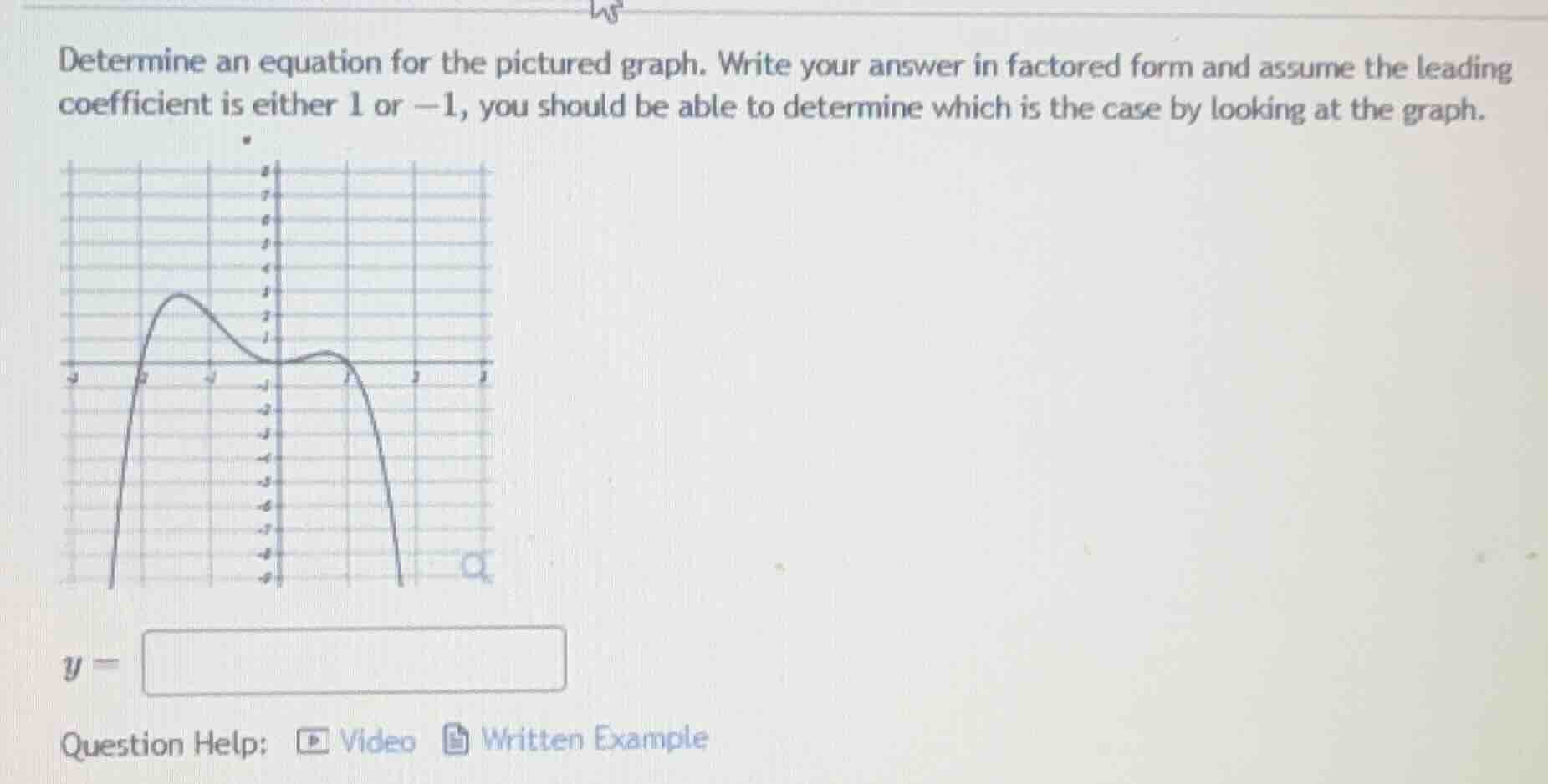
determine an equation for the pictured graph. write your answer in factored form and assume the leading coefficient is either 1 or -1, you should be able to determine which is the case by looking at the graph.
question help: ⏹ video 📄 written example
Step1: Identify x-intercepts and multiplicities
The graph crosses the x-axis at \( x = -2 \) (simple root, multiplicity 1), touches and turns at \( x = 0 \) (multiplicity 2), and touches and turns at \( x = 1 \) (multiplicity 2)? Wait, no, looking again: the graph crosses at \( x = -2 \), touches at \( x = 0 \) (so multiplicity 2), and touches at \( x = 1 \)? Wait, no, the graph: let's check the roots. The x-intercepts are \( x = -2 \), \( x = 0 \) (with a touch, so even multiplicity), and \( x = 1 \) (with a touch? Wait, no, the graph: when x=0, it touches the axis (so multiplicity 2), x=-2 is a cross (multiplicity 1), x=1 is a cross? Wait, no, the graph: let's see the shape. The leading coefficient: as x approaches \( +\infty \), the graph goes down, so leading coefficient is negative (since degree is 1 + 2 + 2 = 5? Wait, no: x=-2 (multiplicity 1), x=0 (multiplicity 2), x=1 (multiplicity 2). So the factored form is \( y = a(x + 2)x^2(x - 1)^2 \). Now, check the leading coefficient. The degree is 1 + 2 + 2 = 5 (odd), and as x approaches \( +\infty \), \( y \) approaches \( -\infty \) (since the leading term is \( a x^5 \), so \( a < 0 \). We assume \( a = -1 \) (since leading coefficient is -1 or 1). Let's verify with a point, say x=-1. At x=-1, what's the y-value? From the graph, at x=-1, y is around 2. Let's plug into \( y = -1(x + 2)x^2(x - 1)^2 \). At x=-1: \( -1(-1 + 2)(-1)^2(-1 - 1)^2 = -1(1)(1)(4) = -4 \)? Wait, that's not matching. Wait, maybe the multiplicity at x=1 is 1? Wait, no, the graph: let's re-examine. The graph: crosses at x=-2, touches at x=0 (multiplicity 2), and crosses at x=1? Wait, no, the graph near x=1: does it cross or touch? The graph: when x=1, it looks like it touches? Wait, maybe I misread. Wait, the graph: let's see the roots. The x-intercepts are \( x = -2 \), \( x = 0 \) (touch, multiplicity 2), and \( x = 1 \) (touch, multiplicity 2)? No, maybe x=1 is a cross. Wait, maybe the roots are x=-2 (multiplicity 1), x=0 (multiplicity 2), x=1 (multiplicity 1). Wait, no, the graph: let's count the turning points. But maybe simpler: the factored form with roots at x=-2 (multiplicity 1), x=0 (multiplicity 2), x=1 (multiplicity 1). Then degree is 1 + 2 + 1 = 4? No, 1+2+1=4, even. But as x approaches +infty, the graph goes down, so leading coefficient negative. Wait, maybe my initial root analysis was wrong. Let's try again. The graph: crosses at x=-2, touches at x=0 (multiplicity 2), and crosses at x=1 (multiplicity 1). So factored form: \( y = a(x + 2)x^2(x - 1) \). Now, degree is 1 + 2 + 1 = 4 (even). As x approaches +infty, \( y = a x^4 \). If a is negative, as x approaches +infty, y approaches -infty, which matches the graph (since at x=2, the graph is down). Now, check a point. Let's take x=-1. At x=-1, from the graph, y is positive (around 2). Plug into \( y = a(x + 2)x^2(x - 1) \): \( a(-1 + 2)(-1)^2(-1 - 1) = a(1)(1)(-2) = -2a \). We want this to be positive, so -2a > 0 => a < 0. We assume a = -1? Wait, no: if a = -1, then -2*(-1) = 2, which matches the y-value at x=-1 (around 2). Perfect. So let's check: \( y = -1(x + 2)x^2(x - 1) \). Let's expand the leading term: \( -1 x^4 \), which as x approaches +infty, y approaches -infty, correct. Now, check x=0: y=0, correct (touches the axis, multiplicity 2). x=-2: y=0, crosses, multiplicity 1. x=1: y=0, crosses? Wait, no, if multiplicity 1, it should cross. But in the graph, at x=1, does it cross? Let's see: the graph at x=1, does it go from above to below or below to above? The graph: at x=1, it looks like it touches? Wait, no, maybe my multiplicity is wro…

Snap & solve any problem in the app
Get step-by-step solutions on Sovi AI
Photo-based solutions with guided steps
Explore more problems and detailed explanations
\( y = -x^2(x + 2)(x - 1) \)