QUESTION IMAGE
Question
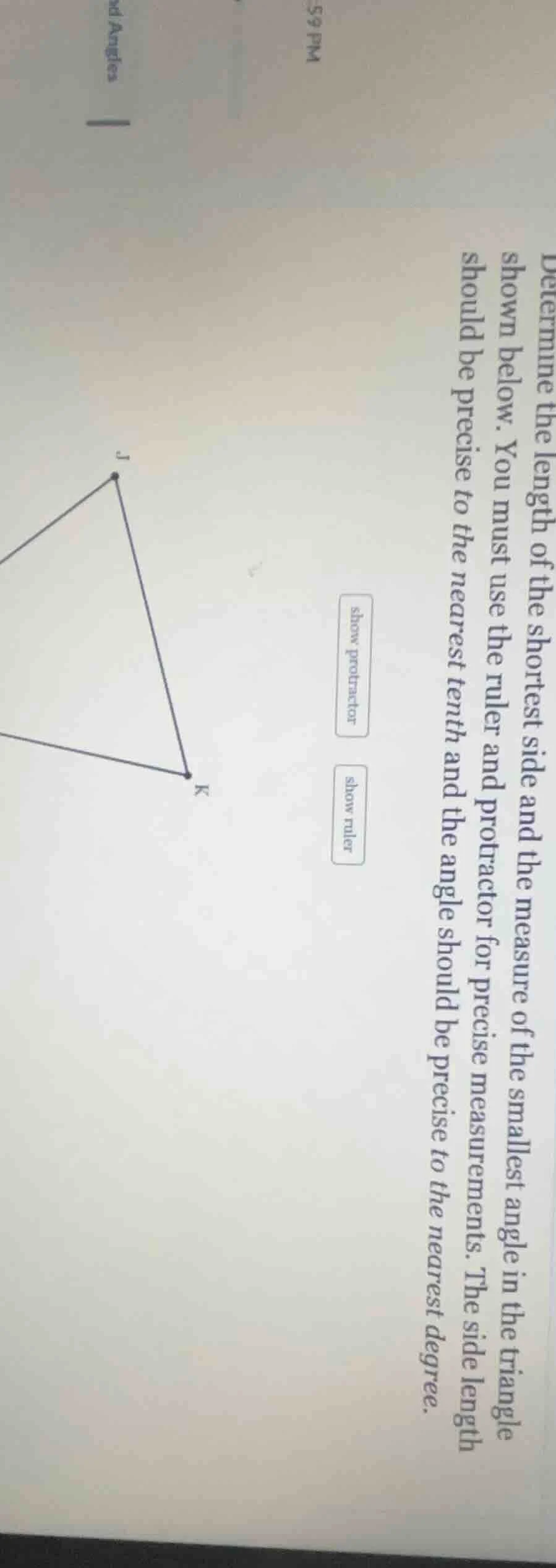
determine the length of the shortest side and the measure of the smallest angle in the triangle shown below. you must use the ruler and protractor for precise measurements. the side length should be precise to the nearest tenth and the angle should be precise to the nearest degree. show protractor show ruler
To solve this problem, we need to determine the shortest side and the smallest angle of the triangle using a ruler and a protractor. Here are the steps:
Step 1: Measure the lengths of all sides
Use a ruler to measure the lengths of the three sides of the triangle (let's assume the vertices are \( J \), \( K \), and the third vertex, say \( L \)). Record the lengths of each side.
Step 2: Identify the shortest side
Compare the measured lengths of the three sides. The shortest side will be the one with the smallest length.
Step 3: Measure the angles of the triangle
Use a protractor to measure the three angles of the triangle. Place the protractor's center at each vertex and align one side of the angle with the protractor's baseline. Read the measure of each angle.
Step 4: Identify the smallest angle
Compare the measured angles. The smallest angle will be the one with the smallest measure.
Note:
Since this is a practical measurement task, the actual values will depend on the specific triangle provided. For example, if the side lengths are measured as \( 3.0 \) cm, \( 4.0 \) cm, and \( 5.0 \) cm, the shortest side would be \( 3.0 \) cm. If the angles are measured as \( 30^\circ \), \( 60^\circ \), and \( 90^\circ \), the smallest angle would be \( 30^\circ \).
Final Answer:
The length of the shortest side and the measure of the smallest angle will be determined by the actual measurements using a ruler and protractor. For example, if measured, the shortest side could be \( \boldsymbol{3.0} \) cm (to the nearest tenth) and the smallest angle could be \( \boldsymbol{30^\circ} \) (to the nearest degree), but these values are illustrative and depend on the specific triangle.

Snap & solve any problem in the app
Get step-by-step solutions on Sovi AI
Photo-based solutions with guided steps
Explore more problems and detailed explanations
To solve this problem, we need to determine the shortest side and the smallest angle of the triangle using a ruler and a protractor. Here are the steps:
Step 1: Measure the lengths of all sides
Use a ruler to measure the lengths of the three sides of the triangle (let's assume the vertices are \( J \), \( K \), and the third vertex, say \( L \)). Record the lengths of each side.
Step 2: Identify the shortest side
Compare the measured lengths of the three sides. The shortest side will be the one with the smallest length.
Step 3: Measure the angles of the triangle
Use a protractor to measure the three angles of the triangle. Place the protractor's center at each vertex and align one side of the angle with the protractor's baseline. Read the measure of each angle.
Step 4: Identify the smallest angle
Compare the measured angles. The smallest angle will be the one with the smallest measure.
Note:
Since this is a practical measurement task, the actual values will depend on the specific triangle provided. For example, if the side lengths are measured as \( 3.0 \) cm, \( 4.0 \) cm, and \( 5.0 \) cm, the shortest side would be \( 3.0 \) cm. If the angles are measured as \( 30^\circ \), \( 60^\circ \), and \( 90^\circ \), the smallest angle would be \( 30^\circ \).
Final Answer:
The length of the shortest side and the measure of the smallest angle will be determined by the actual measurements using a ruler and protractor. For example, if measured, the shortest side could be \( \boldsymbol{3.0} \) cm (to the nearest tenth) and the smallest angle could be \( \boldsymbol{30^\circ} \) (to the nearest degree), but these values are illustrative and depend on the specific triangle.