QUESTION IMAGE
Question
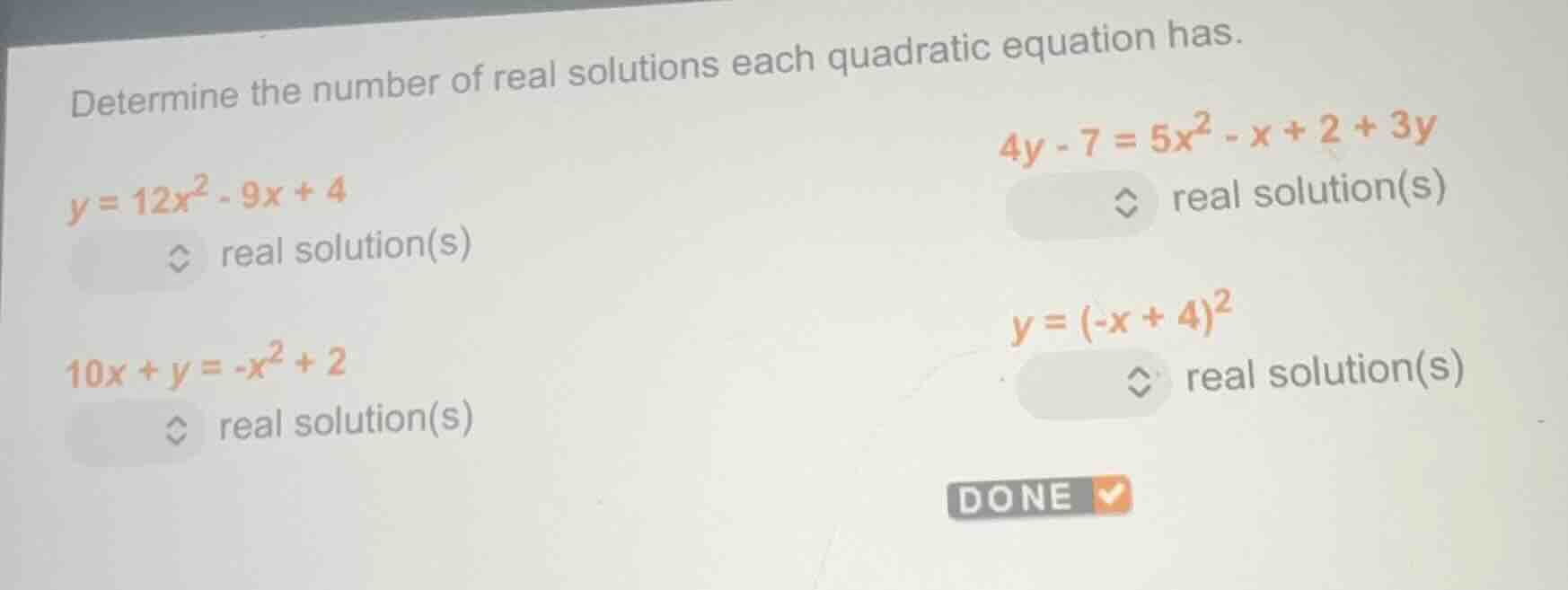
determine the number of real solutions each quadratic equation has.
y = 12x² - 9x + 4
real solution(s)
4y - 7 = 5x² - x + 2 + 3y
real solution(s)
10x + y = -x² + 2
real solution(s)
y = (-x + 4)²
real solution(s)
done
For each quadratic equation, we use the discriminant $\Delta = b^2 - 4ac$ of the standard form $ax^2+bx+c=0$:
- If $\Delta > 0$: 2 real solutions
- If $\Delta = 0$: 1 real solution
- If $\Delta < 0$: 0 real solutions
---
Step1: Analyze $y=12x^2-9x+4$
Set to $12x^2-9x+4=0$, so $a=12, b=-9, c=4$.
$\Delta = (-9)^2 - 4(12)(4) = 81 - 192 = -111$
Step2: Analyze $10x+y=-x^2+2$
Rearrange to $x^2+10x+y-2=0$, treat as $x^2+10x+(y-2)=0$, so $a=1, b=10, c=y-2$.
$\Delta = 10^2 - 4(1)(y-2) = 100 - 4y + 8 = 108 - 4y$. But for the quadratic in $x$, the discriminant for real $x$ is always non-negative? No, wait, as a quadratic equation in $x$, the discriminant is $10^2-4(1)(2-y)=100-8+4y=92+4y$? No, correct rearrangement: $x^2+10x + y - 2 = 0$, so $c = y-2$. $\Delta = 100 - 4(1)(y-2) = 108 - 4y$. But since we are looking for real solutions (x,y), for any real y, we can find x if $\Delta \geq 0$, but no—wait, no, the question is the number of real solutions (x,y) for the equation. Wait, no, actually, for a quadratic equation in one variable, but these are equations in two variables. Wait, no, the question says "number of real solutions" for each quadratic equation. Wait, actually, each equation is a relation between x and y, so the number of real (x,y) pairs? No, no—wait, no, for a quadratic equation in x (treating y as a variable), but no, the correct way is: for each equation, we can consider it as a quadratic in x, and the number of real x for any y, but no, the question is asking for the number of real solutions (i.e., real (x,y) pairs) that satisfy the equation. Wait, no, actually, no—wait, no, the standard way for such questions is to rewrite the equation in standard quadratic form (for x) and find the discriminant to see if there are real x values for real y, but actually, each of these is a parabola, so there are infinitely many real solutions? No, that can't be. Wait, no, I misread: the question is asking for the number of real solutions when considering the equation as a quadratic in x (i.e., for the equation to have real x values, how many real solutions for x given y? No, no, wait, no—the original question is "Determine the number of real solutions each quadratic equation has." Oh, wait, maybe these are equations where we are to find real x (treating y as a dependent variable), so for each equation, how many real x values satisfy the equation for real y? No, no, the correct approach is: for each equation, rewrite it as a quadratic in x, then compute the discriminant to see if there are real x solutions (i.e., for the quadratic equation in x, the discriminant tells us if there are real x values that satisfy the equation for real y). Wait, no, let's re-express each equation as a quadratic in x, then find the discriminant:
Wait, first equation: $y=12x^2-9x+4$ → $12x^2-9x+(4-y)=0$. The discriminant is $\Delta = (-9)^2 - 4(12)(4-y) = 81 - 192 + 48y = 48y - 111$. But that's not right. Wait, no, the question is actually asking: for each quadratic equation (in x, with y as the output), how many real x-intercepts? No, the question says "number of real solutions"—so real (x,y) pairs? No, that can't be, because a parabola has infinitely many real (x,y) pairs. Oh! Wait, no, I think the question is asking for the number of real solutions when the equation is set to 0 (i.e., y=0). Oh! That makes sense. So we set y=0 and find the number of real x solutions.
Ah, that's the mistake. Let's correct that:
Step1: Analyze $y=12x^2-9x+4$ (set y=0)
$12x^2-9x+4=0$, $a=12, b=-9, c=4$.
$\Delta = (-9)^2 - 4(12)(4) = 81 - 192 = -111 < 0$
Step2: Analy…

Snap & solve any problem in the app
Get step-by-step solutions on Sovi AI
Photo-based solutions with guided steps
Explore more problems and detailed explanations
- $y=12x^2-9x+4$: 0 real solutions
- $10x+y=-x^2+2$: 2 real solutions
- $4y-7=5x^2-x+2+3y$: 0 real solutions
- $y=(-x+4)^2$: 1 real solution