QUESTION IMAGE
Question
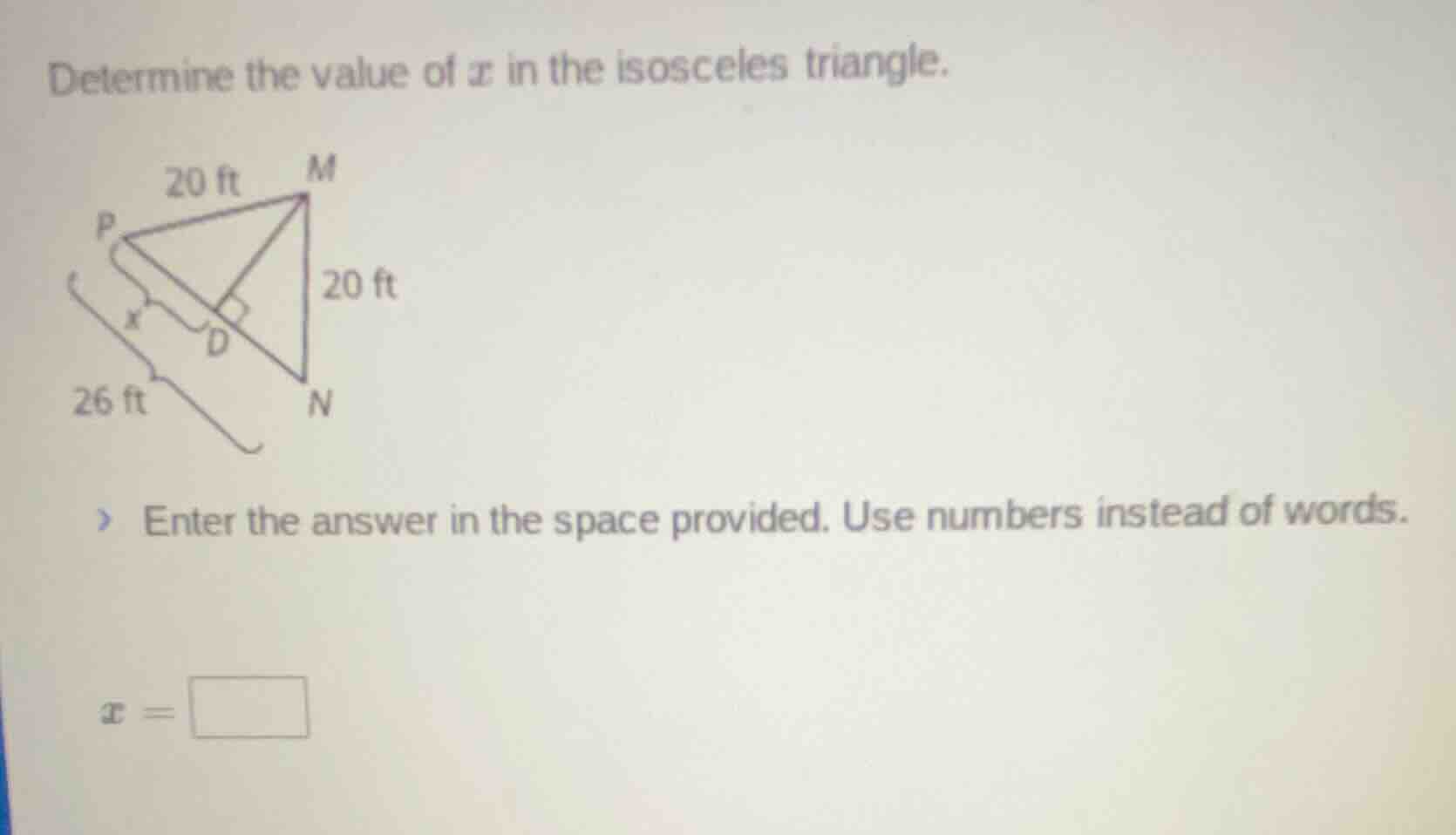
determine the value of ( x ) in the isosceles triangle.
enter the answer in the space provided. use numbers instead of words.
( x = square )
Step1: Identify triangle type and properties
In isosceles triangle \( \triangle PMN \), \( PM = MN = 20 \) ft. \( MD \perp PN \), so \( D \) is midpoint? Wait, no, use Pythagorean theorem in \( \triangle MDN \). \( MN = 20 \), \( PN = 26 \), let \( DN = y \), \( MD = \sqrt{20^2 - y^2} \), but also in \( \triangle PMD \), \( PM = 20 \), \( PD = x \), \( MD = \sqrt{20^2 - x^2} \). Wait, actually, in isosceles triangle, the altitude to the base bisects the base? Wait, no, \( PM = MN \), so \( \triangle PMN \) has \( PM = MN \), so it's isosceles with \( PM = MN \), so base is \( PN \)? Wait, no, \( PM = 20 \), \( MN = 20 \), so \( \triangle PMN \) is isosceles with \( PM = MN \), so the altitude from \( M \) to \( PN \) (which is \( MD \)) will bisect \( PN \)? Wait, no, in a triangle, if two sides are equal, the altitude to the third side bisects it. Wait, \( PM = MN = 20 \), so sides \( PM \) and \( MN \) are equal, so the base is \( PN \), and the altitude from \( M \) to \( PN \) (point \( D \)) will bisect \( PN \)? Wait, no, \( PM = MN \), so vertex is \( M \), base is \( PN \), so altitude from \( M \) to \( PN \) bisects \( PN \). Wait, but \( PN = 26 \), so \( PD = DN = 13 \)? No, wait, no, maybe I got the sides wrong. Wait, the diagram: \( P \) to \( M \) is 20, \( M \) to \( N \) is 20, \( P \) to \( N \) is 26? Wait, no, the segment from \( P \) to \( N \) is 26 ft, with \( D \) on \( PN \), \( MD \perp PN \), \( PM = 20 \), \( MN = 20 \). So in \( \triangle MDN \), right triangle, \( MN = 20 \), \( DN = 26 - x \), \( MD = \sqrt{20^2 - (26 - x)^2} \). In \( \triangle PMD \), right triangle, \( PM = 20 \), \( PD = x \), \( MD = \sqrt{20^2 - x^2} \). So set them equal: \( \sqrt{20^2 - x^2} = \sqrt{20^2 - (26 - x)^2} \). Wait, that would imply \( x = 26 - x \), so \( 2x = 26 \), \( x = 13 \)? No, that can't be, because then \( MD \) would be \( \sqrt{20^2 - 13^2} = \sqrt{400 - 169} = \sqrt{231} \), but also \( DN = 26 - 13 = 13 \), so \( MD = \sqrt{20^2 - 13^2} \), which is same. But wait, maybe the triangle is \( PM = 20 \), \( MN = 20 \), and \( PN \) is the base, but \( PN = 26 \), so altitude \( MD \) splits \( PN \) into \( PD \) and \( DN \), with \( PD = x \), \( DN = 26 - x \). Then by Pythagoras:
In \( \triangle PMD \): \( PM^2 = PD^2 + MD^2 \) → \( 20^2 = x^2 + MD^2 \)
In \( \triangle MDN \): \( MN^2 = DN^2 + MD^2 \) → \( 20^2 = (26 - x)^2 + MD^2 \)
Subtract the two equations: \( 0 = x^2 - (26 - x)^2 \) → \( x^2 = (26 - x)^2 \) → \( x = 26 - x \) → \( 2x = 26 \) → \( x = 13 \)? Wait, but that would mean \( PD = 13 \), but the problem says \( x \) is the segment from \( P \) to \( D \), and \( PN = 26 \), but maybe I misread the diagram. Wait, maybe \( MN = 20 \), \( PM = 20 \), and \( PN \) is 26, but \( D \) is not the midpoint? Wait, no, the two equations show that \( x = 26 - x \), so \( x = 13 \). Wait, but that seems too simple. Wait, maybe the triangle is \( PM = 20 \), \( MN = 20 \), and \( PN \) is 26, so it's isosceles with \( PM = MN \), so altitude from \( M \) to \( PN \) bisects \( PN \), so \( PD = 13 \). But the problem says "x" is the segment from \( P \) to \( D \), and \( PN = 26 \), so \( x = 26 - 13 \)? No, wait, no, maybe the diagram has \( P \) to \( D \) is \( x \), \( D \) to \( N \) is \( 26 - x \), and \( MD \) is altitude, so in \( \triangle MDN \), \( MN = 20 \), \( DN = 26 - x \), \( MD = \sqrt{20^2 - (26 - x)^2} \), and in \( \triangle PMD \), \( PM = 20 \), \( PD = x \), \( MD = \sqrt{20^2 - x^2} \). So setting them equal: \( 20^2 - x^2 = 20^2 - (26 - x)^2 \) → \( -x^2 = - (26 - x)…

Snap & solve any problem in the app
Get step-by-step solutions on Sovi AI
Photo-based solutions with guided steps
Explore more problems and detailed explanations
\( x = 13 \)