QUESTION IMAGE
Question
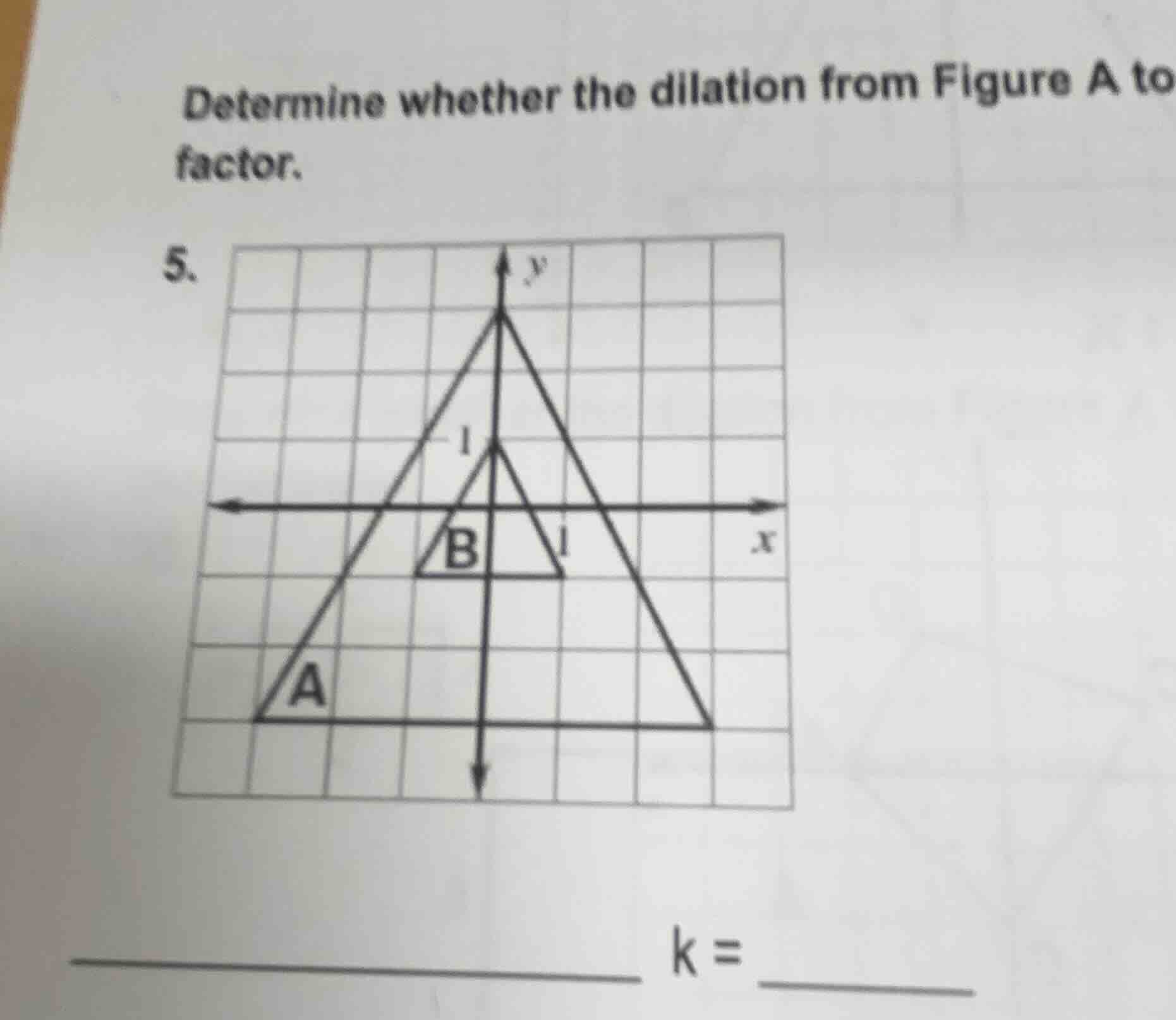
determine whether the dilation from figure a to factor.
5.
(figure with coordinate plane, triangle a and triangle b, asking for dilation factor k)
Step1: Identify corresponding sides
Let's assume the base length of Figure A (the larger triangle) and Figure B (the smaller triangle). From the grid, if we consider the base of Figure A: let's count the grid units. Suppose the base of A spans, say, 6 units (from leftmost to rightmost on the x - axis at the bottom), and the base of B spans 2 units (from left to right at its bottom).
Step2: Calculate the scale factor
The scale factor \( k \) of a dilation is given by the ratio of the length of a side of the image (Figure B) to the length of the corresponding side of the pre - image (Figure A). So \( k=\frac{\text{Length of side of B}}{\text{Length of side of A}} \). If base of B is 2 and base of A is 6, then \( k = \frac{2}{6}=\frac{1}{3} \)? Wait, no, wait. Wait, the dilation from A to B: A is the pre - image, B is the image. Wait, maybe I got the pre - image and image wrong. Wait, the problem says "dilation from Figure A to Figure B". So pre - image is A, image is B. So we need to find the ratio of the length of a side of B to the length of the corresponding side of A.
Looking at the vertical or horizontal sides. Let's take the base: Let's count the number of grid squares. Let's say the base of triangle A (the big one) has a length of, for example, 6 units (from x=-3 to x = 3 at the bottom, so 6 units), and the base of triangle B (the small one) has a length of 2 units (from x=-1 to x = 1 at its bottom, so 2 units). Then the scale factor \( k=\frac{\text{length of B's base}}{\text{length of A's base}}=\frac{2}{6}=\frac{1}{3} \)? Wait, no, maybe my grid counting is wrong. Wait, let's look at the y - axis. The height of triangle A: from the bottom (y=-1) to the top (y = 4), so height is 5? No, maybe better to take the horizontal side. Wait, the base of the small triangle (B) is 2 units (from x=-1 to x = 1, so length 2), and the base of the large triangle (A) is 6 units (from x=-3 to x = 3, length 6). So the scale factor \( k=\frac{2}{6}=\frac{1}{3} \)? Wait, no, wait, maybe the base of A is 6 and base of B is 2, so \( k=\frac{2}{6}=\frac{1}{3} \). Wait, but let's check another side. Let's take the slant side. The slope of the sides: for triangle A, from ( - 3,-1) to (0,4), the run is 3, rise is 5? No, maybe this is overcomplicating. Alternatively, if we consider the distance from the center of dilation (which seems to be the origin, (0,0) or the intersection of the axes). Wait, the center of dilation is the same point for both triangles, probably the origin or the point (0,1)? Wait, no, looking at the triangles, they are centered on the y - axis. So the base of triangle A: let's count the number of grid squares. Let's say at the bottom of triangle A, the left vertex is at x=-3, y=-1, and the right vertex is at x = 3, y=-1. So the length of the base is \( 3 - (-3)=6 \) units. For triangle B, the left vertex of the base is at x=-1, y=-1, and the right vertex is at x = 1, y=-1. So the length of the base is \( 1-(-1) = 2 \) units. Then the scale factor \( k=\frac{\text{length of B's base}}{\text{length of A's base}}=\frac{2}{6}=\frac{1}{3} \). Wait, but maybe the height. The height of triangle A: from y=-1 to y = 4 (the top vertex), so height is \( 4-(-1)=5 \)? No, the top vertex of A is at (0,4)? Wait, no, the top vertex of A is at (0,4)? Wait, the top vertex of B is at (0,1). So the height of A is from y=-1 to y = 4, so 5 units? The height of B is from y=-1 to y = 1, so 2 units? No, that doesn't match. Wait, maybe I made a mistake in identifying the vertices. Let's re - examine the graph. The large triangle (A) has its base on th…

Snap & solve any problem in the app
Get step-by-step solutions on Sovi AI
Photo-based solutions with guided steps
Explore more problems and detailed explanations
The dilation from Figure A to Figure B is a reduction with a scale factor of \(\frac{1}{3}\) (assuming the base of A is 6 units and base of B is 2 units, so \(k = \frac{2}{6}=\frac{1}{3}\)). So \(k=\frac{1}{3}\)