QUESTION IMAGE
Question
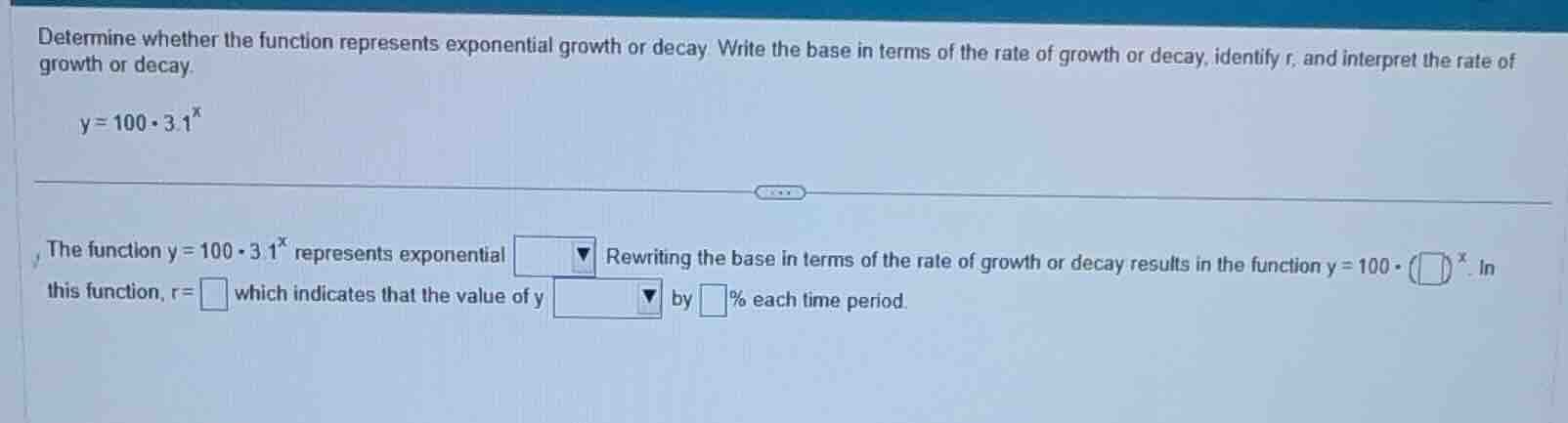
determine whether the function represents exponential growth or decay. write the base in terms of the rate of growth or decay, identify r, and interpret the rate of growth or decay.
$y = 100 \cdot 3.1^x$
the function $y = 100 \cdot 3.1^x$ represents exponential □ rewriting the base in terms of the rate of growth or decay results in the function $y = 100 \cdot (\\;)^x$. in this function, $r=\square$ which indicates that the value of y □ by □% each time period.
Step1: Identify growth/decay type
An exponential function has the form $y = a \cdot b^x$. If $b>1$, it is growth. Here, $b=3.1>1$, so it is exponential growth.
Step2: Rewrite base as $1+r$
We need to express $3.1$ as $1+r$. Solve for $r$:
$r = 3.1 - 1 = 2.1$
So the rewritten function is $y=100 \cdot (1+2.1)^x$.
Step3: Convert r to percentage
To get the percentage, multiply $r$ by 100: $2.1 \times 100 = 210\%$. This means the value of $y$ increases by this percentage each period.

Snap & solve any problem in the app
Get step-by-step solutions on Sovi AI
Photo-based solutions with guided steps
Explore more problems and detailed explanations
The function $y = 100 \cdot 3.1^x$ represents exponential growth. Rewriting the base in terms of the rate of growth or decay results in the function $y = 100 \cdot (1+2.1)^x$. In this function, $r=2.1$ which indicates that the value of $y$ increases by $210\%$ each time period.