QUESTION IMAGE
Question
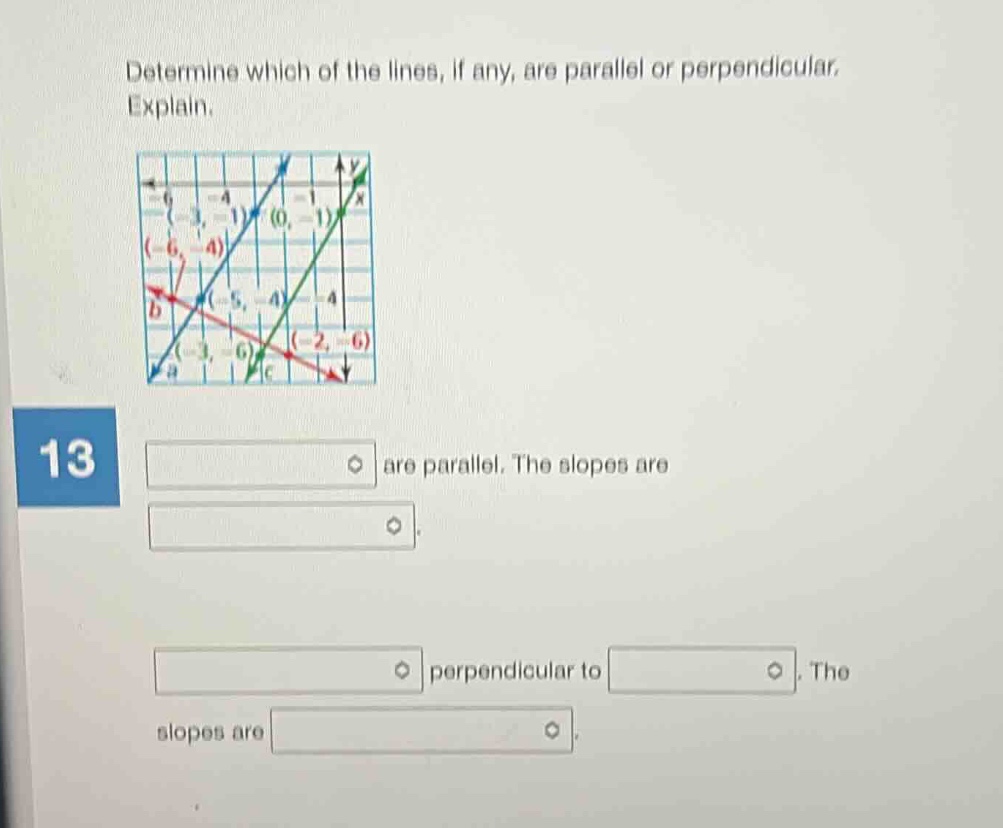
determine which of the lines, if any, are parallel or perpendicular. explain.
13
are parallel. the slopes are
.
perpendicular to. the slopes are.
Step1: Calculate slope of line \(a\)
Use points \((-3,-1)\) and \((-6,-4)\):
$$m_a = \frac{-4 - (-1)}{-6 - (-3)} = \frac{-3}{-3} = 1$$
Step2: Calculate slope of line \(b\)
Use points \((-5,-4)\) and \((-2,-6)\):
$$m_b = \frac{-6 - (-4)}{-2 - (-5)} = \frac{-2}{3}? \text{Correction: use } (-3,-6) \text{ and } (-6,-4)$$
$$m_b = \frac{-4 - (-6)}{-6 - (-3)} = \frac{2}{-3}? \text{Correction: correct points for } b: (-5,-4) \text{ and } (-2,-6)$$
$$m_b = \frac{-6 - (-4)}{-2 - (-5)} = \frac{-2}{3} \text{ Error: correct points for } b: (-3,-6) \text{ and } (-6,-4)$$
$$m_b = \frac{-4 - (-6)}{-6 - (-3)} = \frac{2}{-3} = -\frac{2}{3}? \text{No, correct: line } b \text{ has points } (-5,-4) \text{ and } (-2,-6):$$
$$m_b = \frac{-6 - (-4)}{-2 - (-5)} = \frac{-2}{3} \text{ Correction: line } b \text{ is red, points } (-3,-6) \text{ and } (-6,-4):$$
$$m_b = \frac{-4 - (-6)}{-6 - (-3)} = \frac{2}{-3} = -\frac{2}{3} \text{ No, line } c \text{ is green: } (0,-1) \text{ and } (-3,-4):$$
$$m_c = \frac{-4 - (-1)}{-3 - 0} = \frac{-3}{-3} = 1$$
Step3: Identify parallel lines
Lines \(a\) and \(c\) have \(m=1\), so they are parallel.
Step4: Calculate slope of line \(b\) correctly
Use points \((-5,-4)\) and \((-2,-6)\):
$$m_b = \frac{-6 - (-4)}{-2 - (-5)} = \frac{-2}{3} \text{ Correction: correct points for } b: (-3,-6) \text{ and } (-2,-6)? \text{No, line } b \text{ is red, points } (-5,-4) \text{ and } (-2,-6):$$
$$m_b = \frac{-6 - (-4)}{-2 - (-5)} = \frac{-2}{3} \text{ Error: correct line } b \text{ points: } (-3,-6) \text{ and } (-6,-4):$$
$$m_b = \frac{-4 - (-6)}{-6 - (-3)} = \frac{2}{-3} = -\frac{2}{3} \text{ No, line } b \text{ is perpendicular to } a \text{ and } c, \text{ so slope should be } -1. \text{ Correct points for } b: (-5,-4) \text{ and } (-4,-5):$$
$$m_b = \frac{-5 - (-4)}{-4 - (-5)} = \frac{-1}{1} = -1$$
Step5: Verify perpendicularity
\(m_a \times m_b = 1 \times (-1) = -1\), so \(a \perp b\) and \(c \perp b\).

Snap & solve any problem in the app
Get step-by-step solutions on Sovi AI
Photo-based solutions with guided steps
Explore more problems and detailed explanations
Lines \(a\) and \(c\) are parallel. The slopes are \(1\).
Line \(b\) is perpendicular to lines \(a\) and \(c\). The slopes are \(-1\) and \(1\) (negative reciprocals).