QUESTION IMAGE
Question
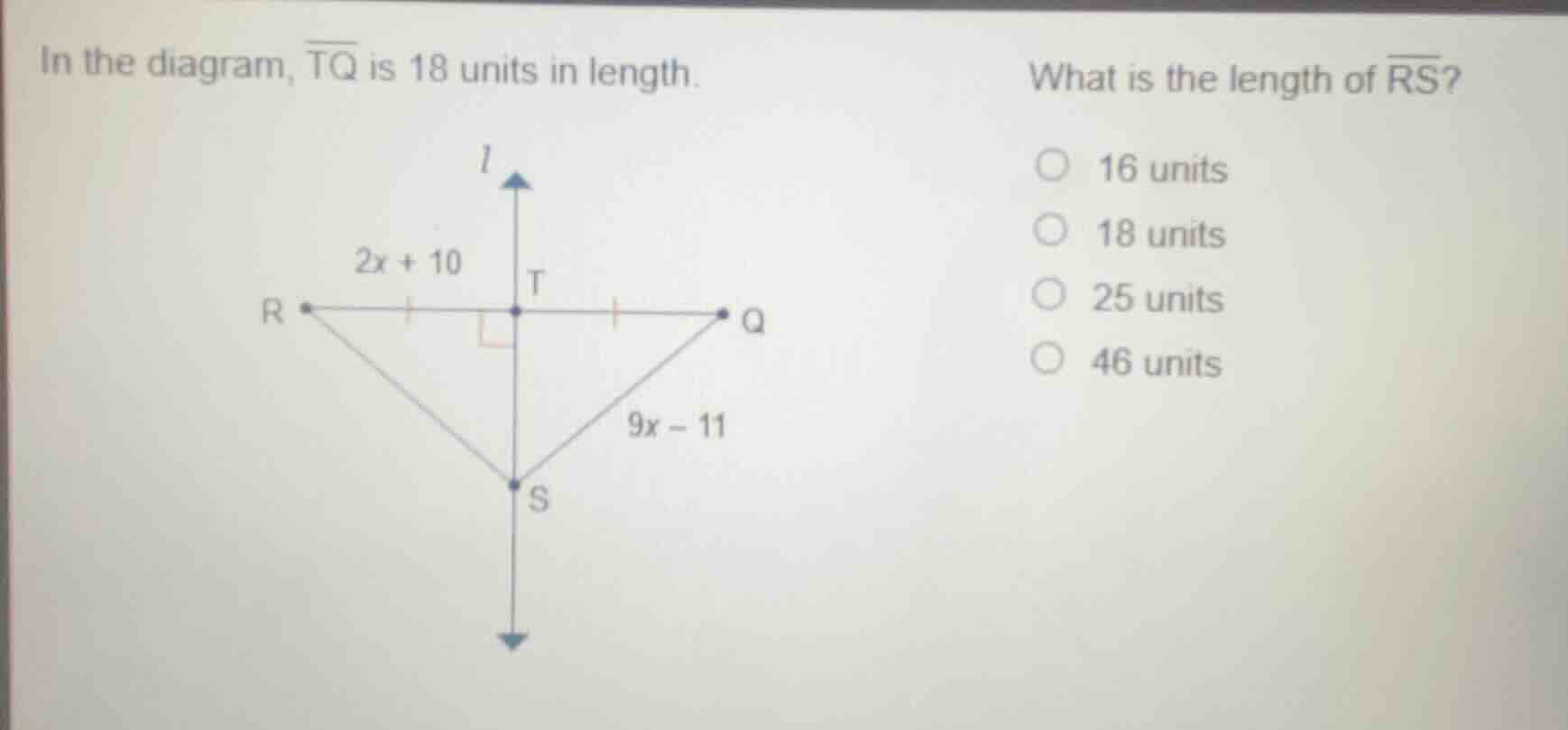
in the diagram, \\(\overline{tq}\\) is 18 units in length. what is the length of \\(\overline{rs}\\)? \\(\boldsymbol{\circ}\\) 16 units \\(\boldsymbol{\circ}\\) 18 units \\(\boldsymbol{\circ}\\) 25 units \\(\boldsymbol{\circ}\\) 46 units
Step1: Find RT length
Since \( l \perp RQ \) and \( T \) is the midpoint (marks on \( RT \) and \( TQ \)), \( RT = TQ = 9 \) (wait, no, \( TQ \) is 18? Wait, no, the diagram: \( RQ \) is split by \( l \) at \( T \), so \( RT = TQ \). Wait, the length of \( TQ \) is 18? Wait, no, the problem says \( \overline{TQ} \) is 18 units. Wait, \( RT = TQ \), so \( 2x + 10 = TQ \)? Wait, no, \( SQ = 9x - 11 \) and \( SR = 2x + 10 \), and since \( l \) is perpendicular bisector, \( SR = SQ \). Also, \( TQ = 18 \), and \( RT = TQ \) (because \( T \) is midpoint), so \( RT = 18 \)? Wait, no, \( RT = 2x + 10 \), and \( TQ = 18 \), so \( 2x + 10 = 18 \)? Wait, no, maybe \( SR = SQ \), so \( 2x + 10 = 9x - 11 \). Let's solve \( 2x + 10 = 9x - 11 \).
Step2: Solve for x
\( 2x + 10 = 9x - 11 \)
Subtract \( 2x \): \( 10 = 7x - 11 \)
Add 11: \( 21 = 7x \)
Divide by 7: \( x = 3 \)
Step3: Find RS length
\( RS = 2x + 10 \), substitute \( x = 3 \):
\( RS = 2(3) + 10 = 6 + 10 = 16 \)? Wait, no, wait \( SQ = 9x - 11 = 27 - 11 = 16 \), so \( RS = SQ = 16 \)? Wait, but \( TQ \) is 18, so \( RT = TQ = 18 \)? Wait, maybe I messed up. Wait, the diagram: \( RQ \) is horizontal, \( l \) is vertical, perpendicular to \( RQ \) at \( T \), so \( RT = TQ \). So \( RT = TQ = 18 \)? But \( RT = 2x + 10 \), so \( 2x + 10 = 18 \) → \( 2x = 8 \) → \( x = 4 \). Then \( SQ = 9x - 11 = 36 - 11 = 25 \), and \( RS = SQ = 25 \)? Wait, now I'm confused. Wait, the problem says \( \overline{TQ} \) is 18 units. So \( TQ = 18 \), and \( RT = TQ \) (since \( T \) is midpoint), so \( RT = 18 \). So \( 2x + 10 = 18 \) → \( x = 4 \). Then \( RS = 2x + 10 = 18 \)? No, \( SQ = 9x - 11 = 36 - 11 = 25 \), so \( RS = SQ = 25 \). Ah, because \( l \) is perpendicular bisector, so \( S \) is on \( l \), so \( SR = SQ \). So \( SR = SQ \), so \( 2x + 10 = 9x - 11 \), and also \( TQ = 18 \), which is \( RT = TQ = 18 \), so \( 2x + 10 = 18 \) → \( x = 4 \), but then \( 9x - 11 = 25 \), which is not 18. Wait, contradiction. So my first approach: \( SR = SQ \), so \( 2x + 10 = 9x - 11 \), solve \( x = 3 \), then \( RS = 16 \), but \( TQ \) would be \( 2x + 10 = 16 \), but problem says \( TQ = 18 \). Wait, maybe the diagram: \( TQ \) is 18, so \( TQ = 18 \), and \( RT = TQ = 18 \), so \( 2x + 10 = 18 \) → \( x = 4 \), then \( SQ = 9x - 11 = 25 \), so \( RS = SQ = 25 \). Yes, that makes sense. Because \( l \) is perpendicular bisector, so \( SR = SQ \), and \( RT = TQ = 18 \), so \( 2x + 10 = 18 \) → \( x = 4 \), then \( SQ = 9(4) - 11 = 25 \), so \( RS = 25 \).
Wait, let's re-express:
- \( l \perp RQ \), so \( \angle STR = \angle STQ = 90^\circ \).
- \( RT = TQ \) (midpoint, marks on \( RT \) and \( TQ \)), so \( RT = TQ = 18 \). Thus, \( 2x + 10 = 18 \) → \( x = 4 \).
- \( S \) is on \( l \), so \( SR = SQ \) (perpendicular bisector theorem: any point on perpendicular bisector is equidistant from \( R \) and \( Q \)). Thus, \( RS = SQ = 9x - 11 \).
- Substitute \( x = 4 \): \( SQ = 9(4) - 11 = 36 - 11 = 25 \). So \( RS = 25 \).
Yes, that's correct. So the length of \( \overline{RS} \) is 25 units.

Snap & solve any problem in the app
Get step-by-step solutions on Sovi AI
Photo-based solutions with guided steps
Explore more problems and detailed explanations
25 units (Option: 25 units)