QUESTION IMAGE
Question
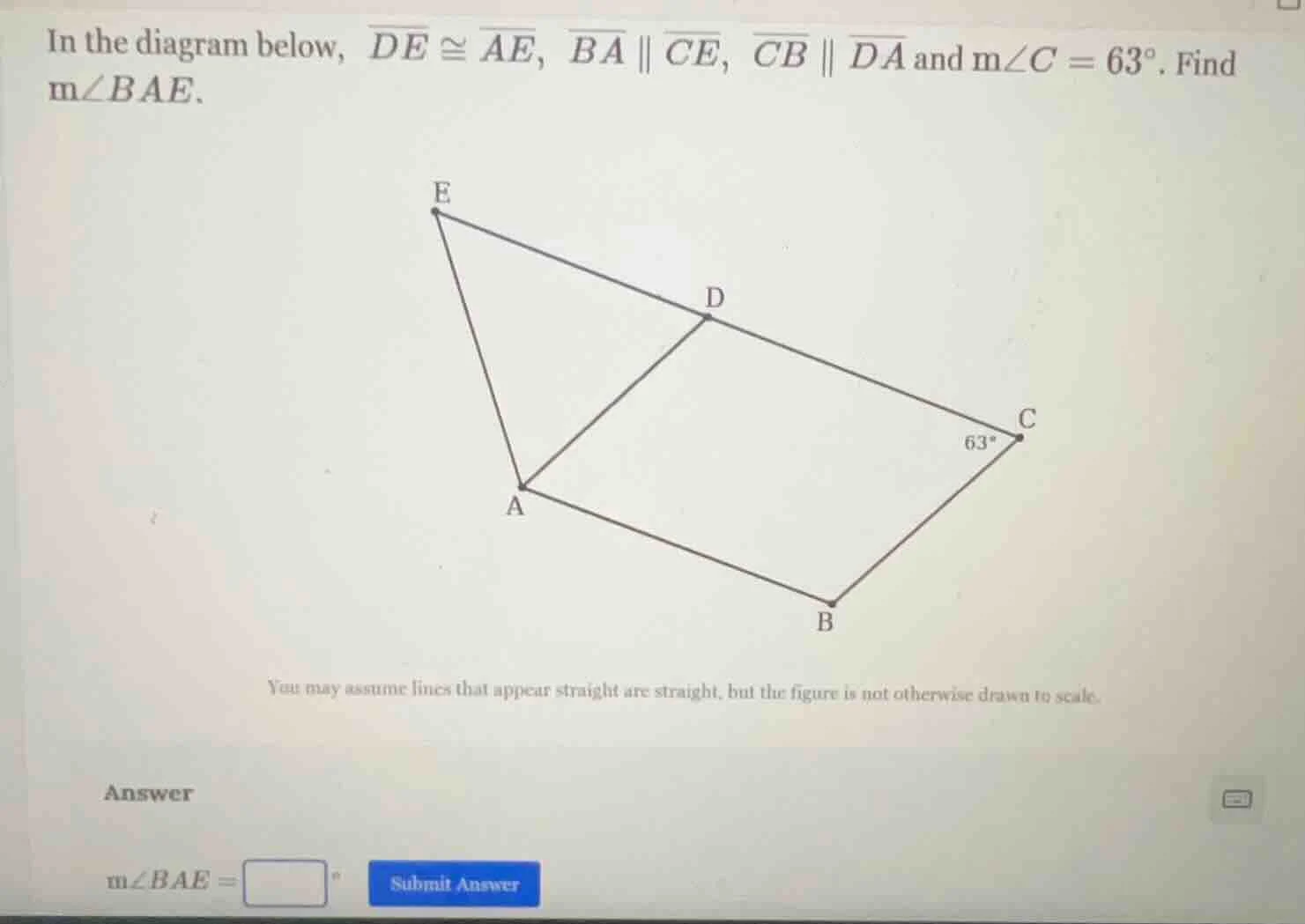
in the diagram below, \\(\overline{de} \cong \overline{ae}\\), \\(\overline{ba} \parallel \overline{ce}\\), \\(\overline{cb} \parallel \overline{da}\\) and \\(\text{m}\angle c = 63^\circ\\). find \\(\text{m}\angle bae\\).
you may assume lines that appear straight are straight, but the figure is not otherwise drawn to scale.
answer
\\(\text{m}\angle bae = \square^\circ\\)
Step1: Identify parallelogram properties
Since $\overline{BA} \parallel \overline{CE}$ and $\overline{CB} \parallel \overline{DA}$, $ABCD$ is a parallelogram. In a parallelogram, opposite angles are equal, so $\angle C = \angle BAD = 63^\circ$. Also, consecutive angles are supplementary, so $\angle ADC = 180^\circ - 63^\circ = 117^\circ$.
Step2: Use triangle isosceles property
$\overline{DE} \cong \overline{AE}$, so $\triangle AED$ is isosceles with $\angle E = \angle EAD$. $\angle ADC$ is an exterior angle of $\triangle AED$, so $\angle ADC = \angle E + \angle EAD = 2\angle EAD$.
Step3: Calculate $\angle EAD$
$\angle EAD = \frac{1}{2}\angle ADC = \frac{1}{2} \times 117^\circ = 58.5^\circ$
Step4: Find $\angle BAE$
$\angle BAE = \angle BAD + \angle EAD = 63^\circ + 58.5^\circ$

Snap & solve any problem in the app
Get step-by-step solutions on Sovi AI
Photo-based solutions with guided steps
Explore more problems and detailed explanations
$121.5^\circ$