QUESTION IMAGE
Question
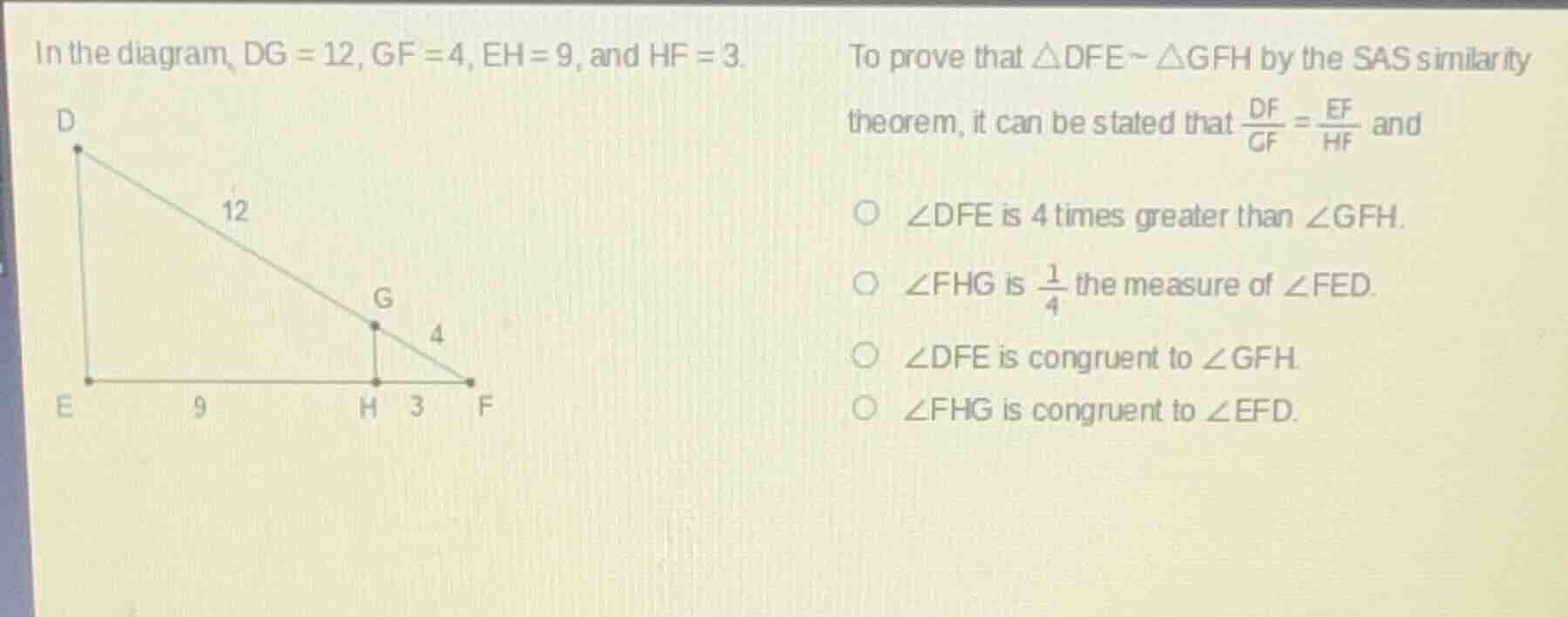
in the diagram, dg = 12, gf = 4, eh = 9, and hf = 3. to prove that $\triangle dfe \sim \triangle gfh$ by the sas similarity theorem, it can be stated that $\frac{df}{gf} = \frac{ef}{hf}$ and \
$\angle dfe$ is 4 times greater than $\angle gfh$.\
$\angle fhg$ is $\frac{1}{4}$ the measure of $\angle fed$.\
$\angle dfe$ is congruent to $\angle gfh$.\
$\angle fhg$ is congruent to $\angle efd$.
Step1: Recall SAS similarity rule
SAS similarity requires two pairs of proportional sides and the included angle congruent.
Step2: Verify side proportions
First calculate $DF = DG + GF = 12 + 4 = 16$, $EF = EH + HF = 9 + 3 = 12$.
Check $\frac{DF}{GF} = \frac{16}{4} = 4$, $\frac{EF}{HF} = \frac{12}{3} = 4$. The sides are proportional.
Step3: Identify included angle
The angle included between sides $DF, EF$ is $\angle DFE$; the angle included between sides $GF, HF$ is $\angle GFH$. For SAS similarity, these included angles must be congruent.

Snap & solve any problem in the app
Get step-by-step solutions on Sovi AI
Photo-based solutions with guided steps
Explore more problems and detailed explanations
∠DFE is congruent to ∠GFH.