QUESTION IMAGE
Question
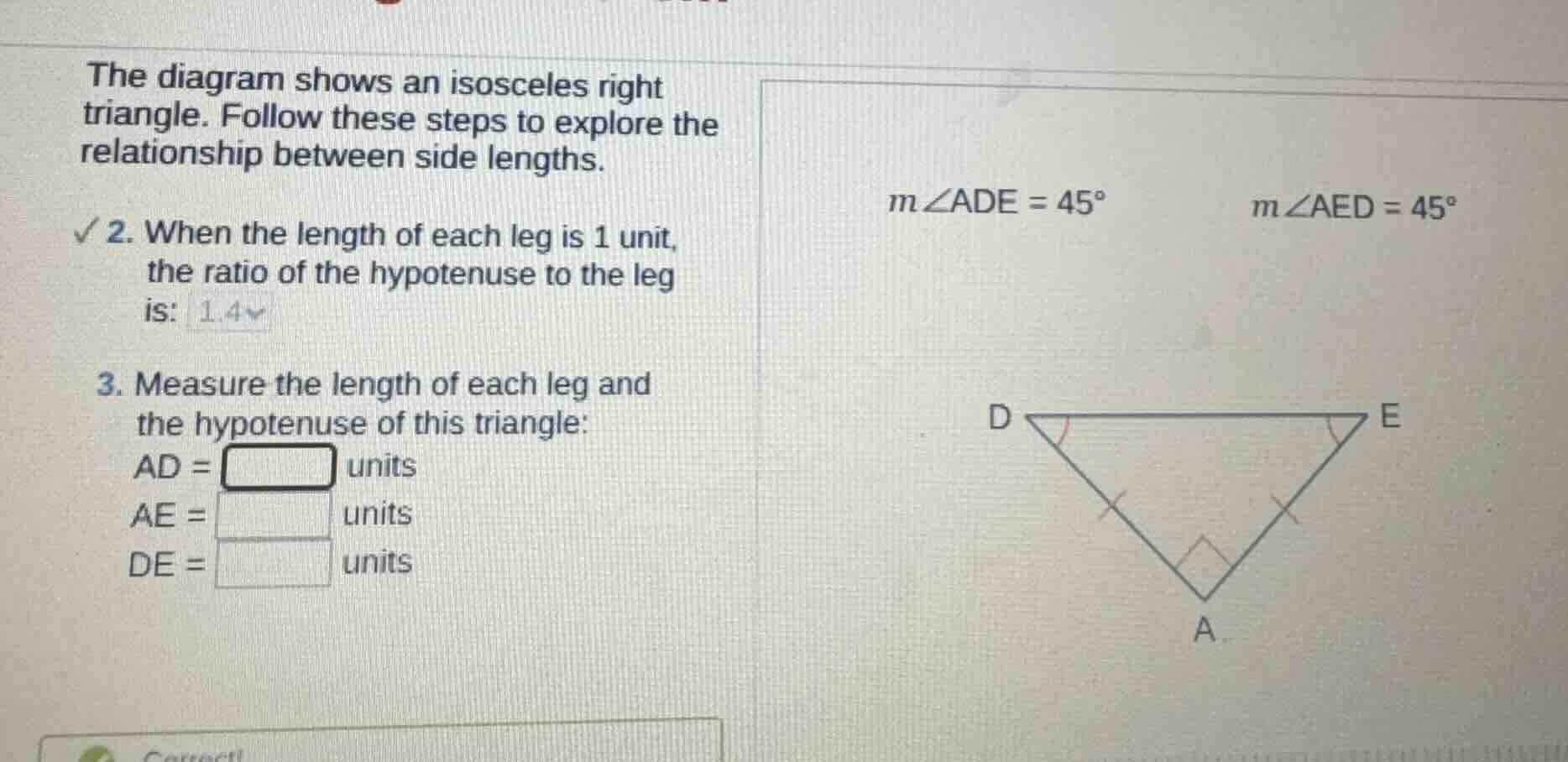
the diagram shows an isosceles right triangle. follow these steps to explore the relationship between side lengths.
✓ 2. when the length of each leg is 1 unit,
the ratio of the hypotenuse to the leg
is: 1.4
- measure the length of each leg and
the hypotenuse of this triangle:
ad = □ units
ae = □ units
de = □ units
$m\angle ade = 45^\circ$
$m\angle aed = 45^\circ$
Step1: Identify triangle properties
This is an isosceles right triangle, so legs $AD = AE$. $\angle A = 90^\circ$, $m\angle ADE = m\angle AED = 45^\circ$.
Step2: Use given leg ratio context
From step 2, when leg = 1 unit, hypotenuse $\approx 1.4$ (exact value $\sqrt{2} \approx 1.414$). Assume the triangle uses the standard 1-unit leg for consistency.
Step3: Assign leg lengths
Since it's isosceles right, $AD = AE = 1$ unit.
Step4: Calculate hypotenuse
Use Pythagorean theorem: $DE = \sqrt{AD^2 + AE^2}$
$\displaystyle DE = \sqrt{1^2 + 1^2} = \sqrt{2} \approx 1.4$ units

Snap & solve any problem in the app
Get step-by-step solutions on Sovi AI
Photo-based solutions with guided steps
Explore more problems and detailed explanations
$AD = 1$ units
$AE = 1$ units
$DE = \sqrt{2}$ (or $\approx 1.4$) units