QUESTION IMAGE
Question
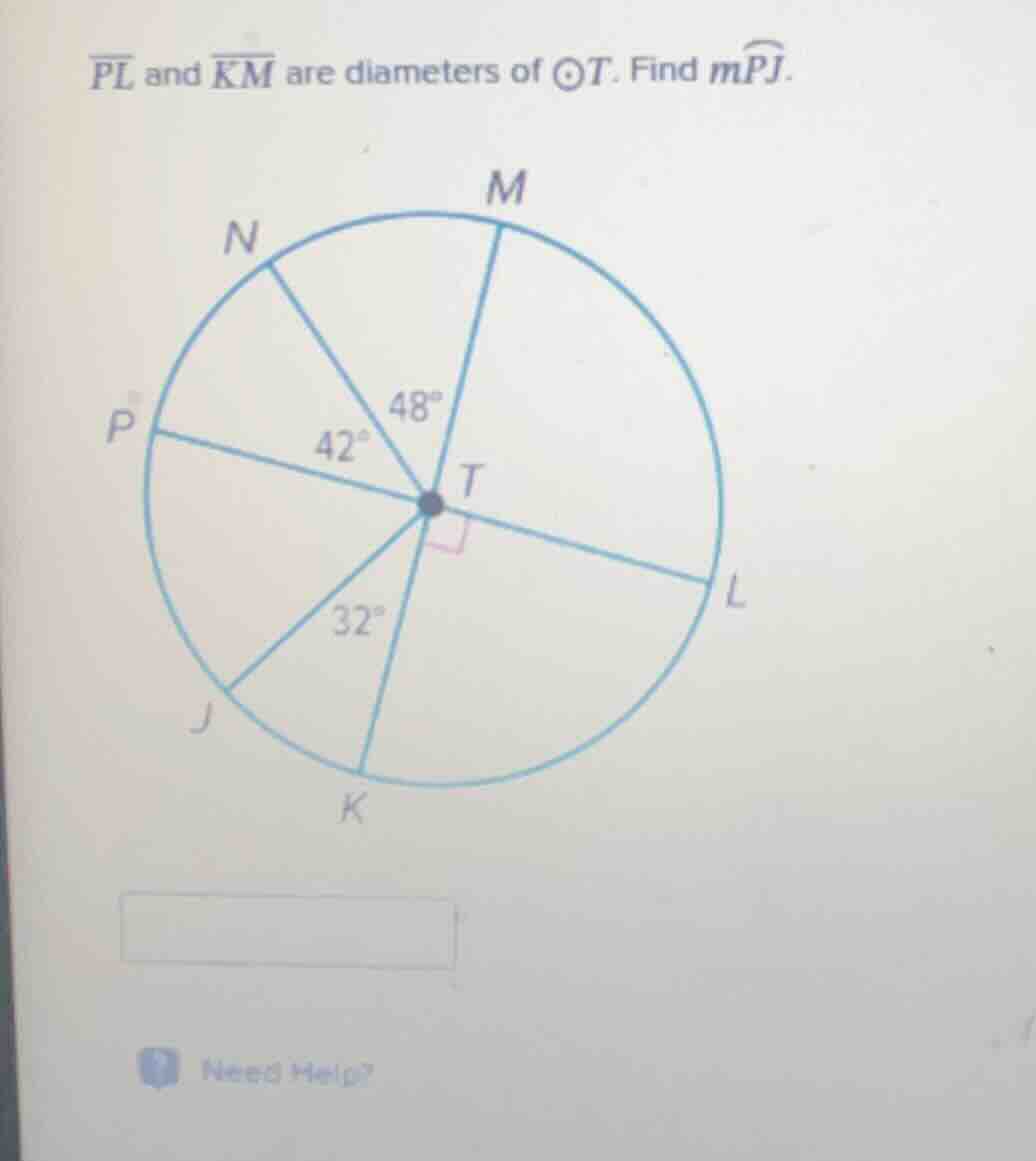
$\overline{pl}$ and $\overline{km}$ are diameters of $\odot t$. find $m\overarc{pj}$.
Step1: Identify right angle
Since \( PL \) is a diameter and there's a right angle at \( T \) (the right - angle symbol), the angle between \( PT \) and \( LT \) is \( 90^{\circ} \). We know the angle between \( KT \) and \( JT \) is \( 32^{\circ} \), and we need to find the measure of arc \( PJ \). The sum of angles around a point \( T \) on a straight line (diameter \( PL \)) and considering the other angles. Wait, actually, since \( KM \) and \( PL \) are diameters, the sum of angles in a semicircle? Wait, no. Let's look at the angles at the center. The angle for arc \( PJ \) is the angle at \( T \) between \( P \) and \( J \). We know that the angle between \( LT \) and \( KT \): Wait, maybe a better way. The total angle in a circle is \( 360^{\circ} \), but since \( PL \) and \( KM \) are diameters, they divide the circle into four semicircles? No, diameters intersect at \( T \), so the vertical angles are equal. Wait, looking at the diagram, we have angle \( \angle PTN = 42^{\circ} \), \( \angle NT M=48^{\circ} \), \( \angle KTL \) (wait, no, there's a right angle between \( PT \) and \( LT \)? Wait, the diagram has a right - angle symbol between \( PT \) and \( LT \), so \( \angle PTL = 90^{\circ} \). Then, the angle between \( KT \) and \( JT \) is \( 32^{\circ} \), and we need to find \( \angle PTJ \). Since \( \angle PTL = 90^{\circ} \), and \( \angle KTL \) (wait, no, \( KM \) is a diameter, so \( \angle KTM = 180^{\circ} \)? No, let's re - examine. The center angles: We know that \( \angle PTJ+\angle JT K+\angle KTL = 180^{\circ} \)? Wait, no, \( PL \) is a diameter, so the straight line \( PL \) means that the sum of angles on one side of \( PL \) is \( 180^{\circ} \). Wait, the right - angle is \( \angle PTL = 90^{\circ} \), so \( \angle PTK+\angle KTL = 90^{\circ} \)? No, maybe I made a mistake. Wait, the angle between \( PT \) and \( LT \) is \( 90^{\circ} \), so \( \angle PTJ+\angle JT K+\angle KTL=90^{\circ} \)? No, \( \angle KTL \) is not given. Wait, no, looking at the diagram, the angle between \( KT \) and \( JT \) is \( 32^{\circ} \), and we know that the angle between \( PT \) and \( LT \) is \( 90^{\circ} \), and the angle between \( KT \) and \( LT \): Wait, maybe the correct approach is: Since \( \angle PTL = 90^{\circ} \), and \( \angle JT K = 32^{\circ} \), and we need to find \( \angle PTJ \). Wait, no, let's see the angles at \( T \). The angle for arc \( PJ \) is \( \angle PTJ \). We know that \( \angle PTL = 90^{\circ} \), and \( \angle KTL \) (wait, no, \( KM \) is a diameter, so \( \angle KTM = 180^{\circ} \), but maybe the right - angle is \( \angle PTL = 90^{\circ} \), so \( \angle PTJ=90^{\circ}-\angle JT K - \angle KTL \)? No, this is confusing. Wait, maybe the diagram has \( \angle PTJ = 90^{\circ}- 32^{\circ}-(180^{\circ}- 90^{\circ}- 42^{\circ}- 48^{\circ}) \)? No, that's not right. Wait, let's start over.
Wait, the key is that the measure of an arc is equal to the measure of its central angle. So we need to find the central angle \( \angle PTJ \). We know that \( \angle PTL = 90^{\circ} \) (right angle), \( \angle JT K = 32^{\circ} \), and we can find \( \angle KTL \) from the other angles? Wait, no, the sum of angles around point \( T \) on the line \( PL \) (since \( PL \) is a diameter) should be \( 180^{\circ} \) on each side? No, \( PL \) is a straight line, so the sum of angles on one side of \( PL \) is \( 180^{\circ} \). The right - angle is \( 90^{\circ} \), so the other part (from \( K \) to \( P \) through \( J \)) should also sum to \( 90^{\circ} \)? Wait, no, the right - ang…

Snap & solve any problem in the app
Get step-by-step solutions on Sovi AI
Photo-based solutions with guided steps
Explore more problems and detailed explanations
\( 58^{\circ} \)