QUESTION IMAGE
Question
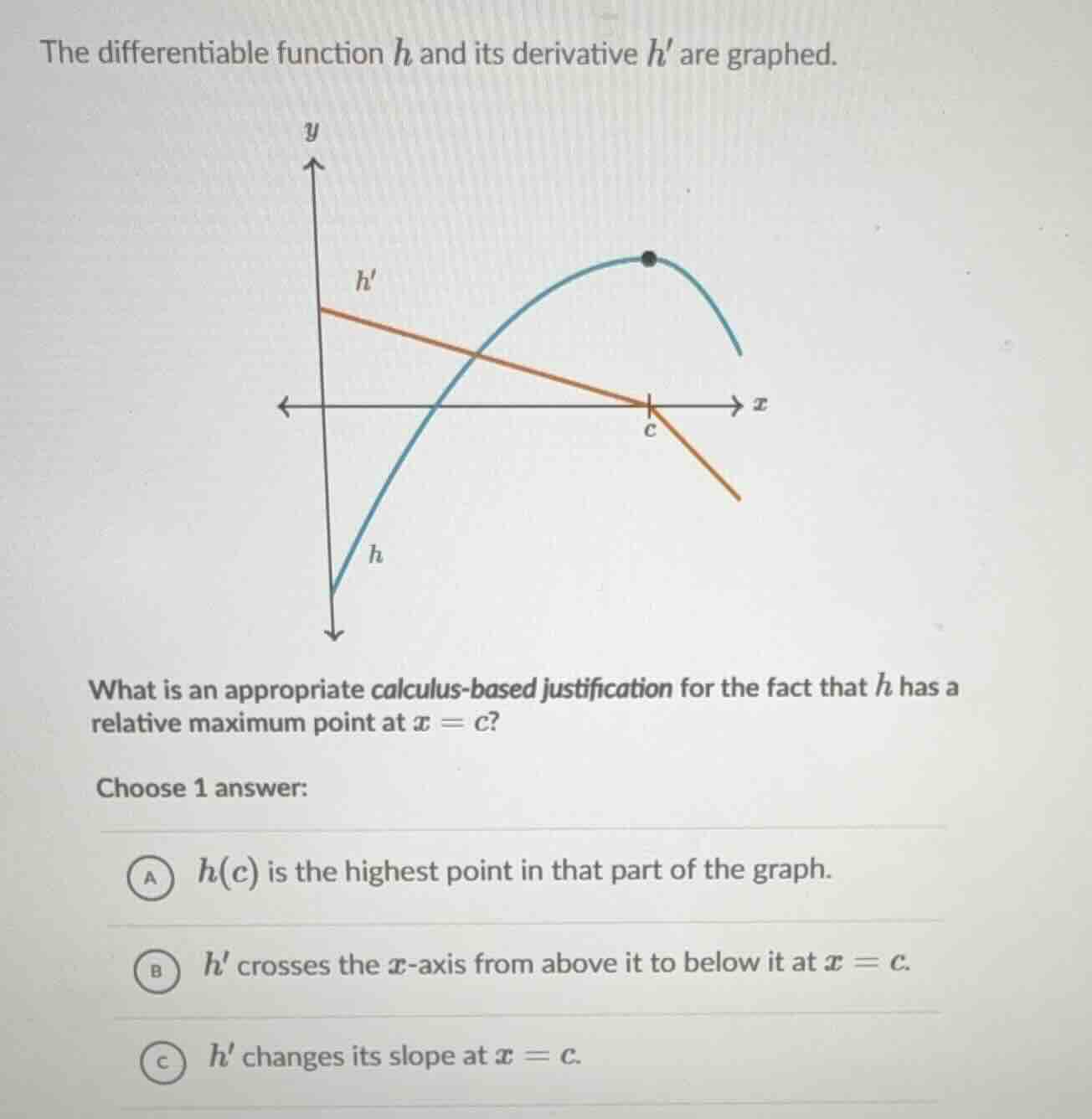
the differentiable function h and its derivative h are graphed.
graph showing two functions: h (blue) and h (orange), with h crossing the x - axis at x = c
what is an appropriate calculus - based justification for the fact that h has a relative maximum point at x = c?
choose 1 answer:
a) h(c) is the highest point in that part of the graph.
b) h crosses the x - axis from above it to below it at x = c.
c) h changes its slope at x = c.
To determine a relative maximum of a function \( h(x) \), we use the First Derivative Test. The First Derivative Test states that if \( h'(x) \) changes sign from positive to negative at \( x = c \), then \( h(x) \) has a relative maximum at \( x = c \).
- Option A: Stating \( h(c) \) is the highest point is a graphical justification, not a calculus - based (using derivatives) one.
- Option B: If \( h' \) crosses the \( x \) - axis from above (where \( h'(x)>0 \), so \( h(x) \) is increasing) to below (where \( h'(x)<0 \), so \( h(x) \) is decreasing), this means \( h'(x) \) changes from positive to negative at \( x = c \). By the First Derivative Test, this implies \( h(x) \) has a relative maximum at \( x = c \). This is a calculus - based justification.
- Option C: The slope of \( h' \) (which is \( h''(x) \)) changing at \( x = c \) is related to concavity, not to the existence of a relative maximum of \( h(x) \).

Snap & solve any problem in the app
Get step-by-step solutions on Sovi AI
Photo-based solutions with guided steps
Explore more problems and detailed explanations
B. \( h' \) crosses the \( x \)-axis from above it to below it at \( x = c \).