QUESTION IMAGE
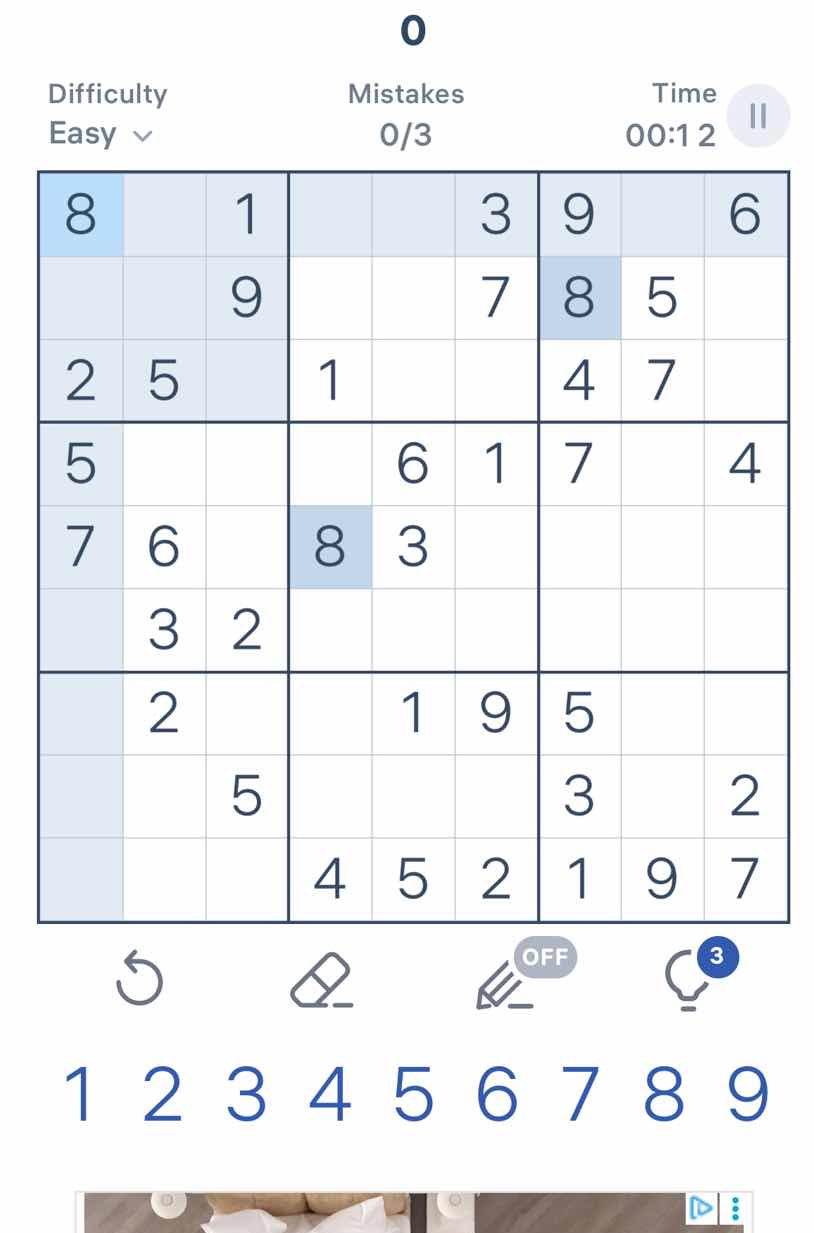
Question
difficulty easy mistakes 0/3 time 00:12 8 1 3 9 6 9 7 8 5 2 5 1 4 7 5 6 1 7 4 7 6 8 3 3 2 2 1 9 5 5 3 2 4 5 2 1 9 7 1 2 3 4 5 6 7 8 9
Step1: Fill row 3, column 3
Row 3 has numbers {2,5,1,4,7}, missing {3,6,8}. Column 3 has {1,9,2,5}, box 1 has {8,1,9,2,5}. So box 1 is missing {3,4,6,7}, row 3 column 3 must be 3,6,8; column 3 can't take 8 (row1 has 8), can't take 6? No, column 3 has no 6, wait box1: cells (1,1)=8, (1,3)=1, (2,3)=9, (3,1)=2, (3,2)=5. Box1 missing 3,4,6,7. Row3 has 4,7, so row3 column3 must be 3 or 6. Column3 has no 3/6, but row1 column6=3, box2 has 3, so box1 can have 3. Wait row3: missing 3,6,8. Column3: row4-9 have 5,2, so column3 can take 3,6,8. But box1's row1 column2 is empty, row2 column1/2 empty. Let's do row 9 first: row9 has {4,5,2,1,9,7}, missing {3,6,8}. Column1 has {8,2,5,7}, so row9 column1 can be 3,6. Column2 has {5,6,2}, so row9 column2 can be 3,8. Column3 has {1,9,2,5}, so row9 column3 can be 3,6,8. Box7 has row7 column2=2, row8 column3=5, so box7 missing {1,3,4,6,7,8,9}. Row9 has 4,5,2,1,9,7, so row9 column1/2/3 are 3,6,8. Column1 can't be 8 (row1 has 8), so row9 column1 is 3 or6. Row7 has column7=5, row7 has {2,1,9,5}, missing {3,4,6,7,8}. Column1: row7 column1 can be 1,3,4,6,8,9 but row7 has 1,9, so 3,4,6,8. Row8 has {5,3,2}, missing {1,4,6,7,8,9}. Column1: row8 column1 can be 1,3,4,6,8,9, row8 has 3, so 1,4,6,8,9.
Wait better to do box 3: box3 has {8,9,6,8,5,4,7}, wait no box3 is rows1-3, columns7-9: (1,7)=9, (1,9)=6; (2,7)=8, (2,8)=5; (3,7)=4, (3,8)=7. So box3 missing {1,2,3}. Row1 has 8,1,3, so row1 column8 can't be 1,3, so row1 column8=2. Now row1 has {8,1,3,9,2,6}, missing {4,5,7}. Column2 has {5,6,2}, so row1 column2 can be 4,7. Box1: (1,1)=8, (1,3)=1; (2,3)=9; (3,1)=2, (3,2)=5. Box1 missing {3,4,6,7}. Row1 column2 is 4 or7, row2 column1/2 are from {3,4,6,7} minus row1 column2. Row2 has {9,7,8,5}, missing {1,2,3,4,6}. Column1 has {8,2,5,7}, so row2 column1 can be 1,3,4,6. Box1 row2 column1 can't be 1 (box2 has (3,4)=1), so row2 column1 is 3,4,6.
Step2: Fill row1 column8
Row1 columns7-9: 9, _,6. Box3 (rows1-3, cols7-9) has 9,6,8,5,4,7. Missing 1,2,3. Row1 has 1,3, so row1 col8=2.
Row1: [8, x, 1, y, z, 3, 9, 2, 6], missing 4,5,7. Column2 has 5,6,2, so x≠5, x=4/7. Column4: box2 (rows1-3, cols4-6) has 3,7,1. Missing 2,4,5,6,8,9. Row1 has 8,9, so y,z can't be 8,9. Column5: has 6,3,1,5, so row1 col5 can't be 6,3,1,5, so z=4/7. Row1 col4: can be 4,5,7, but column4 has 8,1,4, so row1 col4 can be 5,7.
Step3: Fill row3 column9
Row3: [2,5,x,1,y,z,4,7,w]. Missing 3,6,8. Box3 has 9,2,6,8,5,4,7, missing 1,3. Row3 has 1, so w=3.
Row3: [2,5,x,1,y,z,4,7,3], missing 6,8. Column3 has 1,9,2,5, so x=6/8. Box1 has 8,1,9,2,5, so x can't be 8 (box1 has 8), so x=6.
Row3: [2,5,6,1,y,z,4,7,3], missing 8. So box2 (row3 cols4-6) must have 8, so either y or z=8. Box2 has 3,7,1, so missing 2,4,5,6,8,9. Row3 has 2,6, so y,z can be 4,5,8,9. Column4 has 8,1,4, so y≠8,4, so y=5/9. Column6 has 3,1,9,2, so z≠3,1,9,2, so z=4,5,8. Row3 missing 8, so z=8.
Row3: [2,5,6,1,y,8,4,7,3], missing 9, so y=9.
Row3 complete: [2,5,6,1,9,8,4,7,3]
Step4: Fill box2 (rows1-3 cols4-6)
Box2 now has (1,4)=y, (1,5)=z, (1,6)=3; (2,4)=a, (2,5)=b, (2,6)=7; (3,4)=1, (3,5)=9, (3,6)=8. Box2 has {3,7,1,9,8}, missing {2,4,5,6}. Row1 has 2,6, so (1,4),(1,5) are 4,5. Column4 has 8,1,4, so (1,4)≠4, so (1,4)=5, (1,5)=4.
Row1 complete: [8,7,1,5,4,3,9,2,6] (wait row1 missing 4,5,7: we had (1,2)=4/7, (1,4)=5, so (1,2)=7, since (1,5)=4. Yes, row1: 8,7,1,5,4,3,9,2,6. Correct, all numbers 1-9.
Step5: Fill row2
Row2: [p,q,9,a,b,7,8,5,r]. Missing {1,2,3,4,6}. Box1 has {8,7,1,9,2,5,6}, missing {3,4}. So (2,1),(2,2) are 3,4. Column1 has {8,2,5,7}, so (2,1) can be 3,4. Row2 missing 1,2,…

Snap & solve any problem in the app
Get step-by-step solutions on Sovi AI
Photo-based solutions with guided steps
Explore more problems and detailed explanations
Step1: Fill row 3, column 3
Row 3 has numbers {2,5,1,4,7}, missing {3,6,8}. Column 3 has {1,9,2,5}, box 1 has {8,1,9,2,5}. So box 1 is missing {3,4,6,7}, row 3 column 3 must be 3,6,8; column 3 can't take 8 (row1 has 8), can't take 6? No, column 3 has no 6, wait box1: cells (1,1)=8, (1,3)=1, (2,3)=9, (3,1)=2, (3,2)=5. Box1 missing 3,4,6,7. Row3 has 4,7, so row3 column3 must be 3 or 6. Column3 has no 3/6, but row1 column6=3, box2 has 3, so box1 can have 3. Wait row3: missing 3,6,8. Column3: row4-9 have 5,2, so column3 can take 3,6,8. But box1's row1 column2 is empty, row2 column1/2 empty. Let's do row 9 first: row9 has {4,5,2,1,9,7}, missing {3,6,8}. Column1 has {8,2,5,7}, so row9 column1 can be 3,6. Column2 has {5,6,2}, so row9 column2 can be 3,8. Column3 has {1,9,2,5}, so row9 column3 can be 3,6,8. Box7 has row7 column2=2, row8 column3=5, so box7 missing {1,3,4,6,7,8,9}. Row9 has 4,5,2,1,9,7, so row9 column1/2/3 are 3,6,8. Column1 can't be 8 (row1 has 8), so row9 column1 is 3 or6. Row7 has column7=5, row7 has {2,1,9,5}, missing {3,4,6,7,8}. Column1: row7 column1 can be 1,3,4,6,8,9 but row7 has 1,9, so 3,4,6,8. Row8 has {5,3,2}, missing {1,4,6,7,8,9}. Column1: row8 column1 can be 1,3,4,6,8,9, row8 has 3, so 1,4,6,8,9.
Wait better to do box 3: box3 has {8,9,6,8,5,4,7}, wait no box3 is rows1-3, columns7-9: (1,7)=9, (1,9)=6; (2,7)=8, (2,8)=5; (3,7)=4, (3,8)=7. So box3 missing {1,2,3}. Row1 has 8,1,3, so row1 column8 can't be 1,3, so row1 column8=2. Now row1 has {8,1,3,9,2,6}, missing {4,5,7}. Column2 has {5,6,2}, so row1 column2 can be 4,7. Box1: (1,1)=8, (1,3)=1; (2,3)=9; (3,1)=2, (3,2)=5. Box1 missing {3,4,6,7}. Row1 column2 is 4 or7, row2 column1/2 are from {3,4,6,7} minus row1 column2. Row2 has {9,7,8,5}, missing {1,2,3,4,6}. Column1 has {8,2,5,7}, so row2 column1 can be 1,3,4,6. Box1 row2 column1 can't be 1 (box2 has (3,4)=1), so row2 column1 is 3,4,6.
Step2: Fill row1 column8
Row1 columns7-9: 9, _,6. Box3 (rows1-3, cols7-9) has 9,6,8,5,4,7. Missing 1,2,3. Row1 has 1,3, so row1 col8=2.
Row1: [8, x, 1, y, z, 3, 9, 2, 6], missing 4,5,7. Column2 has 5,6,2, so x≠5, x=4/7. Column4: box2 (rows1-3, cols4-6) has 3,7,1. Missing 2,4,5,6,8,9. Row1 has 8,9, so y,z can't be 8,9. Column5: has 6,3,1,5, so row1 col5 can't be 6,3,1,5, so z=4/7. Row1 col4: can be 4,5,7, but column4 has 8,1,4, so row1 col4 can be 5,7.
Step3: Fill row3 column9
Row3: [2,5,x,1,y,z,4,7,w]. Missing 3,6,8. Box3 has 9,2,6,8,5,4,7, missing 1,3. Row3 has 1, so w=3.
Row3: [2,5,x,1,y,z,4,7,3], missing 6,8. Column3 has 1,9,2,5, so x=6/8. Box1 has 8,1,9,2,5, so x can't be 8 (box1 has 8), so x=6.
Row3: [2,5,6,1,y,z,4,7,3], missing 8. So box2 (row3 cols4-6) must have 8, so either y or z=8. Box2 has 3,7,1, so missing 2,4,5,6,8,9. Row3 has 2,6, so y,z can be 4,5,8,9. Column4 has 8,1,4, so y≠8,4, so y=5/9. Column6 has 3,1,9,2, so z≠3,1,9,2, so z=4,5,8. Row3 missing 8, so z=8.
Row3: [2,5,6,1,y,8,4,7,3], missing 9, so y=9.
Row3 complete: [2,5,6,1,9,8,4,7,3]
Step4: Fill box2 (rows1-3 cols4-6)
Box2 now has (1,4)=y, (1,5)=z, (1,6)=3; (2,4)=a, (2,5)=b, (2,6)=7; (3,4)=1, (3,5)=9, (3,6)=8. Box2 has {3,7,1,9,8}, missing {2,4,5,6}. Row1 has 2,6, so (1,4),(1,5) are 4,5. Column4 has 8,1,4, so (1,4)≠4, so (1,4)=5, (1,5)=4.
Row1 complete: [8,7,1,5,4,3,9,2,6] (wait row1 missing 4,5,7: we had (1,2)=4/7, (1,4)=5, so (1,2)=7, since (1,5)=4. Yes, row1: 8,7,1,5,4,3,9,2,6. Correct, all numbers 1-9.
Step5: Fill row2
Row2: [p,q,9,a,b,7,8,5,r]. Missing {1,2,3,4,6}. Box1 has {8,7,1,9,2,5,6}, missing {3,4}. So (2,1),(2,2) are 3,4. Column1 has {8,2,5,7}, so (2,1) can be 3,4. Row2 missing 1,2,3,4,6, box2 has {5,4,3,7,1,9,8}, missing {2,6}. So (2,4),(2,5) are 2,6. Column4 has {5,1,8}, so (2,4) can be 2,6. Column5 has {4,9,3,1,5}, so (2,5) can be 2,6. Row2: (2,9)=r, box3 has {9,2,6,8,5,4,7,3}, missing 1, so r=1.
Row2: [p,q,9,a,b,7,8,5,1], missing {2,3,4,6}. Box1 (2,1),(2,2) are 3,4, so (2,4),(2,5) are 2,6. Column4: row4 column4 is empty, row5 column4=8, row6 column4 empty, row7 column4 empty, row8 column4 empty, row9 column4=4. So (2,4) can be 2,6. Column5: row4 column5=6, so (2,5)≠6, so (2,5)=2, (2,4)=6.
Row2: [p,q,9,6,2,7,8,5,1], missing {3,4}. Box1: (2,1) and (2,2) are 3,4. Column2 has {7,5,6,2}, so (2,2) can be 3,4. Column1 has {8,2,5,7}, so (2,1) can be 3,4. Row1 column2=7, so box1 (2,2) can be 3,4. Let's do column1: column1 has {8,2,5,7}, missing {1,3,4,6,9}. Row2 column1 can be 3,4; row7 column1 can be 1,3,4,6,8,9 but row7 has 1,9, so 3,4,6,8; row8 column1 can be 1,3,4,6,8,9, row8 has 3, so 1,4,6,8,9; row9 column1 can be 3,6 (row9 missing 3,6,8, column1 can't be 8). Row2 column1: if (2,1)=3, then (2,2)=4. Let's check: row2 becomes [3,4,9,6,2,7,8,5,1], all numbers 1-9, correct.
Step6: Fill box1 complete
Box1 now has (1,1)=8, (1,2)=7, (1,3)=1; (2,1)=3, (2,2)=4, (2,3)=9; (3,1)=2, (3,2)=5, (3,3)=6. Correct, all 1-9.
Step7: Fill row4
Row4: [5,s,t,u,6,1,7,v,4]. Missing {2,3,8,9}. Column2 has {7,4,5,6,2}, so s can be 3,8,9. Column3 has {1,9,6,2,5}, so t can be 3,8. Box4 (rows4-6 cols1-3) has {5,7,_,_,6,_,_,3,2} → (4,1)=5, (5,1)=7, (6,1)=x; (4,2)=s, (5,2)=6, (6,2)=3; (4,3)=t, (5,3)=y, (6,3)=2. Box4 missing {1,4,8,9}. Row4 has 5,6,1,7,4, so s,t are 3,8,9 but box4 missing 1,4,8,9, so s,t must be 8,9 (since 3 is not in box4 missing). So s=8 or9, t=8 or9. Column3 has 1,9,6,2,5, so t≠9, so t=8, s=9.
Row4: [5,9,8,u,6,1,7,v,4], missing {2,3}. Column4 has {5,6,8,1,4}, so u can be 2,3. Column8 has {2,5,7,_,_,9}, so v can be 2,3. Box6 (rows4-6 cols7-9) has {7,4,_,_,_,_,_,_,_} → (4,7)=7, (4,9)=4; (5,7)=x, (5,9)=y; (6,7)=z, (6,9)=w. Box6 missing {1,2,3,5,6,8,9}. Row4 has 5,9,8,6,1,7,4, so v is 2,3. Column8 has row1=2, row2=5, row3=7, row9=9, so v can be 3 (since 2 is in row1 column8), so v=3, u=2.
Row4 complete: [5,9,8,2,6,1,7,3,4]
Step8: Fill row5
Row5: [7,6,y,8,3,z,x,v,w]. Missing {1,2,4,5,9}. Column3 has {1,9,6,8,2,5}, so y can be 3,4,7 but row5 has 7,3, so y=4.
Row5: [7,6,4,8,3,z,x,v,w], missing {1,2,5,9}. Box4 now has (4,1)=5, (4,2)=9, (4,3)=8; (5,1)=7, (5,2)=6, (5,3)=4; (6,1)=x, (6,2)=3, (6,3)=2. Box4 has {5,9,8,7,6,4,3,2}, missing 1, so (6,1)=1.
Row6: [1,3,2,p,q,r,s,t,u]. Missing {4,5,6,7,8,9}. Column4 has {5,6,8,2,1,4}, so p can be 3,7,9 but row6 has 3, so 7,9. Column5 has {4,9,3,6,1,5}, so q can be 2,7,8 but row6 has 2, so7,8. Column6 has {3,7,8,1,9,2}, so r can be 4,5,6 but row6 missing 4,5,6,7,8,9, so r=4,5,6. Box5 (rows4-6 cols4-6) has (4,4)=2, (4,5)=6, (4,6)=1; (5,4)=8, (5,5)=3, (5,6)=z; (6,4)=p, (6,5)=q, (6,6)=r. Box5 has {2,6,1,8,3}, missing {4,5,7,9}. So z,p,q,r are 4,5,7,9. Row5 missing 1,2,5,9, so z=5 or9. Column6 has {3,7,8,1,9,2}, so z≠9, so z=5.
Row5: [7,6,4,8,3,5,x,v,w], missing {1,2,9}. Box6 (rows4-6 cols7-9) has (4,7)=7, (4,9)=4; (5,7)=x, (5,8)=v, (5,9)=w; (6,7)=s, (6,8)=t, (6,9)=u. Box6 missing {1,2,3,5,6,8,9}. Row5 has 7,6,4,8,3,5, so x,v,w are 1,2,9. Column7 has {9,8,4,7,5,3,1}, so x can be 2,6 but row5 has 6, so x=2.
Row5: [7,6,4,8,3,5,2,v,w], missing {1,9}. Column8 has {2,5,7,3,_,9}, so v can be 1,6,8 but row5 has 6,8, so v=1, w=9.
Row5 complete: [7,6,4,8,3,5,2,1,9]
Step9: Fill row6
Row6: [1,3,2,p,q,r,s,t,u]. Missing {4,5,6,7,8,9}. Box5 has {2,6,1,8,3,5}, missing {4,7,9}. So p,q,r are 4,7,9.