QUESTION IMAGE
Question
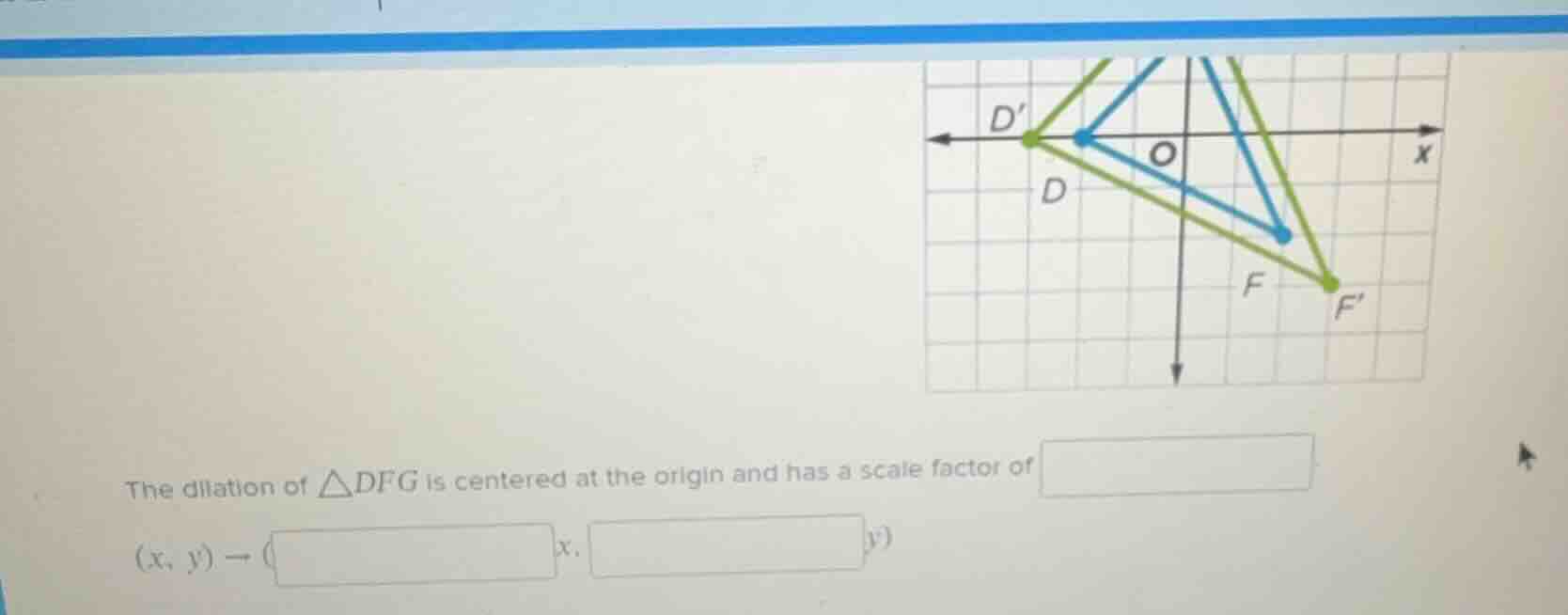
the dilation of △dfg is centered at the origin and has a scale factor of
(x, y) → ( x, y)
Step1: Identify coordinates of D and D'
Let's assume the grid has each square as 1 unit. From the graph, let's find coordinates of \( D \) and \( D' \). Suppose \( D \) is at \( (-2, -1) \) and \( D' \) is at \( (-4, -2) \). (We can check other points too, but let's use D first.)
Step2: Calculate scale factor for x and y
For a dilation centered at origin, the rule is \( (x,y) \to (kx, ky) \), where \( k \) is scale factor.
For x - coordinate: \( k\times(-2)= - 4\), so \( k=\frac{-4}{-2} = 2 \).
For y - coordinate: \( k\times(-1)= - 2\), so \( k=\frac{-2}{-1}=2 \).
We can verify with another point, say \( F \) and \( F' \). Suppose \( F \) is at \( (2, - 2) \) and \( F' \) is at \( (4, - 4) \).
For x - coordinate: \( k\times2 = 4\), \( k = 2 \).
For y - coordinate: \( k\times(-2)=-4\), \( k = 2 \).
So the scale factor \( k = 2 \), and the transformation is \( (x,y)\to(2x,2y) \).

Snap & solve any problem in the app
Get step-by-step solutions on Sovi AI
Photo-based solutions with guided steps
Explore more problems and detailed explanations
The scale factor is \( 2 \), and the transformation is \( (x, y) \to (2x, 2y) \). So the scale factor box is \( \boldsymbol{2} \), the x - coefficient box is \( \boldsymbol{2} \), and the y - coefficient box is \( \boldsymbol{2} \).