QUESTION IMAGE
Question
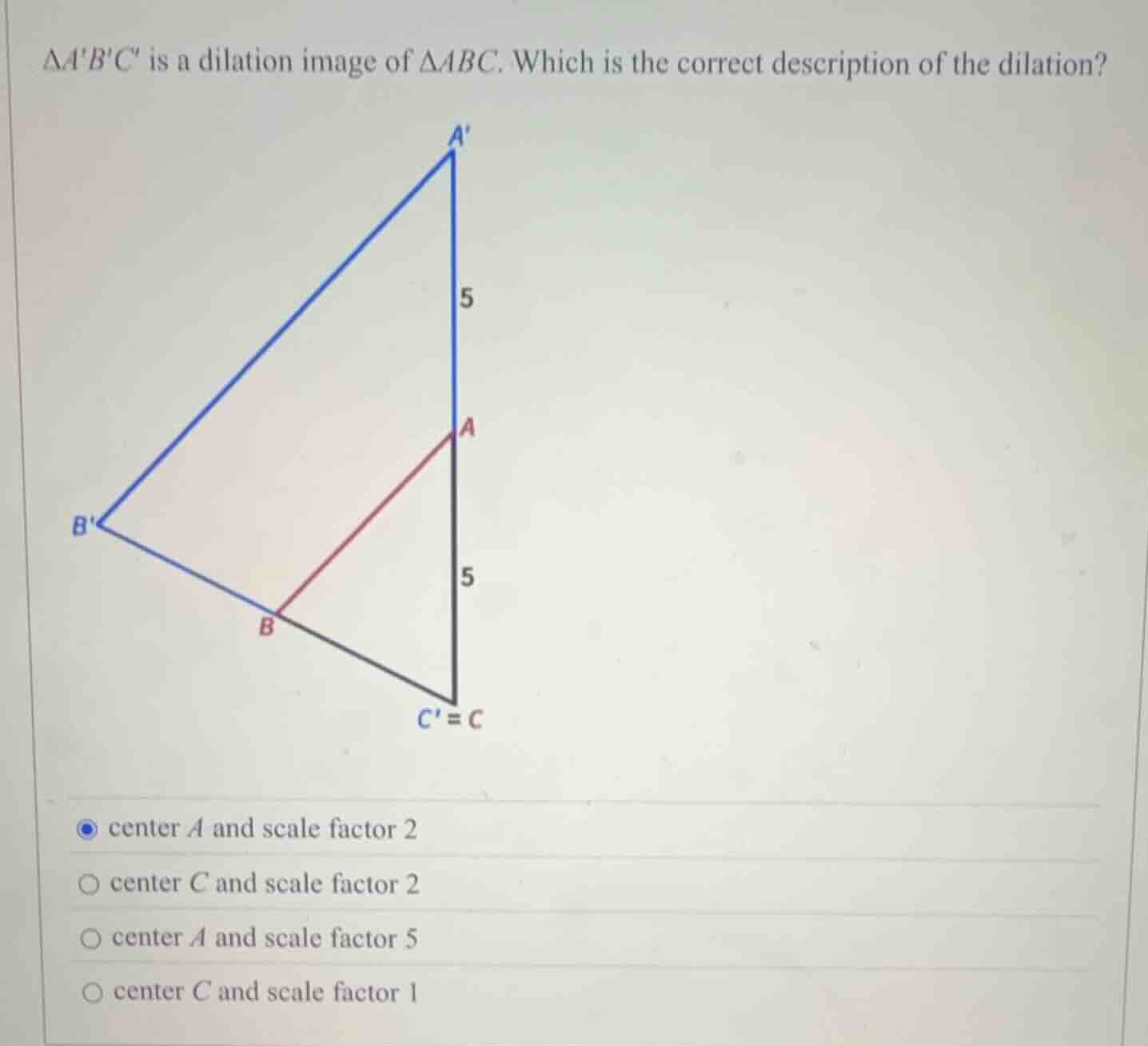
$\triangle abc$ is a dilation image of $\triangle abc$. which is the correct description of the dilation?
$c = c$
- center $a$ and scale factor $2$
- center $c$ and scale factor $2$
- center $a$ and scale factor $5$
- center $c$ and scale factor $1$
Step1: Identify the center of dilation
In a dilation, the center of dilation is a point that remains fixed (or maps to itself) or is the intersection point of the lines connecting corresponding vertices. Here, \( C' = C \), so \( C \) is a fixed point? Wait, no, let's check the corresponding points. The line \( CC' \) is a point (since \( C' = C \)), and the line \( AA' \): from \( A \) to \( A' \), and \( BB' \): from \( B \) to \( B' \). Wait, actually, looking at the diagram, \( C' = C \), so \( C \) is the center? Wait, no, let's calculate the scale factor. The length from \( C \) to \( A \) is 5, and from \( C \) to \( A' \) is \( 5 + 5 = 10 \). Wait, no, the segment \( CA \) is 5, and \( CA' \) is \( 5 + 5 = 10 \)? Wait, no, the diagram shows \( A \) is between \( C \) and \( A' \), with \( CA = 5 \) and \( AA' = 5 \), so \( CA' = CA + AA' = 5 + 5 = 10 \). So the scale factor from \( \triangle ABC \) to \( \triangle A'B'C' \) with center \( C \) would be \( \frac{CA'}{CA} = \frac{10}{5} = 2 \). Also, \( C' = C \), so the center is \( C \)? Wait, no, wait the options: one is center \( C \) and scale factor 2. Wait, but let's check the other points. \( B \) to \( B' \): if center is \( C \), then \( CB' \) should be \( 2 \times CB \). Also, \( A \) to \( A' \): \( CA' = 2 \times CA \) (since \( CA = 5 \), \( CA' = 10 \), which is \( 2 \times 5 \)). And \( C' = C \), so that's consistent. Alternatively, if center is \( A \), then \( AA' = 0 \), which is not the case. Wait, the diagram shows \( C' = C \), so \( C \) is a fixed point, so center is \( C \). Then scale factor: \( CA' = CA + AA' = 5 + 5 = 10 \), so scale factor \( k = \frac{CA'}{CA} = \frac{10}{5} = 2 \). So the correct description is center \( C \) and scale factor 2? Wait, no, wait the original triangle is \( \triangle ABC \), and the image is \( \triangle A'B'C' \) with \( C' = C \). Let's check the length of \( AC \): from \( A \) to \( C \) is 5, and from \( A' \) to \( C' (C) \) is 10, so scale factor 2. And the center is \( C \) because \( C \) maps to itself (\( C' = C \)). So the correct option is center \( C \) and scale factor 2. Wait, but the first option was center \( A \) and scale factor 2, but if center is \( A \), then \( AA' = 0 \), which is not true. So the correct option is center \( C \) and scale factor 2.
Step2: Verify the scale factor and center
- Center: \( C' = C \), so \( C \) is the center (since dilation center is a fixed point).
- Scale factor: The length from \( C \) to \( A \) is 5, from \( C \) to \( A' \) is 10. So scale factor \( k = \frac{CA'}{CA} = \frac{10}{5} = 2 \).
- Check other points: For \( B \), \( CB' \) should be \( 2 \times CB \), and \( B' \) lies on the line \( CB \) extended, which matches the diagram.

Snap & solve any problem in the app
Get step-by-step solutions on Sovi AI
Photo-based solutions with guided steps
Explore more problems and detailed explanations
B. center \( C \) and scale factor 2 (assuming the options are labeled, but in the given options, the correct one is "center \( C \) and scale factor 2")