QUESTION IMAGE
Question
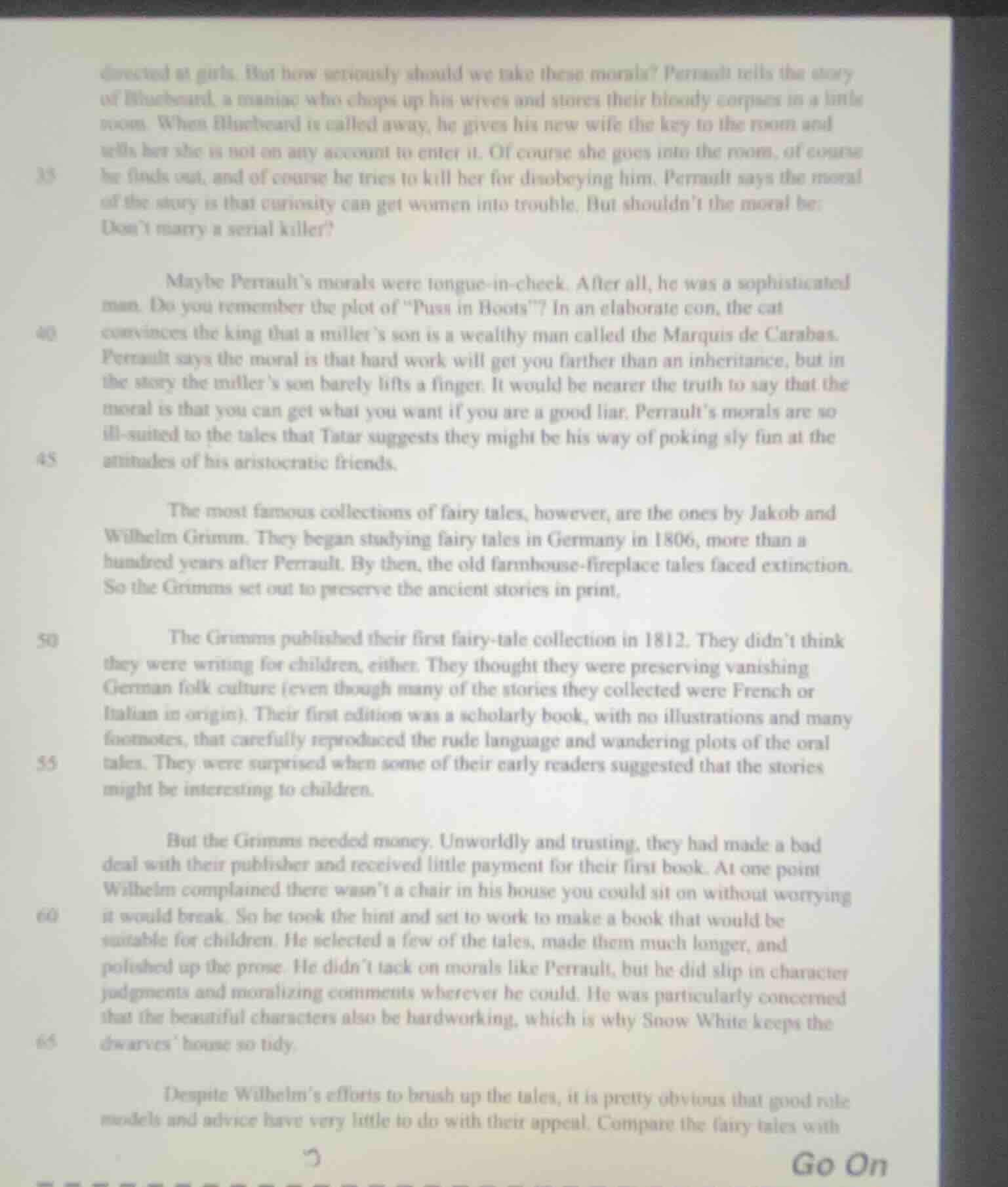
directed at girls. but how seriously should we take these morals? perrault tells the story of bluebeard, a maniac who chops up his wives and stores their bloody corpses in a little room. when bluebeard is called away, he gives his new wife the key to the room and tells her she is not on any account to enter it. of course she goes into the room, of course he finds out, and of course he tries to kill her for disobeying him. perrault says the moral of the story is that curiosity can get women into trouble. but shouldn’t the moral be: don’t marry a serial killer?
maybe perrault’s morals were tongue - in - cheek. after all, he was a sophisticated man. do you remember the plot of “puss in boots”? in an elaborate con, the cat convinces the king that a miller’s son is a wealthy man called the marquis de carabas. perrault says the moral is that hard work will get you farther than an inheritance, but in the story the miller’s son barely lifts a finger. it would be nearer the truth to say that the moral is that you can get what you want if you are a good liar. perrault’s morals are so ill - suited to the tales that tatar suggests they might be his way of poking sly fun at the attitudes of his aristocratic friends.
the most famous collections of fairy tales, however, are the ones by jakob and wilhelm grimm. they began studying fairy tales in germany in 1806, more than a hundred years after perrault. by then, the old farmhouse - fireplace tales faced extinction. so the grimms set out to preserve the ancient stories in print.
the grimms published their first fairy - tale collection in 1812. they didn’t think they were writing for children, either. they thought they were preserving vanishing german folk culture (even though many of the stories they collected were french or italian in origin). their first edition was a scholarly book, with no illustrations and many footnotes, that carefully reproduced the rude language and wandering plots of the oral tales. they were surprised when some of their early readers suggested that the stories might be interesting to children.
but the grimms needed money. unworldly and trusting, they had made a bad deal with their publisher and received little payment for their first book. at one point wilhelm complained there wasn’t a chair in his house you could sit on without worrying it would break. so he took the hint and set to work to make a book that would be suitable for children. he selected a few of the tales, made them much longer, and polished up the prose. he didn’t tack on morals like perrault, but he did slip in character judgments and moralizing comments wherever he could. he was particularly concerned that the beautiful characters also be hardworking, which is why snow white keeps the dwarves’ house so tidy.
despite wilhelm’s efforts to brush up the tales, it is pretty obvious that good role models and advice have very little to do with their appeal. compare the fairy tales with
Since no specific question is provided about this text, it's not possible to give a targeted answer. If you have a question related to this passage, such as analyzing the authors' approaches to fairy tales, identifying themes, or asking about specific details (e.g., why Perrault's morals were ill - suited, how the Grimms' work evolved), please provide more details so that I can assist you.

Snap & solve any problem in the app
Get step-by-step solutions on Sovi AI
Photo-based solutions with guided steps
Explore more problems and detailed explanations
Since no specific question is provided about this text, it's not possible to give a targeted answer. If you have a question related to this passage, such as analyzing the authors' approaches to fairy tales, identifying themes, or asking about specific details (e.g., why Perrault's morals were ill - suited, how the Grimms' work evolved), please provide more details so that I can assist you.