QUESTION IMAGE
Question
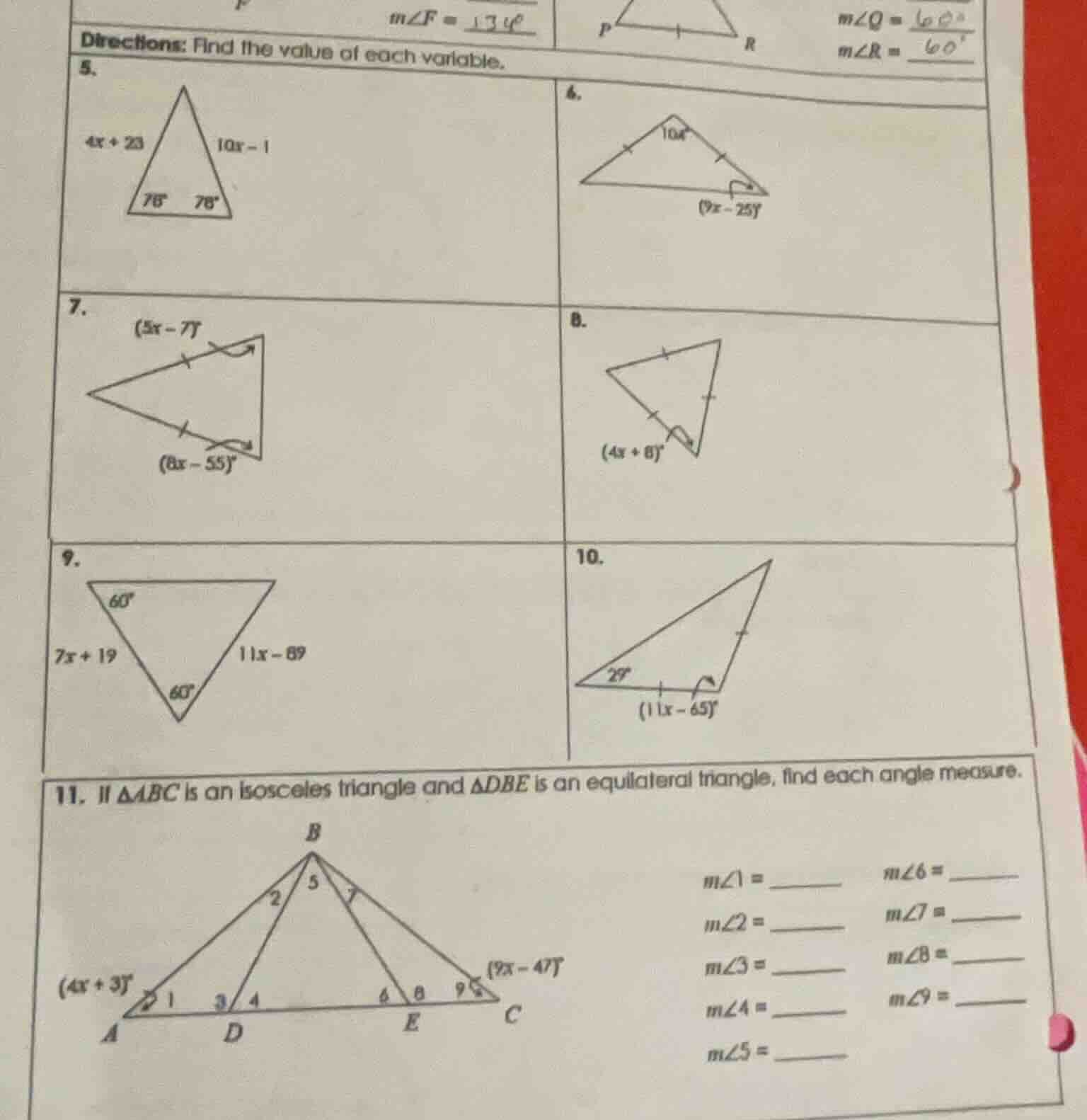
directions: find the value of each variable.
5.
4.
7.
8.
9.
10.
- if ( \triangle abc ) is an isosceles triangle and ( \triangle dbe ) is an equilateral triangle, find each angle measure.
Problem 5
Step1: Equal sides, set expressions equal
$4x + 23 = 10x - 1$
Step2: Solve for x
$23 + 1 = 10x - 4x$
$24 = 6x$
$x = \frac{24}{6} = 4$
Problem 6
Step1: Equal sides → base angle = $10x^\circ$
Step2: Triangle angle sum = $180^\circ$
$10x + 10x + (9x - 25) = 180$
Step3: Simplify and solve for x
$29x - 25 = 180$
$29x = 205$
$x = \frac{205}{29} \approx 7.07$
Problem 7
Step1: Equal sides → opposite angles equal
$5x - 7 = 8x - 55$
Step2: Solve for x
$55 - 7 = 8x - 5x$
$48 = 3x$
$x = 16$
Problem 8
Step1: Equal sides → triangle is isosceles, vertex angle = $(4x+8)^\circ$, base angles equal. Let base angles = $y$, so $2y + (4x+8) = 180$. But since sides are marked equal, the vertex angle is the marked one, so base angles are equal, and we can infer: the triangle has two equal sides, so the angles opposite are equal. Wait, the marked angle is the vertex, so the other two angles are equal. But we only have the vertex angle given, so we assume we solve for x such that the triangle is valid? No, wait: the two sides with ticks are equal, so the angles opposite are equal. The marked angle is $(4x+8)^\circ$, which is the angle between the two equal sides (vertex angle). So the sum is $2y + (4x+8) = 180$, but we need another relation? No, wait, no—wait, no, actually, no, the problem is that the two sides with ticks are equal, so the angles opposite are equal. The angle marked is the vertex angle, so we can only solve if we assume that the triangle's angles sum to 180, but we need to realize that this is an isosceles triangle, so the vertex angle is $(4x+8)^\circ$, and the base angles are equal. But since there's no other angle given, wait no—wait, no, I misread: the two sides with ticks are equal, so the angles opposite are equal. The angle marked is the angle between the non-equal side and one equal side? No, no, the tick marks are on two sides, so those two sides are equal. The angle marked is the angle adjacent to one ticked side and the non-ticked side. So the angle opposite the non-ticked side is $(4x+8)^\circ$, and the two equal angles are the ones opposite the ticked sides. Wait, no, let's correct:
Step1: Equal sides → opposite angles equal
Let the two equal angles be $A$, so $2A + (4x+8) = 180$. But no, wait, no—the tick marks are on two sides, so those sides are congruent, so their opposite angles are congruent. The marked angle is $(4x+8)^\circ$, which is the angle between the two ticked sides (vertex angle). So:
Step2: Triangle angle sum
$2A + (4x+8) = 180$, but we need to realize that this is not solvable unless we know that the triangle is valid, but wait no—wait, no, I made a mistake. The problem says "find the value of each variable", so x is the variable, so we must have that the angle is valid, but no—wait, no, actually, no: the two sides with ticks are equal, so the angles opposite are equal. The marked angle is the vertex angle, so the base angles are equal, but we don't have their measures. Wait, no, no, I misread the diagram: the tick marks are on two sides, so those sides are equal, so the angles opposite are equal. The marked angle is the angle opposite the non-ticked side, so that angle is $(4x+8)^\circ$, and the two equal angles are the ones opposite the ticked sides. But since we have no other information, wait no—wait, no, this is a right triangle? The marked angle has a square, so it's a right angle! Oh right! The square means it's a 90° angle.
Step1: Recognize right angle: $4x+8=90$
Step2: Solve for x
$4x = 90 - 8 = 82$
$x = \frac{82}{4} = 20.5$
Pr…

Snap & solve any problem in the app
Get step-by-step solutions on Sovi AI
Photo-based solutions with guided steps
Explore more problems and detailed explanations
- $x=4$
- $x=\frac{205}{29} \approx 7.07$
- $x=16$
- $x=20.5$
- $x=27$
- $x=\frac{123}{11} \approx 11.18$
11.
$m\angle 1=43^\circ$, $m\angle 2=17^\circ$, $m\angle 3=120^\circ$, $m\angle 4=120^\circ$, $m\angle 5=60^\circ$
$m\angle 6=43^\circ$, $m\angle 7=17^\circ$, $m\angle 8=120^\circ$, $m\angle 9=43^\circ$