QUESTION IMAGE
Question
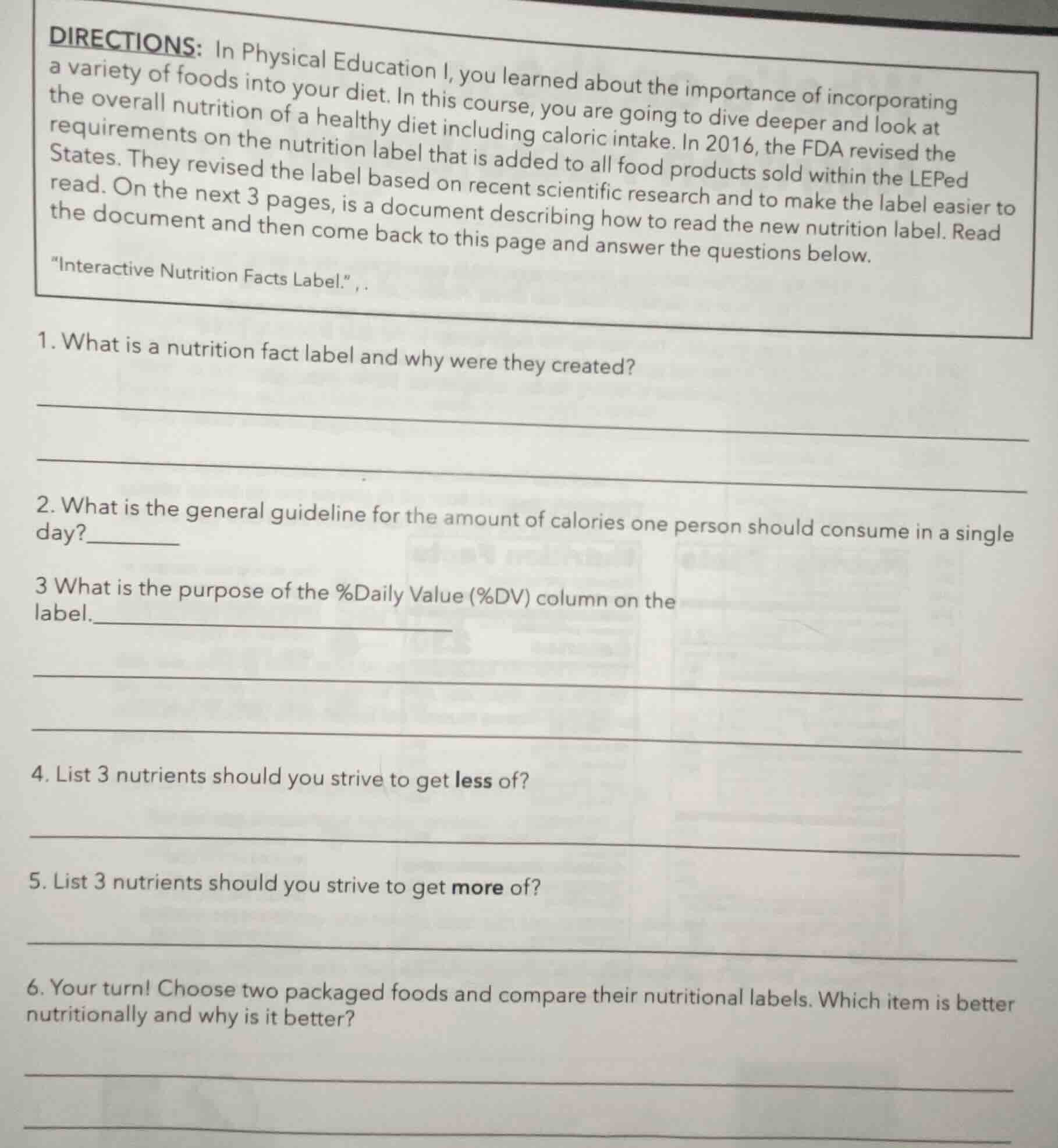
directions: in physical education i, you learned about the importance of incorporating a variety of foods into your diet. in this course, you are going to dive deeper and look at the overall nutrition of a healthy diet including caloric intake. in 2016, the fda revised the requirements on the nutrition label that is added to all food products sold within the leped states. they revised the label based on recent scientific research and to make the label easier to read. on the next 3 pages, is a document describing how to read the new nutrition label. read the document and then come back to this page and answer the questions below.\interactive nutrition facts label.\1. what is a nutrition fact label and why were they created?2. what is the general guideline for the amount of calories one person should consume in a single day?3 what is the purpose of the %daily value (%dv) column on the label.4. list 3 nutrients should you strive to get less of?5. list 3 nutrients should you strive to get more of?6. your turn! choose two packaged foods and compare their nutritional labels. which item is better nutritionally and why is it better?
- A nutrition facts label is a standardized panel on packaged foods that lists nutrient content, serving sizes, and caloric information. It was created to give consumers clear, consistent data to make informed dietary choices, and to ensure food manufacturers meet transparency requirements set by regulatory bodies like the FDA.
- The general guideline is based on a 2,000-calorie daily diet, which is the reference used for most nutrition labels to simplify nutrient comparisons, though individual needs vary by age, gender, and activity level.
- The %Daily Value (%DV) column shows how much a single serving of the food contributes to the average person's daily recommended intake of a nutrient, helping consumers quickly see if a food is high or low in specific nutrients.
- These nutrients are typically overconsumed in standard diets and linked to negative health outcomes when eaten in excess.
- These nutrients support overall bodily function, reduce disease risk, and are often lacking in standard diets.
- The comparison focuses on key nutrient metrics (calories, excess nutrients, beneficial nutrients) to determine the more nutritionally balanced option.

Snap & solve any problem in the app
Get step-by-step solutions on Sovi AI
Photo-based solutions with guided steps
Explore more problems and detailed explanations
- A nutrition facts label is a standardized panel on packaged foods that details nutrient content, serving sizes, and calories. They were created to help consumers make informed dietary choices and enforce food industry transparency under regulatory oversight.
- The general guideline is a 2,000-calorie daily diet (used as a reference; individual needs vary).
- The %Daily Value column helps consumers understand how much a serving of the food contributes to their daily recommended intake of each nutrient, making it easy to gauge if a food is high or low in key nutrients.
- Sodium, saturated fat, added sugars
- Dietary fiber, vitamin D, potassium
- Example comparison:
- Food 1: Plain non-fat Greek yogurt; Food 2: Sweetened fruit yogurt
- Plain non-fat Greek yogurt is nutritionally better. It has fewer calories, no added sugars, more protein, and less saturated fat than the sweetened fruit yogurt, while still providing calcium and probiotics.