QUESTION IMAGE
Question
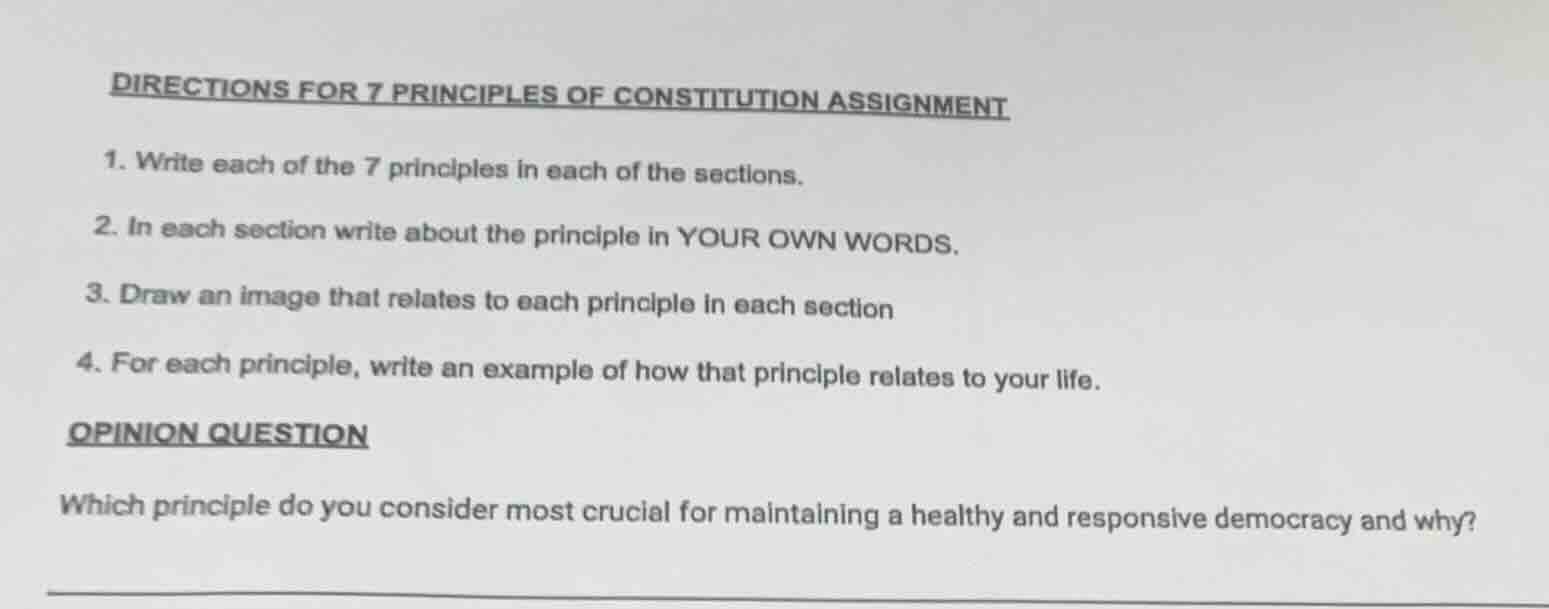
directions for 7 principles of constitution assignment
- write each of the 7 principles in each of the sections.
- in each section write about the principle in your own words.
- draw an image that relates to each principle in each section
- for each principle, write an example of how that principle relates to your life.
opinion question
which principle do you consider most crucial for maintaining a healthy and responsive democracy and why?
The 7 principles of the US Constitution are Popular Sovereignty, Republicanism, Federalism, Separation of Powers, Checks and Balances, Limited Government, and Individual Rights. For the opinion question, let's take "Popular Sovereignty" as an example. Popular Sovereignty means the people are the source of government power. In a healthy democracy, it's crucial because it ensures the government's authority comes from the citizens' will. If the government doesn't reflect the people's desires, citizens can vote for representatives or push for changes, keeping the democracy responsive as it's grounded in the people's voice. Other principles like Checks and Balances prevent abuse but Popular Sovereignty is the foundation of a democracy’s responsiveness to the people.

Snap & solve any problem in the app
Get step-by-step solutions on Sovi AI
Photo-based solutions with guided steps
Explore more problems and detailed explanations
The principle of Popular Sovereignty is most crucial for maintaining a healthy and responsive democracy. Popular Sovereignty is the idea that the ultimate source of governmental power lies with the people. A democracy thrives when it is “of the people, by the people, and for the people” (to paraphrase Lincoln). For a democracy to be healthy and responsive, the government must reflect the will of the citizens. If the people feel their voices are ignored, they can vote out representatives, advocate for policy changes, or participate in civic movements—all actions rooted in the belief that their collective will (popular sovereignty) should guide governance. Without popular sovereignty, a democracy would lack legitimacy and responsiveness, as the government would not be accountable to the people’s needs, values, or priorities. Other principles (e.g., Checks and Balances, Limited Government) support democracy, but Popular Sovereignty is the foundation, ensuring the government exists to serve the people and adapts to their evolving interests.