QUESTION IMAGE
Question
directions: read the passage below. choose the best answer to the questions.
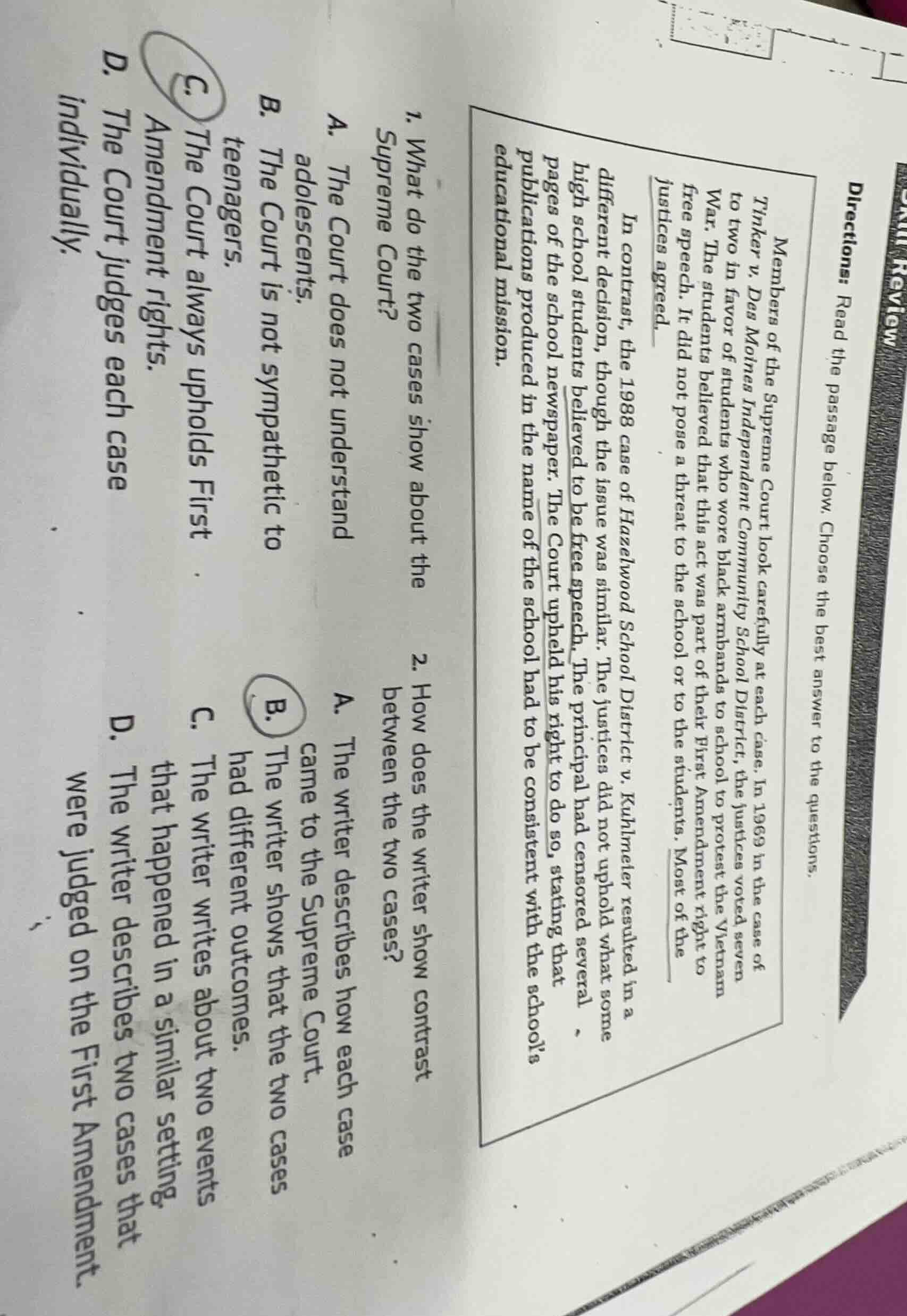
members of the supreme court look carefully at each case. in 1969 in the case of tinker v. des moines independent community school district, the justices voted seven to two in favor of students who wore black armbands to school to protest the vietnam war. the students believed that this act was part of their first amendment right to free speech. it did not pose a threat to the school or to the students. most of the justices agreed.
in contrast, the 1988 case of hazelwood school district v. kuhlmeier resulted in a different decision, though the issue was similar. the justices did not uphold what some high school students believed to be free speech. the principal had censored several pages of the school newspaper. the court upheld his right to do so, stating that publications produced in the name of the school had to be consistent with the school’s educational mission.
- what do the two cases show about the supreme court?
a. the court does not understand adolescents.
b. the court is not sympathetic to teenagers.
c. the court always upholds first amendment rights.
d. the court judges each case individually.
- how does the writer show contrast between the two cases?
a. the writer describes how each case came to the supreme court.
b. the writer shows that the two cases had different outcomes.
c. the writer writes about two events that happened in a similar setting.
d. the writer describes two cases that were judged on the first amendment.
Question 1
To solve this, we analyze the two cases (Tinker v. Des Moines and Hazelwood School District v. Kuhlmeier). In Tinker, the Court upheld students' free speech (First Amendment) rights. In Hazelwood, the Court upheld the principal's censorship. So the Court had different rulings (outcomes) for similar free - speech - related student cases. Option A is wrong as the Court does understand adolescents. Option B is wrong as the Court was sympathetic to students in Tinker. Option C is wrong as the Court didn't always uphold First Amendment rights (Hazelwood shows otherwise). Option D is wrong as the Court doesn't judge each case individually in a way that ignores precedent, but rather based on the context. The correct answer is that the two cases show different outcomes, so the answer related to different outcomes (the option that says the writer shows the two cases had different outcomes, but for question 1, re - evaluating: Wait, question 1 is "What do the two cases show about the Supreme Court?". Let's re - check. Tinker: Court upheld student free speech (First Amendment). Hazelwood: Court upheld principal's action (so didn't uphold student free speech in that context). So the Court's decisions vary, meaning the two cases had different outcomes. So the correct option for question 1 is the one that says the two cases had different outcomes (but looking at the options, option B was circled? Wait no, the options for question 1: A. The Court does not understand adolescents. B. The Court is not sympathetic to teenagers. C. The Court always upholds First Amendment rights. D. The Court judges each case individually. Wait, maybe I misread. Wait Tinker: Court was sympathetic (upheld student free speech). Hazelwood: Court upheld school's action. So the Court's decisions are based on the specific case (judges each case individually). Wait, in Tinker, the speech was not disruptive, in Hazelwood, the speech (school newspaper) was related to school's educational mission. So the Court judges each case on its own merits. So option D? But the circled option is C. Wait no, maybe I made a mistake. Wait the passage says "In 1969 in the case of Tinker v. Des Moines... the justices voted seven to two in favor of students... In contrast, the 1988 case of Hazelwood... the justices did not uphold what some high school students believed to be free speech." So in Tinker, Court upheld First Amendment (student free speech), in Hazelwood, Court did not. So the Court does not always uphold First Amendment rights. So option C is wrong. Wait, maybe the original circled option was a mistake. Let's re - analyze. The correct answer for question 1: The two cases show that the Court's decisions vary, so it judges each case individually (option D)? Or that the two cases had different outcomes (which would relate to option B? No). Wait, the options: A is wrong (Court does understand). B: Court was sympathetic in Tinker, so B is wrong. C: Court didn't always uphold First Amendment (Hazelwood), so C is wrong. D: The Court judges each case individually (because the contexts were different: Tinker was protest against war, non - disruptive; Hazelwood was school newspaper related to school's mission). So D is correct. But the circled option is C, which is wrong. Maybe the user made a mistake in circling. But according to the passage, the correct answer for question 1 is D? Wait no, let's check again. The key is that in Tinker, the Court upheld the First Amendment right, in Hazelwood, it didn't. So the Court does not always uphold First Amendment rights, so option C is incorrect. The c…
We look at how the writer shows the contrast between the two cases. The writer describes what happened in Tinker (students wore armbands, Court upheld free speech) and what happened in Hazelwood (principal censored newspaper, Court upheld principal's action). So the writer shows that the two cases had different outcomes (one upheld student free speech, one didn't). Option A: The writer doesn't describe how each case came to the Supreme Court. Option B: The writer shows the different outcomes (Tinker: Court for students; Hazelwood: Court for school). Option C: The writer writes about two events (cases) that happened in different settings (1969 and 1988, different school - related contexts) but the contrast is in outcomes, not just settings. Option D: The writer describes two cases judged on First Amendment, but the contrast is in the outcomes, not just that they were judged on First Amendment. So the correct answer is B.

Snap & solve any problem in the app
Get step-by-step solutions on Sovi AI
Photo-based solutions with guided steps
Explore more problems and detailed explanations
D. The Court judges each case individually.