QUESTION IMAGE
Question
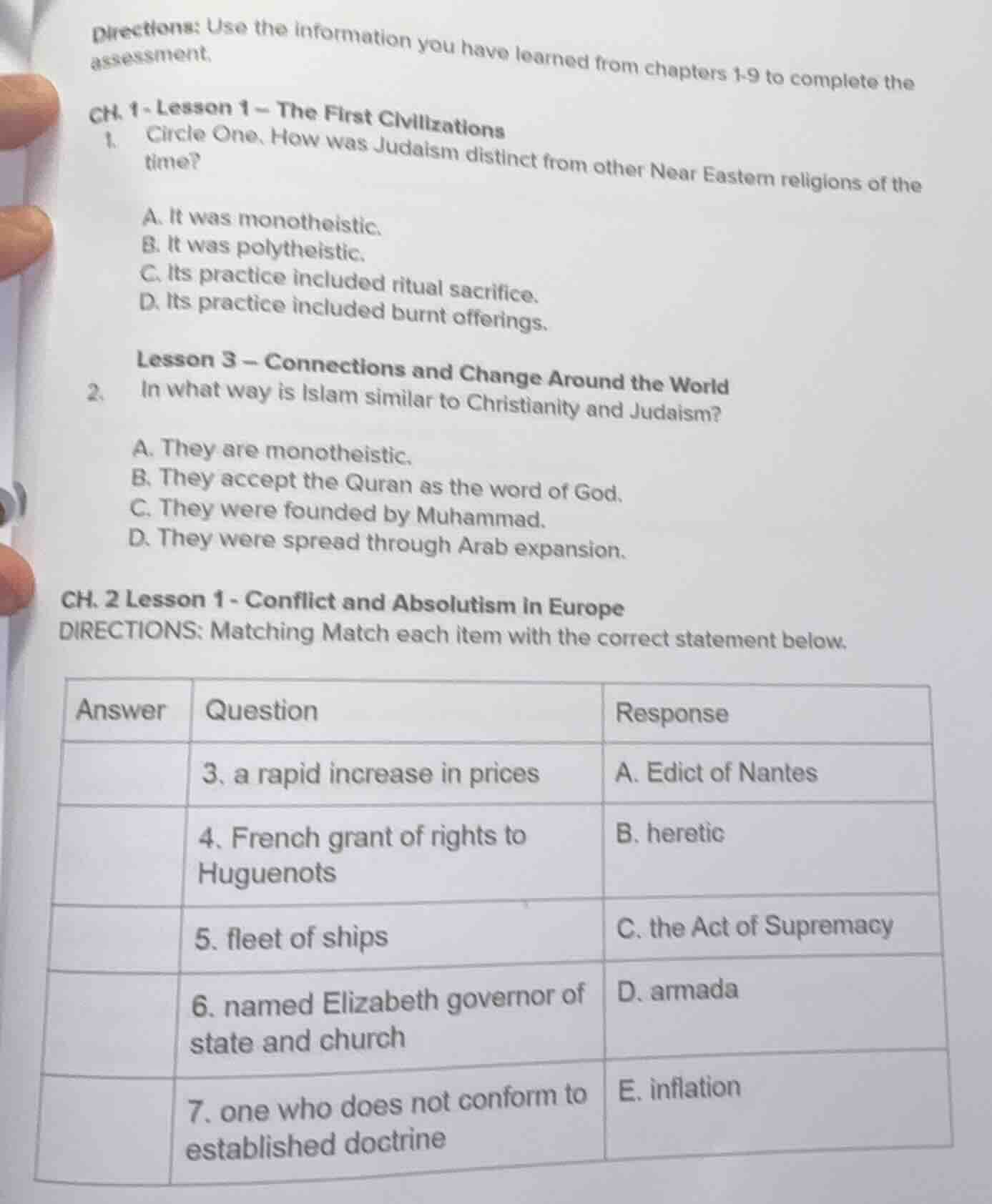
directions: use the information you have learned from chapters 1-9 to complete the assessment.
ch. 1 - lesson 1 - the first civilizations
- circle one. how was judaism distinct from other near eastern religions of the time?
a. it was monotheistic.
b. it was polytheistic.
c. its practice included ritual sacrifice.
d. its practice included burnt offerings.
lesson 3 - connections and change around the world
- in what way is islam similar to christianity and judaism?
a. they are monotheistic.
b. they accept the quran as the word of god.
c. they were founded by muhammad.
d. they were spread through arab expansion.
ch. 2 lesson 1 - conflict and absolutism in europe
directions: matching match each item with the correct statement below.
| answer | question | response |
|---|---|---|
| 4. french grant of rights to huguenots | b. heretic | |
| 5. fleet of ships | c. the act of supremacy | |
| 6. named elizabeth governor of state and church | d. armada | |
| 7. one who does not conform to established doctrine | e. inflation |
Brief Explanations
- Judaism was distinct for its monotheism (belief in one God) unlike polytheistic Near Eastern religions.
- Islam, Christianity, and Judaism are all monotheistic faiths.
- Inflation is defined as a rapid increase in prices.
- The Edict of Nantes granted rights to French Huguenots.
- An armada refers to a fleet of ships.
- The Act of Supremacy named Elizabeth I governor of state and church.
- A heretic is one who rejects established doctrine.

Snap & solve any problem in the app
Get step-by-step solutions on Sovi AI
Photo-based solutions with guided steps
Explore more problems and detailed explanations
- A. It was monotheistic.
- A. They are monotheistic.
- E. inflation
- A. Edict of Nantes
- D. armada
- C. the Act of Supremacy
- B. heretic