QUESTION IMAGE
Question
discuss each of the following questions with your group; record your best answers (in your words), then check your answers.
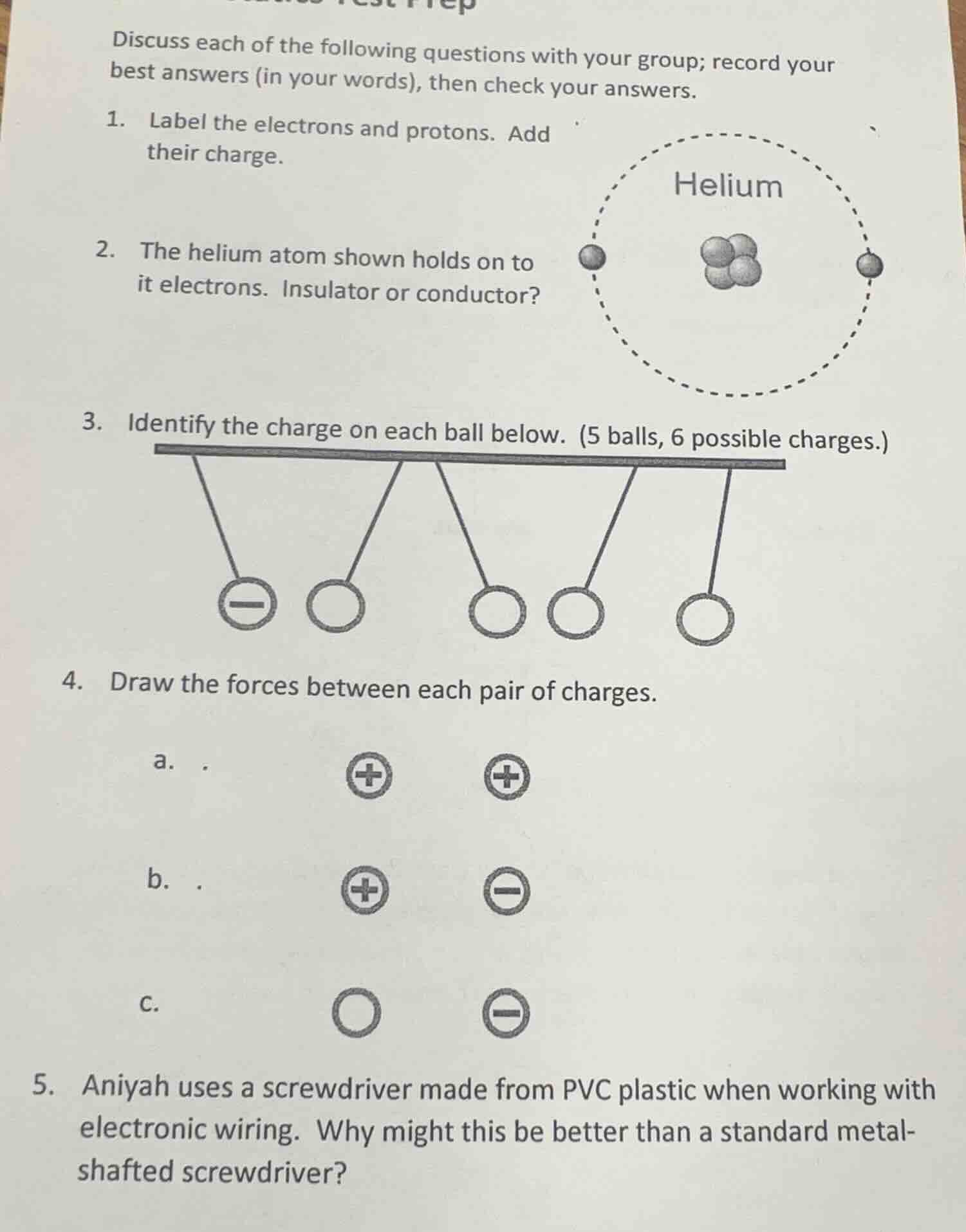
- label the electrons and protons. add their charge.
- the helium atom shown holds on to it electrons. insulator or conductor?
- identify the charge on each ball below. (5 balls, 6 possible charges.)
- draw the forces between each pair of charges.
a.
b.
c.
- aniyah uses a screwdriver made from pvc plastic when working with electronic wiring. why might this be better than a standard metal - shafted screwdriver?
Brief Explanations
- For the helium atom: The central cluster contains protons, each with a +1 charge; the two small particles on the outer ring are electrons, each with a -1 charge.
- Atoms that hold tightly to their electrons do not allow free electron flow, which is a property of insulators.
- The first ball has a negative (-) charge. The second ball is repelled by the negative ball, so it also has a negative (-) charge. The third ball is attracted to the negative second ball, so it has a positive (+) charge. The fourth ball is repelled by the positive third ball, so it has a positive (+) charge. The fifth ball is attracted to the positive fourth ball, so it has a negative (-) charge.
- a. Like positive charges repel each other, so forces point away from each charge.
b. Opposite charges attract each other, so forces point toward each other.
c. A neutral object is attracted to a negative charge, so forces point toward each other.
- PVC plastic is an insulator, which does not conduct electricity. A metal screwdriver is a conductor that could carry electric current, risking electric shock; the plastic screwdriver prevents this.

Snap & solve any problem in the app
Get step-by-step solutions on Sovi AI
Photo-based solutions with guided steps
Explore more problems and detailed explanations
- Central cluster (protons): Each proton has a charge of $+1$; Outer ring particles (electrons): Each electron has a charge of $-1$
- Insulator
- Ball 1: $-$, Ball 2: $-$, Ball 3: $+$, Ball 4: $+$, Ball 5: $-$
- a. Two outward-pointing arrows (one from each + charge, pointing away from the other)
b. Two inward-pointing arrows (one from each charge, pointing toward the other)
c. Two inward-pointing arrows (one from each object, pointing toward the other)
- PVC plastic is an electrical insulator, so it prevents electric current from flowing through it, reducing the risk of electric shock while working with electronic wiring, unlike a conductive metal screwdriver.