QUESTION IMAGE
Question
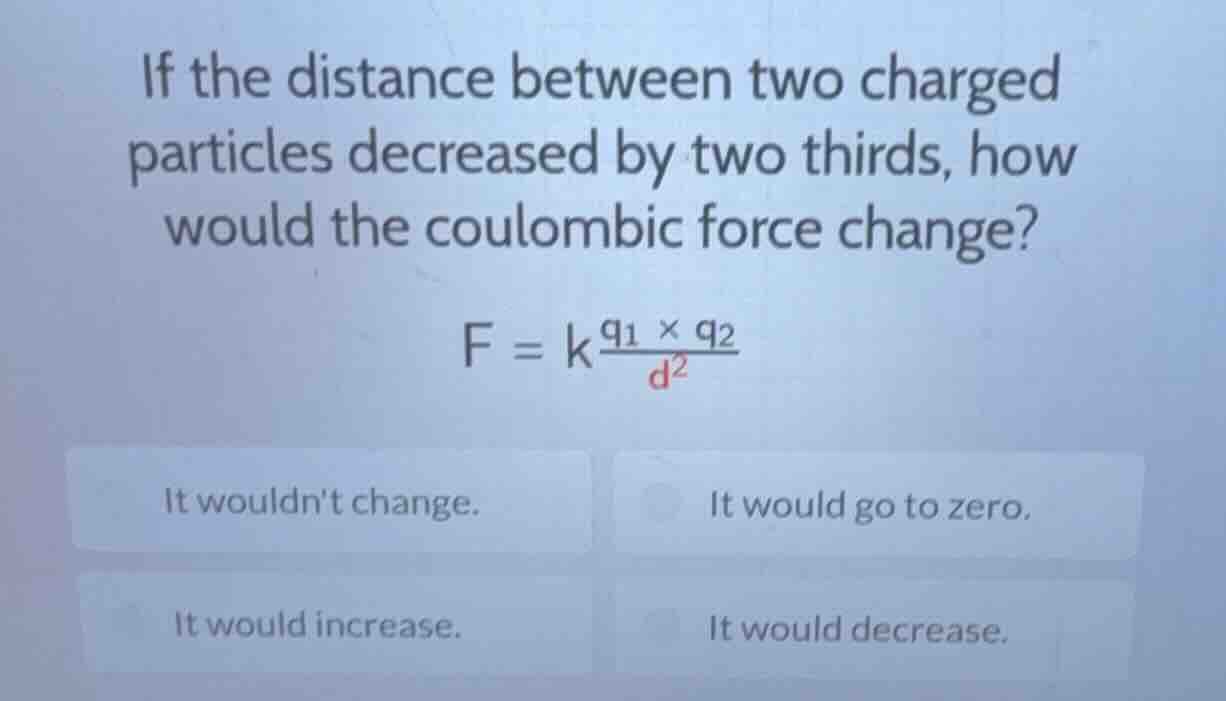
if the distance between two charged particles decreased by two thirds, how would the coulombic force change?
$f = k\frac{q_1 \times q_2}{d^2}$
it wouldnt change.
it would go to zero.
it would increase.
it would decrease.
Step1: Analyze the Coulomb's Law formula
The Coulomb's force formula is \( F = k\frac{q_1\times q_2}{d^2} \), where \( F \) is the force, \( k \) is a constant, \( q_1,q_2 \) are the charges, and \( d \) is the distance between the charges. From this formula, we can see that the force \( F \) is inversely proportional to the square of the distance \( d \) (i.e., \( F\propto\frac{1}{d^2} \)) when the charges are constant.
Step2: Determine the new distance
The distance is decreased by two - thirds. Let the original distance be \( d_{original}=d \). The amount of decrease is \( \frac{2}{3}d \), so the new distance \( d_{new}=d-\frac{2}{3}d=\frac{1}{3}d \).
Step3: Find the ratio of the new force to the original force
Let the original force be \( F_{original}=k\frac{q_1q_2}{d^2} \) and the new force be \( F_{new}=k\frac{q_1q_2}{d_{new}^2} \). Substitute \( d_{new}=\frac{1}{3}d \) into the formula for \( F_{new} \):
\( F_{new}=k\frac{q_1q_2}{(\frac{1}{3}d)^2}=k\frac{q_1q_2}{\frac{1}{9}d^2}=9k\frac{q_1q_2}{d^2} \)
Since \( F_{original}=k\frac{q_1q_2}{d^2} \), we can see that \( F_{new} = 9F_{original} \). This means that the force increases.

Snap & solve any problem in the app
Get step-by-step solutions on Sovi AI
Photo-based solutions with guided steps
Explore more problems and detailed explanations
It would increase.