QUESTION IMAGE
Question
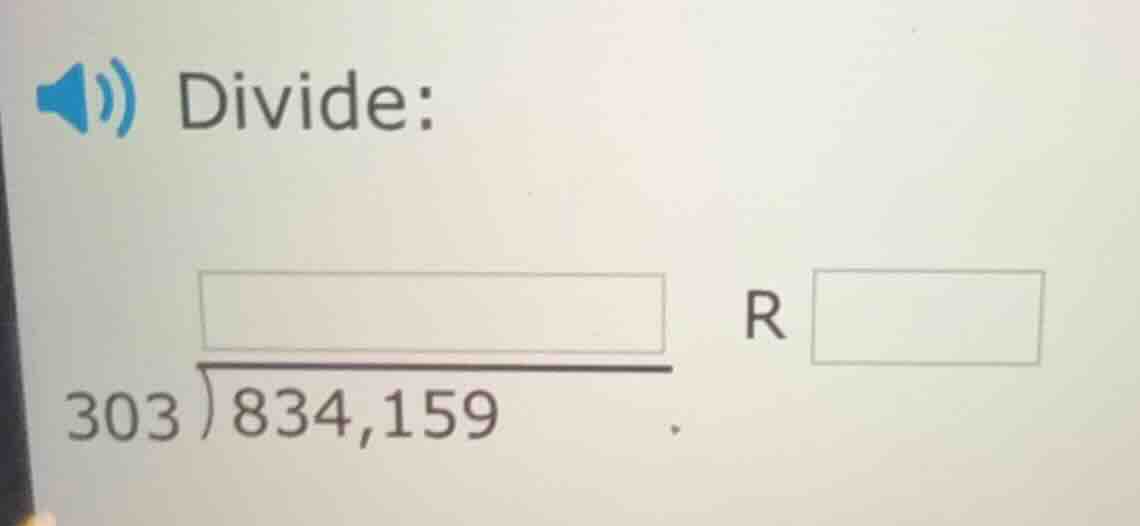
divide:
( \begin{array}{r} square \\ 303 enclose{longdiv}{834,159} end{array} ) r ( square )
Step1: Estimate the first digit
We divide \(834159\) by \(303\). First, look at how many times \(303\) goes into \(8341\) (since \(303\times27 = 8181\) and \(303\times28=8484\) which is too big). So the first digit of the quotient is \(27\)? Wait, no, let's do long division properly.
Wait, actually, \(303\times2753 = 303\times(2000 + 700+50 + 3)\)
\(303\times2000 = 606000\)
\(303\times700 = 212100\)
\(303\times50=15150\)
\(303\times3 = 909\)
Adding them up: \(606000+212100 = 818100\); \(818100+15150=833250\); \(833250 + 909=834159\). Wait, that's exact? Wait, let's check \(303\times2753\). Let's compute \(303\times2753\):
\(2753\times300=825900\)
\(2753\times3 = 8259\)
Then \(825900+8259 = 834159\). Oh, so there is no remainder? Wait, maybe I made a mistake in estimation. Let's do long division:
Divide \(834159\) by \(303\).
First, \(303\) into \(834\) (the first three digits of the dividend) is \(2\) times (\(303\times2 = 606\)), subtract \(606\) from \(834\) we get \(228\). Bring down the next digit \(1\) to make \(2281\).
\(303\) into \(2281\): \(303\times7 = 2121\), subtract \(2121\) from \(2281\) we get \(160\). Bring down the next digit \(5\) to make \(1605\).
\(303\) into \(1605\): \(303\times5 = 1515\), subtract \(1515\) from \(1605\) we get \(90\). Bring down the last digit \(9\) to make \(909\).
\(303\) into \(909\) is exactly \(3\) times (\(303\times3 = 909\)), subtract \(909\) from \(909\) we get \(0\).
So putting it all together, the quotient is \(2753\) and the remainder is \(0\). Wait, let's verify: \(303\times2753 = 303\times(2000 + 700 + 50 + 3)=303\times2000+303\times700+303\times50+303\times3 = 606000+212100+15150+909 = 606000+212100=818100; 818100+15150=833250; 833250+909=834159\). Yes, that's correct. So the division is exact, so the quotient is \(2753\) and the remainder is \(0\).
Wait, maybe the problem was expecting a division with remainder, but in this case, it's exact. Let's confirm the long division steps again:
- \(303\) into \(834\) (first three digits of \(834159\)): \(303\times2 = 606\), \(834 - 606 = 228\). Bring down \(1\) to get \(2281\).
- \(303\) into \(2281\): \(303\times7 = 2121\), \(2281 - 2121 = 160\). Bring down \(5\) to get \(1605\).
- \(303\) into \(1605\): \(303\times5 = 1515\), \(1605 - 1515 = 90\). Bring down \(9\) to get \(909\).
- \(303\) into \(909\): \(303\times3 = 909\), \(909 - 909 = 0\).
So the quotient is \(2753\) (from the digits we got: \(2\) (from first step), \(7\) (second), \(5\) (third), \(3\) (fourth)) and the remainder is \(0\).
Step1: Perform long division
We divide \(834159\) by \(303\):
- \(303 \times 2 = 606\), \(834 - 606 = 228\); bring down \(1\) to get \(2281\).
- \(303 \times 7 = 2121\), \(2281 - 2121 = 160\); bring down \(5\) to get \(1605\).
- \(303 \times 5 = 1515\), \(1605 - 1515 = 90\); bring down \(9\) to get \(909\).
- \(303 \times 3 = 909\), \(909 - 909 = 0\).
Combining the quotient digits (\(2, 7, 5, 3\)) gives \(2753\), and the remainder is \(0\).

Snap & solve any problem in the app
Get step-by-step solutions on Sovi AI
Photo-based solutions with guided steps
Explore more problems and detailed explanations
The quotient is \(2753\) and the remainder is \(0\), so the first box is \(2753\) and the second box (remainder) is \(0\).