QUESTION IMAGE
Question
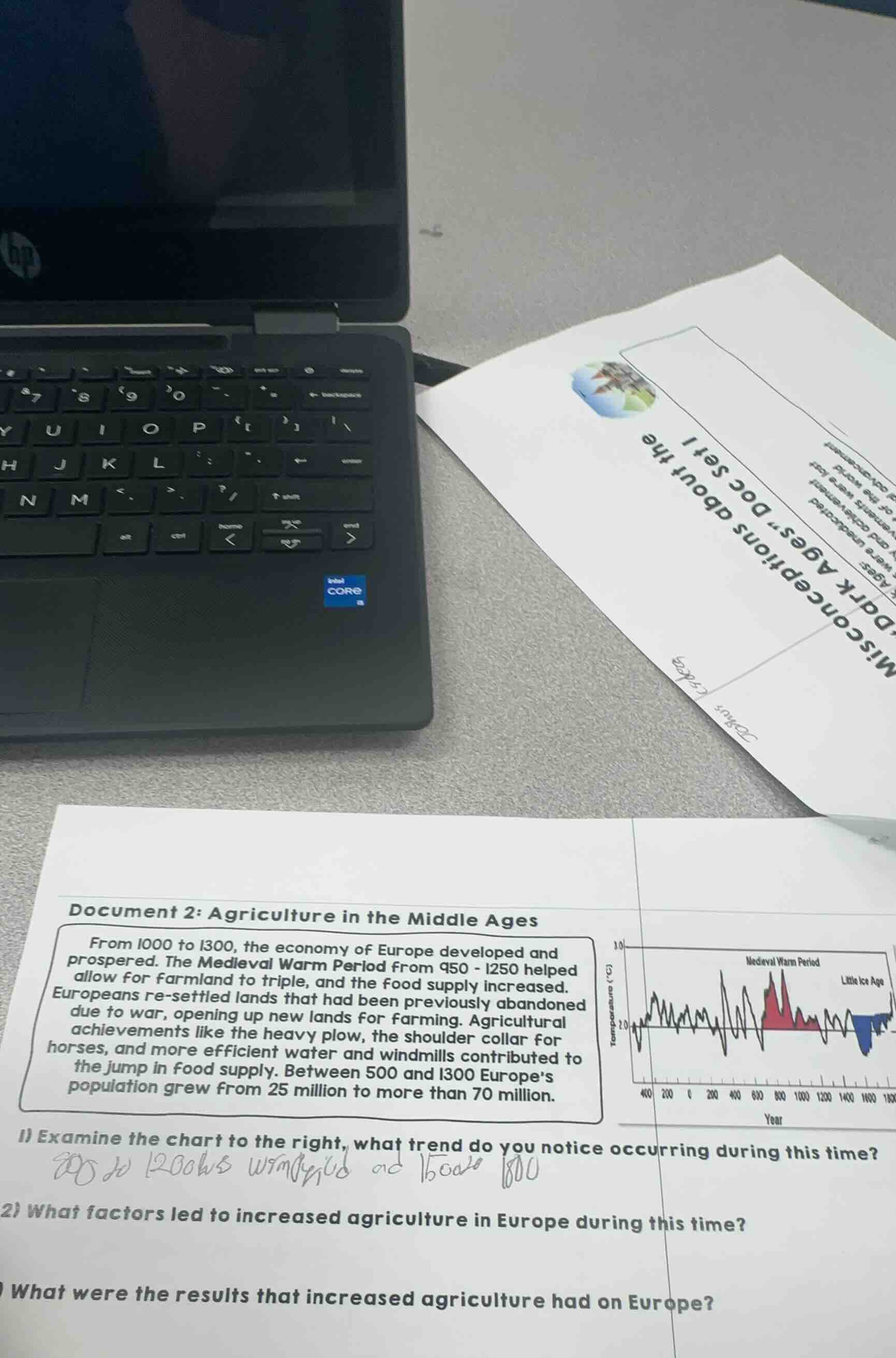
document 2: agriculture in the middle ages
from 1000 to 1300, the economy of europe developed and prospered. the medieval warm period from 950 - 1250 helped allow for farmland to triple, and the food supply increased. europeans re - settled lands that had been previously abandoned due to war, opening up new lands for farming. agricultural achievements like the heavy plow, the shoulder collar for horses, and more efficient water and windmills contributed to the jump in food supply. between 500 and 1300 europes population grew from 25 million to more than 70 million.
- examine the chart to the right, what trend do you notice occurring during this time?
- what factors led to increased agriculture in europe during this time?
) what were the results that increased agriculture had on europe?
Sub - Question 1:
To answer this, we analyze the chart (with Medieval Warm Period 950 - 1250 and Little Ice Age later) and the text. The chart's x - axis is year, y - axis is temperature. During the Medieval Warm Period (950 - 1250), temperature was relatively warm (as seen from the red - marked area), and after that (Little Ice Age), it cooled. So the trend is that from around 950 - 1250 (Medieval Warm Period), temperatures were warmer, and then there was a cooling trend (Little Ice Age).
We refer to the text in "Document 2: Agriculture in the Middle Ages". The factors are: 1. The Medieval Warm Period (950 - 1250) allowed farmland to triple. 2. Europeans re - settled abandoned lands (due to war) for farming. 3. Agricultural innovations like the heavy plow, shoulder collar for horses, and more efficient water and windmills.
From the text: "the food supply increased" and "Between 500 and 1300 Europe's population grew from 25 million to more than 70 million" and the economy "developed and prospered". So the results of increased agriculture were: increased food supply, population growth (from 25 million to over 70 million between 500 - 1300), and economic development/prosperity in Europe.

Snap & solve any problem in the app
Get step-by-step solutions on Sovi AI
Photo-based solutions with guided steps
Explore more problems and detailed explanations
During the Medieval Warm Period (950 - 1250), temperatures were relatively warm, and after that (entering the Little Ice Age), there was a cooling trend in temperature.