QUESTION IMAGE
Question
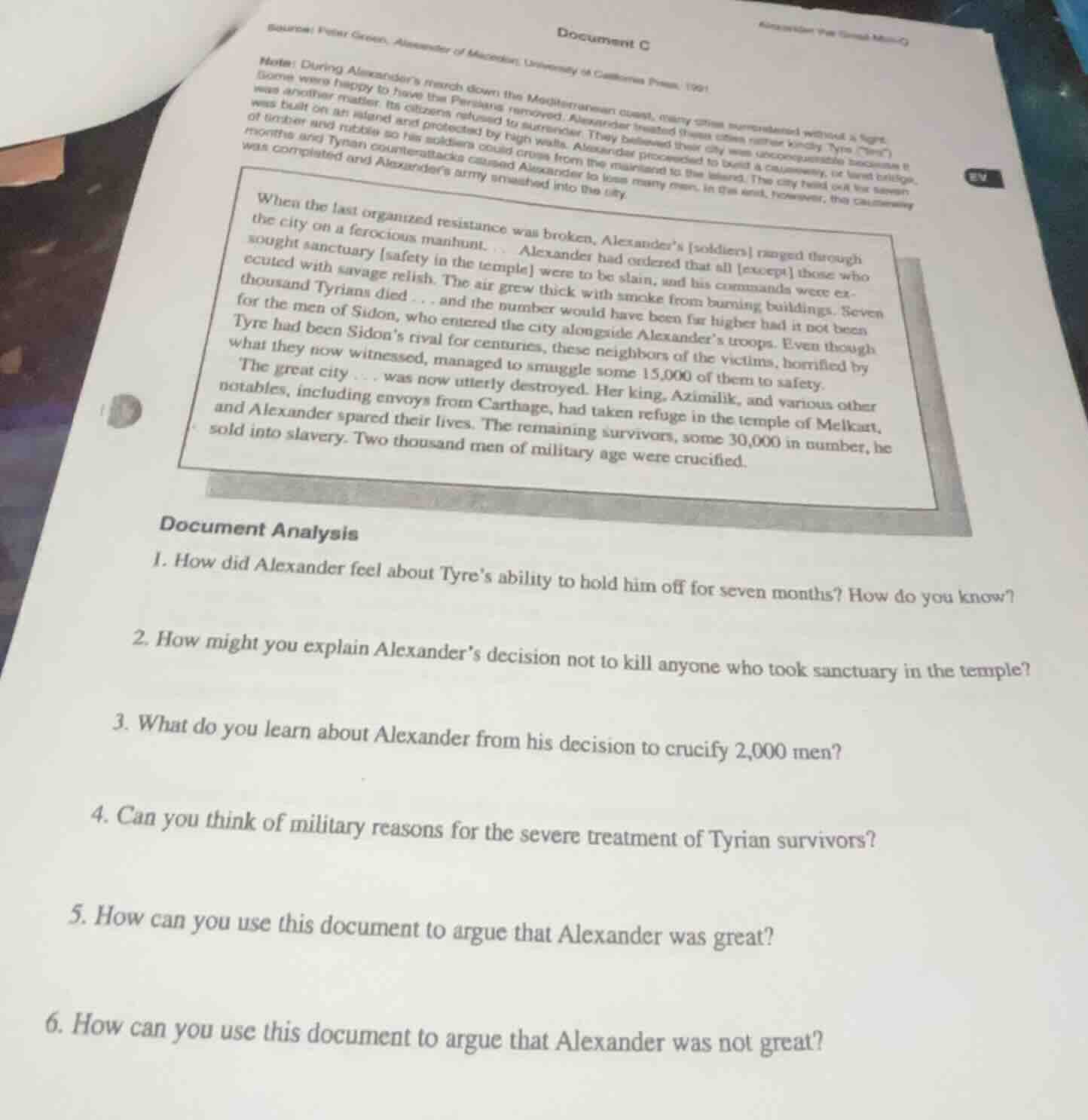
document c
source: peter green, alexander of macedon, university of california press, 1991
note: during alexander’s march down the mediterranean coast, many cities surrendered without a fight. some were happy to have the persians removed. alexander treated these cities rather kindly. tyre (“tir”) was another matter. its citizens refused to surrender. they believed their city was unconquerable because it was built on an island and protected by high walls. alexander proceeded to build a causeway, or land bridge, of timber and rubble so his soldiers could cross from the mainland to the island. the city held out for seven months and tyrian counterattacks caused alexander to lose many men. in the end, however, the causeway was completed and alexander’s army smashed into the city.
when the last organized resistance was broken, alexander’s soldiers ranged through the city on a ferocious manhunt. … alexander had ordered that all except those who sought sanctuary safety in the temple were to be slain, and his commands were executed with savage relish. the air grew thick with smoke from burning buildings. seven thousand tyrians died … and the number would have been far higher had it not been for the men of sidon, who entered the city alongside alexander’s troops. even though tyre had been sidon’s rival for centuries, these neighbors of the victims, horrified by what they now witnessed, managed to smuggle some 15,000 of them to safety.
the great city … was now utterly destroyed. her king, azimilk, and various other notables, including envoys from carthage, had taken refuge in the temple of melkart, and alexander spared their lives. the remaining survivors, some 30,000 in number, he sold into slavery. two thousand men of military age were crucified.
document analysis
- how did alexander feel about tyre’s ability to hold him off for seven months? how do you know?
- how might you explain alexander’s decision not to kill anyone who took sanctuary in the temple?
- what do you learn about alexander from his decision to crucify 2,000 men?
- can you think of military reasons for the severe treatment of tyrian survivors?
- how can you use this document to argue that alexander was great?
- how can you use this document to argue that alexander was not great?
Question 1
To determine Alexander's feelings, we analyze his actions after Tyre's resistance. Tyre held him off for seven months, and when he finally conquered the city, his soldiers conducted a "ferocious manhunt" and he ordered most (except temple - sanctuary seekers) to be slain. This extreme violence suggests he was angry or frustrated because Tyre's long - lasting resistance challenged his authority and military prowess, and his harsh response was a way to vent that and assert dominance.
In ancient cultures, temples were considered sacred spaces, often associated with the gods. Alexander may have respected the religious significance of the temple. By sparing those in the temple, he could gain favor with the local religious authorities or avoid the wrath of the gods, which was important for maintaining control over the newly conquered region and its people. Also, it could be a strategic move to show a modicum of mercy, perhaps to encourage other cities to surrender more easily in the future, as they would see that there was a chance for mercy in sacred spaces.
From his decision to crucify 2,000 men of military age, we learn that Alexander was ruthless and willing to use extreme, terrifying punishment to assert his power and deter future resistance. Crucifixion was a very public and painful form of execution, and by doing this, he was sending a message to other cities or potential rebels that resisting him would lead to severe consequences. It also shows his lack of mercy towards those who had fought against him, prioritizing his military authority and the suppression of resistance over human life.

Snap & solve any problem in the app
Get step-by-step solutions on Sovi AI
Photo-based solutions with guided steps
Explore more problems and detailed explanations
Alexander likely felt angry or frustrated. We know this because after finally taking Tyre (after seven months of resistance), his soldiers carried out a ferocious manhunt, and he ordered the slaying of most Tyrians (except those in the temple for sanctuary), showing his harsh reaction to having been held off.