QUESTION IMAGE
Question
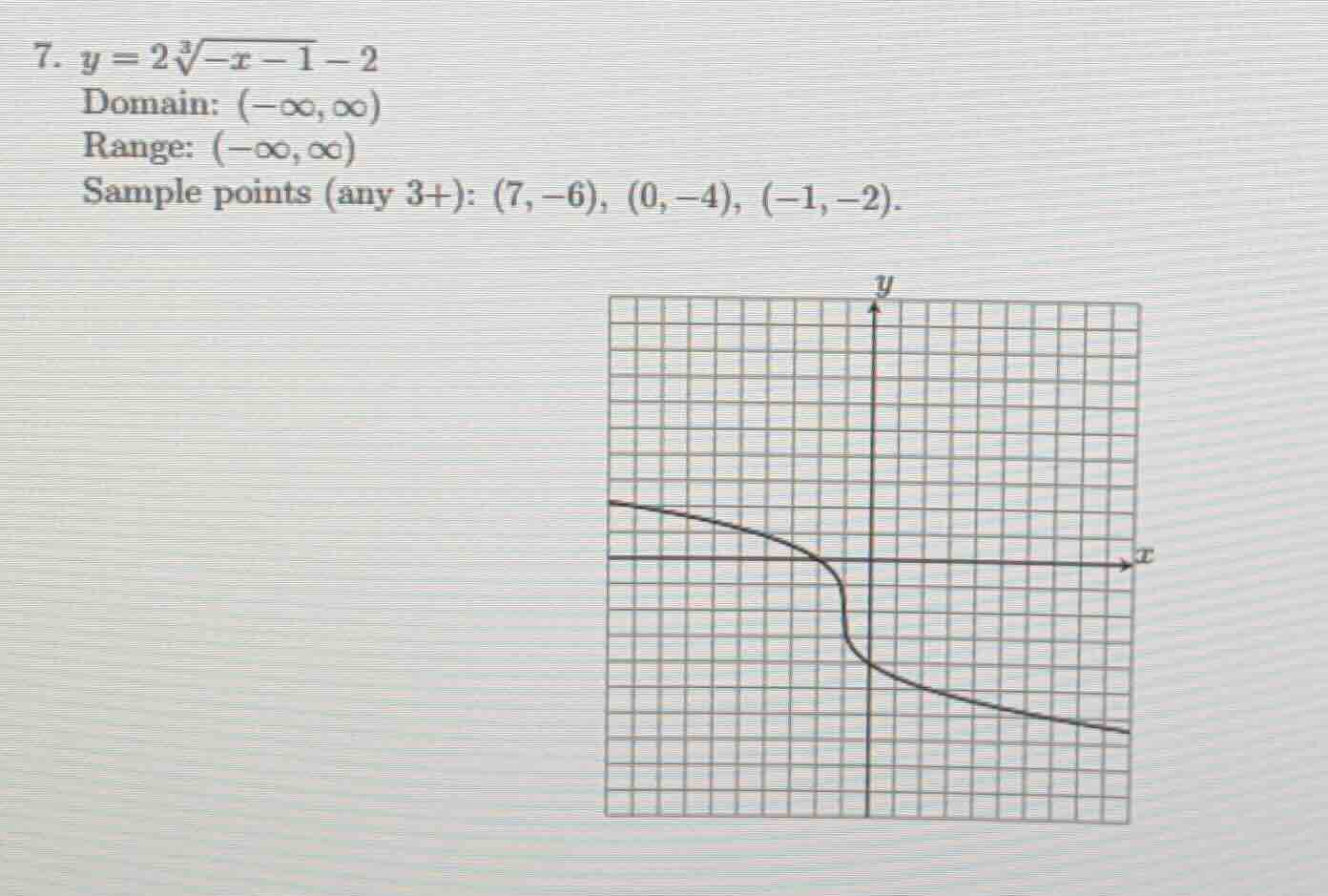
- $y = 2sqrt3{-x - 1} - 2$
domain: $(-infty, infty)$
range: $(-infty, infty)$
sample points (any 3+): $(7, -6)$, $(0, -4)$, $(-1, -2)$.
graph of the function on a coordinate grid
Step1: Analyze the cube root function
The function is \( y = 2\sqrt[3]{-x - 1}-2 \). The cube root function \( \sqrt[3]{u} \) has a domain of all real numbers (\( u\in\mathbb{R} \)) because we can take the cube root of any real number (positive, negative, or zero). Here, the expression inside the cube root is \( -x - 1 \), which is a linear expression in \( x \). For any real number \( x \), \( -x - 1 \) will be a real number. So, the domain of the function is all real numbers, i.e., \( (-\infty, \infty) \).
Step2: Analyze the range of the cube root function
The cube root function \( \sqrt[3]{u} \) has a range of all real numbers (\( \sqrt[3]{u}\in\mathbb{R} \)) because as \( u \) takes all real values (from \( -\infty \) to \( \infty \)), \( \sqrt[3]{u} \) also takes all real values. When we multiply \( \sqrt[3]{-x - 1} \) by 2, we are just stretching the function vertically, but the range still remains all real numbers (since multiplying a real number by 2 gives a real number, and all real numbers are still covered). Then, subtracting 2 from \( 2\sqrt[3]{-x - 1} \) is a vertical shift, which also does not restrict the range to anything less than all real numbers. So, the range of the function is all real numbers, i.e., \( (-\infty, \infty) \).
Step3: Verify sample points
- For the point \( (7, -6) \): Substitute \( x = 7 \) into the function. \( y = 2\sqrt[3]{-7 - 1}-2 = 2\sqrt[3]{-8}-2 \). Since \( \sqrt[3]{-8} = -2 \), then \( y = 2(-2)-2 = -4 - 2 = -6 \). So, this point is on the graph.
- For the point \( (0, -4) \): Substitute \( x = 0 \) into the function. \( y = 2\sqrt[3]{-0 - 1}-2 = 2\sqrt[3]{-1}-2 \). Since \( \sqrt[3]{-1} = -1 \), then \( y = 2(-1)-2 = -2 - 2 = -4 \). So, this point is on the graph.
- For the point \( (-1, -2) \): Substitute \( x = -1 \) into the function. \( y = 2\sqrt[3]{-(-1) - 1}-2 = 2\sqrt[3]{1 - 1}-2 = 2\sqrt[3]{0}-2 \). Since \( \sqrt[3]{0} = 0 \), then \( y = 2(0)-2 = -2 \). So, this point is on the graph.

Snap & solve any problem in the app
Get step-by-step solutions on Sovi AI
Photo-based solutions with guided steps
Explore more problems and detailed explanations
The domain is \( (-\infty, \infty) \), the range is \( (-\infty, \infty) \), and the sample points \( (7, -6) \), \( (0, -4) \), \( (-1, -2) \) are verified to lie on the graph of the function \( y = 2\sqrt[3]{-x - 1}-2 \).