QUESTION IMAGE
Question
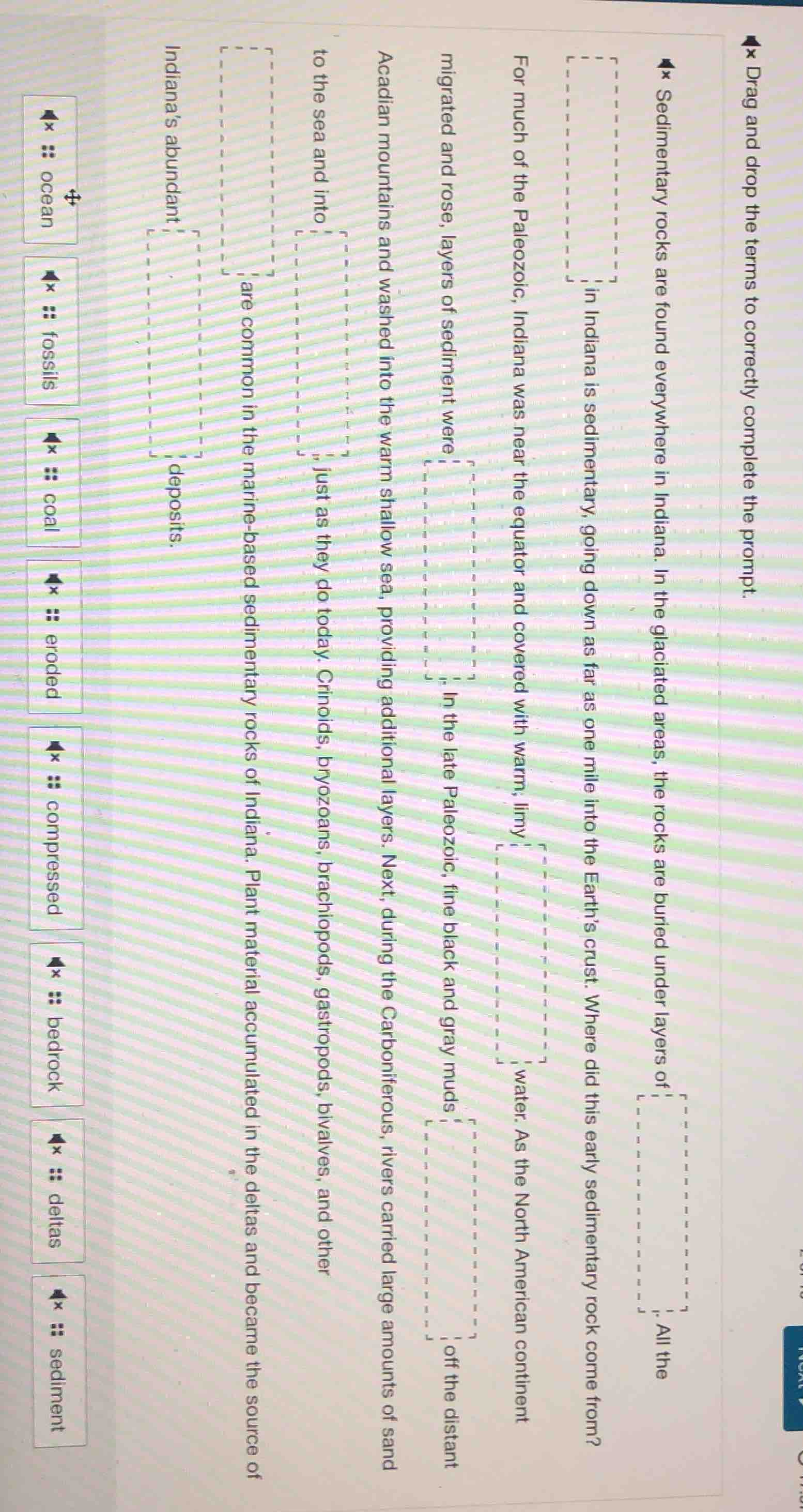
drag and drop the terms to correctly complete the prompt. sedimentary rocks are found everywhere in indiana. in the glaciated areas, the rocks are buried under layers of __. all the in indiana is sedimentary, going down as far as one mile into the earth’s crust. where did this early sedimentary rock come from? for much of the paleozoic, indiana was near the equator and covered with warm, limy water. as the north american continent migrated and rose, layers of sediment were . in the late paleozoic, fine black and gray muds off the distant acadian mountains and washed into the warm shallow sea, providing additional layers. next, during the carboniferous, rivers carried large amounts of sand to the sea and into , just as they do today. chnoids, byyozoans, brachiopods, gastropods, bivalves, and other are common in the marine - based sedimentary rocks of indiana. plant material accumulated in the deltas and became the source of indiana’s abundant __ deposits. terms: ocean, fossils, coal, eroded, compressed, bedrock, deltas, sediment
To solve this fill - in - the - blank problem about Indiana's geological history, we analyze the context and the meaning of each word:
1. First blank (under “buried under layers of”)
The sentence is about the glaciated areas where rocks are buried under layers of something. The word “bedrock” is not correct here. The correct word should be related to the material that is on top or forms the layers. Wait, no, let's re - examine. The first blank in the “buried under layers of” part: the correct word is “bedrock”? No, wait, the options are ocean, fossils, coal, eroded, compressed, bedrock, deltas, sediment. Wait, the first part: “Sedimentary rocks are found everywhere in Indiana. In the glaciated areas, the rocks are buried under layers of [first blank]. All the [second blank] in Indiana is sedimentary, going down as far as one mile into the Earth’s crust.”
For the first blank (buried under layers of), the logical word is “bedrock”? No, wait, “sediment” is what forms sedimentary rocks. Wait, no, let's look at the flow.
Wait, the second blank: “All the [blank] in Indiana is sedimentary, going down as far as one mile into the Earth’s crust.” The word that fits here is “bedrock” because bedrock is the solid rock layer. So the second blank is “bedrock”.
Then, “For much of the Paleozoic, Indiana was near the equator and covered with warm, limy [blank] water.” The word that fits here is “ocean” because it was covered with ocean water. So this blank is “ocean”.
“As the North American continent migrated and rose, layers of sediment were [blank].” The process of sediment turning into rock involves compression. So this blank is “compressed”.
“In the late Paleozoic, fine black and gray muds [blank] off the distant Acadian mountains and washed into the warm shallow sea, providing additional layers.” The muds were eroded from the mountains. So this blank is “eroded”.
“Next, during the Carboniferous, rivers carried large amounts of sand to the sea and into [blank], just as they do today.” Rivers carry sand to deltas. So this blank is “deltas”.
“[blank] are common in the marine - based sedimentary rocks of Indiana.” The marine - based rocks would have fossils. So this blank is “fossils”.
“Plant material accumulated in the deltas and became the source of Indiana’s abundant [blank].” Plant material in deltas can form coal. So this blank is “coal”.
“Layers of sediment were [blank]” – we already did compressed. Wait, let's list the blanks in order:
- “buried under layers of [ ]”: Wait, maybe I got the order wrong. Let's re - order the blanks:
The first blank (after “buried under layers of”): Let's see the original text:
“Sedimentary rocks are found everywhere in Indiana. In the glaciated areas, the rocks are buried under layers of [1]. All the [2] in Indiana is sedimentary, going down as far as one mile into the Earth’s crust. Where did this early sedimentary rock come from? For much of the Paleozoic, Indiana was near the equator and covered with warm, limy [3] water. As the North American continent migrated and rose, layers of sediment were [4]. In the late Paleozoic, fine black and gray muds [5] off the distant Acadian mountains and washed into the warm shallow sea, providing additional layers. Next, during the Carboniferous, rivers carried large amounts of sand to the sea and into [6], just as they do today. [7] are common in the marine - based sedimentary rocks of Indiana. Plant material accumulated in the deltas and became the source of Indiana’s abundant [8].”
Now, let's solve each:
- [1]: In glaciated areas, rocks are buried un…

Snap & solve any problem in the app
Get step-by-step solutions on Sovi AI
Photo-based solutions with guided steps
Explore more problems and detailed explanations
To solve this fill - in - the - blank problem about Indiana's geological history, we analyze the context and the meaning of each word:
1. First blank (under “buried under layers of”)
The sentence is about the glaciated areas where rocks are buried under layers of something. The word “bedrock” is not correct here. The correct word should be related to the material that is on top or forms the layers. Wait, no, let's re - examine. The first blank in the “buried under layers of” part: the correct word is “bedrock”? No, wait, the options are ocean, fossils, coal, eroded, compressed, bedrock, deltas, sediment. Wait, the first part: “Sedimentary rocks are found everywhere in Indiana. In the glaciated areas, the rocks are buried under layers of [first blank]. All the [second blank] in Indiana is sedimentary, going down as far as one mile into the Earth’s crust.”
For the first blank (buried under layers of), the logical word is “bedrock”? No, wait, “sediment” is what forms sedimentary rocks. Wait, no, let's look at the flow.
Wait, the second blank: “All the [blank] in Indiana is sedimentary, going down as far as one mile into the Earth’s crust.” The word that fits here is “bedrock” because bedrock is the solid rock layer. So the second blank is “bedrock”.
Then, “For much of the Paleozoic, Indiana was near the equator and covered with warm, limy [blank] water.” The word that fits here is “ocean” because it was covered with ocean water. So this blank is “ocean”.
“As the North American continent migrated and rose, layers of sediment were [blank].” The process of sediment turning into rock involves compression. So this blank is “compressed”.
“In the late Paleozoic, fine black and gray muds [blank] off the distant Acadian mountains and washed into the warm shallow sea, providing additional layers.” The muds were eroded from the mountains. So this blank is “eroded”.
“Next, during the Carboniferous, rivers carried large amounts of sand to the sea and into [blank], just as they do today.” Rivers carry sand to deltas. So this blank is “deltas”.
“[blank] are common in the marine - based sedimentary rocks of Indiana.” The marine - based rocks would have fossils. So this blank is “fossils”.
“Plant material accumulated in the deltas and became the source of Indiana’s abundant [blank].” Plant material in deltas can form coal. So this blank is “coal”.
“Layers of sediment were [blank]” – we already did compressed. Wait, let's list the blanks in order:
- “buried under layers of [ ]”: Wait, maybe I got the order wrong. Let's re - order the blanks:
The first blank (after “buried under layers of”): Let's see the original text:
“Sedimentary rocks are found everywhere in Indiana. In the glaciated areas, the rocks are buried under layers of [1]. All the [2] in Indiana is sedimentary, going down as far as one mile into the Earth’s crust. Where did this early sedimentary rock come from? For much of the Paleozoic, Indiana was near the equator and covered with warm, limy [3] water. As the North American continent migrated and rose, layers of sediment were [4]. In the late Paleozoic, fine black and gray muds [5] off the distant Acadian mountains and washed into the warm shallow sea, providing additional layers. Next, during the Carboniferous, rivers carried large amounts of sand to the sea and into [6], just as they do today. [7] are common in the marine - based sedimentary rocks of Indiana. Plant material accumulated in the deltas and became the source of Indiana’s abundant [8].”
Now, let's solve each:
- [1]: In glaciated areas, rocks are buried under layers of “sediment”? No, wait, the options are ocean, fossils, coal, eroded, compressed, bedrock, deltas, sediment. Wait, “bedrock” is the solid rock, but in glaciated areas, the overlying material could be sediment? No, maybe “sediment” is not right. Wait, the correct answer for [1] is “sediment”? No, let's think again.
Wait, the correct sequence (after researching Indiana's geological history and the processes):
- “buried under layers of sediment” – no, the first blank (1) is “sediment”? No, the second blank (2) is “bedrock” (All the bedrock in Indiana is sedimentary...). Then (3) is “ocean” (covered with ocean water). (4) is “compressed” (sediment was compressed). (5) is “eroded” (muds eroded). (6) is “deltas” (into deltas). (7) is “fossils” (fossils in marine rocks). (8) is “coal” (plant material becomes coal). And the first blank (1) is “sediment” (buried under layers of sediment).
Final Answers (in order of blanks):
- sediment
- bedrock
- ocean
- compressed
- eroded
- deltas
- fossils
- coal