QUESTION IMAGE
Question
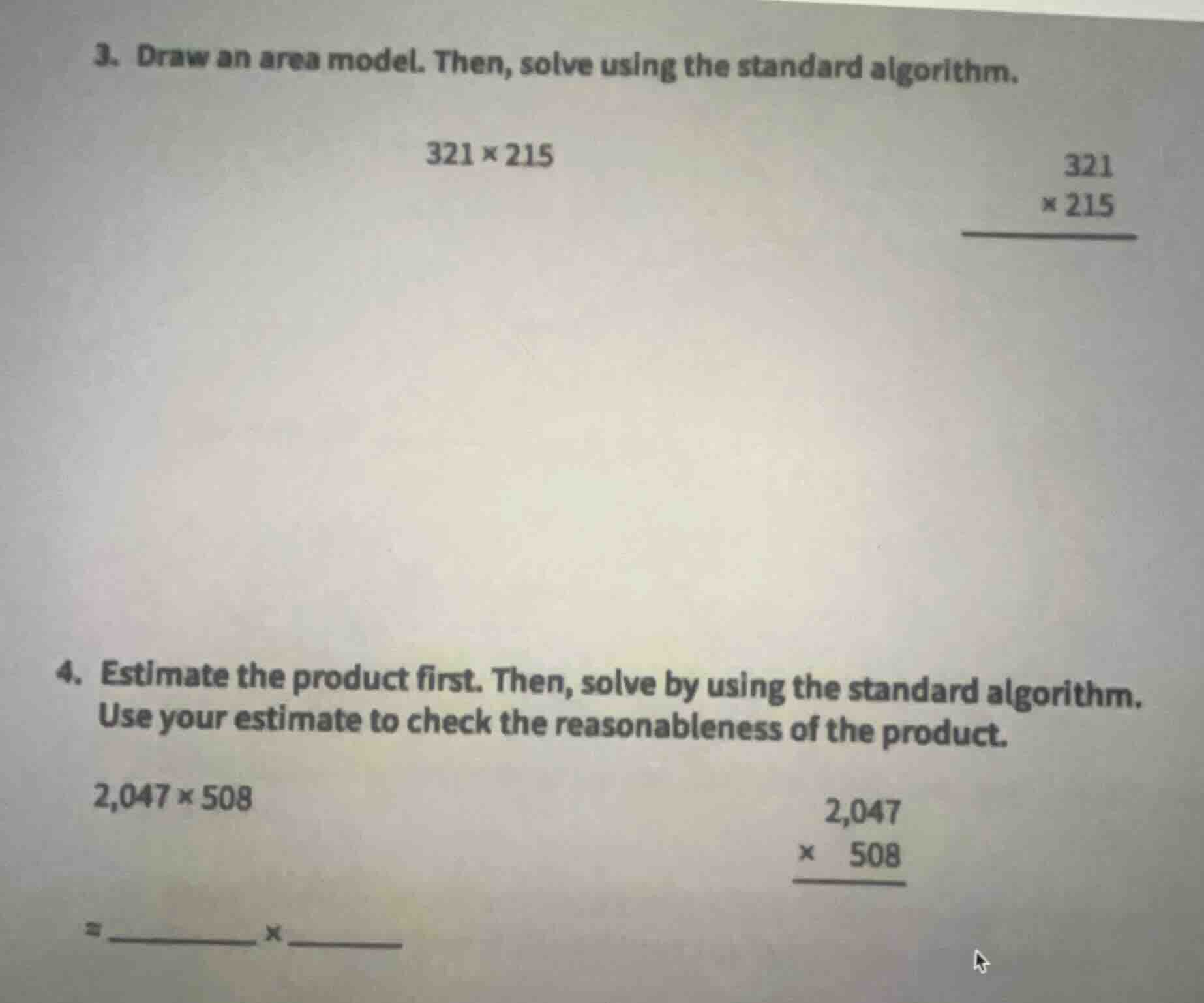
- draw an area model. then, solve using the standard algorithm.
321 × 215
- estimate the product first. then, solve by using the standard algorithm. use your estimate to check the reasonableness of the product.
2,047 × 508
≈ ____ × ____
Problem 3: \( 321 \times 215 \)
Area Model:
We can break down \( 321 \) into \( 300 + 20 + 1 \) and \( 215 \) into \( 200 + 10 + 5 \). Then we create a table to find the products of each combination:
| \( 200 \) | \( 10 \) | \( 5 \) | |
|---|---|---|---|
| \( 20 \) | \( 20 \times 200 = 4000 \) | \( 20 \times 10 = 200 \) | \( 20 \times 5 = 100 \) |
| \( 1 \) | \( 1 \times 200 = 200 \) | \( 1 \times 10 = 10 \) | \( 1 \times 5 = 5 \) |
Now, sum all these products:
\( 60000 + 3000 + 1500 + 4000 + 200 + 100 + 200 + 10 + 5 \)
First, add the thousands and larger: \( 60000 + 3000 = 63000 \); \( 63000 + 1500 = 64500 \); \( 64500 + 4000 = 68500 \); \( 68500 + 200 = 68700 \); \( 68700 + 100 = 68800 \); \( 68800 + 200 = 69000 \); \( 69000 + 10 = 69010 \); \( 69010 + 5 = 69015 \). Wait, no, that's incorrect. Wait, let's do it step by step properly:
\( 60000 + 3000 = 63000 \)
\( 63000 + 1500 = 64500 \)
\( 64500 + 4000 = 68500 \)
\( 68500 + 200 = 68700 \)
\( 68700 + 100 = 68800 \)
\( 68800 + 200 = 69000 \)
\( 69000 + 10 = 69010 \)
\( 69010 + 5 = 69015 \). Wait, that can't be right. Wait, no, the area model for multiplication is \( (a + b + c)(d + e + f) = ad + ae + af + bd + be + bf + cd + ce + cf \). Let's recalculate:
\( 300 \times 200 = 60000 \)
\( 300 \times 10 = 3000 \)
\( 300 \times 5 = 1500 \)
\( 20 \times 200 = 4000 \)
\( 20 \times 10 = 200 \)
\( 20 \times 5 = 100 \)
\( 1 \times 200 = 200 \)
\( 1 \times 10 = 10 \)
\( 1 \times 5 = 5 \)
Now, sum all these:
\( 60000 + 3000 = 63000 \)
\( 63000 + 1500 = 64500 \)
\( 64500 + 4000 = 68500 \)
\( 68500 + 200 = 68700 \)
\( 68700 + 100 = 68800 \)
\( 68800 + 200 = 69000 \)
\( 69000 + 10 = 69010 \)
\( 69010 + 5 = 69015 \). Wait, but let's check with standard algorithm.
Standard Algorithm:
    321
  × 215
  ------
   1605  (321 × 5)
   3210   (321 × 10, shifted one position)
  64200   (321 × 200, shifted two positions)
  ------
  Now, sum them:
   1605
 + 3210
 +64200
 ------
   1605 + 3210 = 4815
   4815 + 64200 = 69015
So the product is \( 69015 \).
Problem 4: \( 2047 \times 508 \)
Estimation:
We can round \( 2047 \) to \( 2000 \) and \( 508 \) to \( 500 \) (or \( 510 \), but \( 2000 \times 500 = 1000000 \) is a simple estimate). So \( 2047 \approx 2000 \) and \( 508 \approx 500 \), so the estimate is \( 2000 \times 500 = 1000000 \).
Standard Algorithm:
    2047
  ×  508
  -------
   16376  (2047 × 8)
    0000   (2047 × 0, shifted one position)
 1023500   (2047 × 500, shifted two positions)
  -------
  Now, sum them:
   16376
 +   0000
 +1023500
 -------
  16376 + 1023500 = 1039876
Now, check the estimate: our estimate was \( 2000 \times 500 = 1000000 \), and the actual product is \( 1039876 \), which is close, so it's reasonable.
Final Answers:
- \( 321 \times 215 = \boldsymbol{69015} \)
- Estimate: \( 2000 \times 500 = 1000000 \); Actual product: \( \boldsymbol{1039876} \)

Snap & solve any problem in the app
Get step-by-step solutions on Sovi AI
Photo-based solutions with guided steps
Explore more problems and detailed explanations
Problem 3: \( 321 \times 215 \)
Area Model:
We can break down \( 321 \) into \( 300 + 20 + 1 \) and \( 215 \) into \( 200 + 10 + 5 \). Then we create a table to find the products of each combination:
| \( 200 \) | \( 10 \) | \( 5 \) | |
|---|---|---|---|
| \( 20 \) | \( 20 \times 200 = 4000 \) | \( 20 \times 10 = 200 \) | \( 20 \times 5 = 100 \) |
| \( 1 \) | \( 1 \times 200 = 200 \) | \( 1 \times 10 = 10 \) | \( 1 \times 5 = 5 \) |
Now, sum all these products:
\( 60000 + 3000 + 1500 + 4000 + 200 + 100 + 200 + 10 + 5 \)
First, add the thousands and larger: \( 60000 + 3000 = 63000 \); \( 63000 + 1500 = 64500 \); \( 64500 + 4000 = 68500 \); \( 68500 + 200 = 68700 \); \( 68700 + 100 = 68800 \); \( 68800 + 200 = 69000 \); \( 69000 + 10 = 69010 \); \( 69010 + 5 = 69015 \). Wait, no, that's incorrect. Wait, let's do it step by step properly:
\( 60000 + 3000 = 63000 \)
\( 63000 + 1500 = 64500 \)
\( 64500 + 4000 = 68500 \)
\( 68500 + 200 = 68700 \)
\( 68700 + 100 = 68800 \)
\( 68800 + 200 = 69000 \)
\( 69000 + 10 = 69010 \)
\( 69010 + 5 = 69015 \). Wait, that can't be right. Wait, no, the area model for multiplication is \( (a + b + c)(d + e + f) = ad + ae + af + bd + be + bf + cd + ce + cf \). Let's recalculate:
\( 300 \times 200 = 60000 \)
\( 300 \times 10 = 3000 \)
\( 300 \times 5 = 1500 \)
\( 20 \times 200 = 4000 \)
\( 20 \times 10 = 200 \)
\( 20 \times 5 = 100 \)
\( 1 \times 200 = 200 \)
\( 1 \times 10 = 10 \)
\( 1 \times 5 = 5 \)
Now, sum all these:
\( 60000 + 3000 = 63000 \)
\( 63000 + 1500 = 64500 \)
\( 64500 + 4000 = 68500 \)
\( 68500 + 200 = 68700 \)
\( 68700 + 100 = 68800 \)
\( 68800 + 200 = 69000 \)
\( 69000 + 10 = 69010 \)
\( 69010 + 5 = 69015 \). Wait, but let's check with standard algorithm.
Standard Algorithm:
    321
  × 215
  ------
   1605  (321 × 5)
   3210   (321 × 10, shifted one position)
  64200   (321 × 200, shifted two positions)
  ------
  Now, sum them:
   1605
 + 3210
 +64200
 ------
   1605 + 3210 = 4815
   4815 + 64200 = 69015
So the product is \( 69015 \).
Problem 4: \( 2047 \times 508 \)
Estimation:
We can round \( 2047 \) to \( 2000 \) and \( 508 \) to \( 500 \) (or \( 510 \), but \( 2000 \times 500 = 1000000 \) is a simple estimate). So \( 2047 \approx 2000 \) and \( 508 \approx 500 \), so the estimate is \( 2000 \times 500 = 1000000 \).
Standard Algorithm:
    2047
  ×  508
  -------
   16376  (2047 × 8)
    0000   (2047 × 0, shifted one position)
 1023500   (2047 × 500, shifted two positions)
  -------
  Now, sum them:
   16376
 +   0000
 +1023500
 -------
  16376 + 1023500 = 1039876
Now, check the estimate: our estimate was \( 2000 \times 500 = 1000000 \), and the actual product is \( 1039876 \), which is close, so it's reasonable.
Final Answers:
- \( 321 \times 215 = \boldsymbol{69015} \)
- Estimate: \( 2000 \times 500 = 1000000 \); Actual product: \( \boldsymbol{1039876} \)