QUESTION IMAGE
Question
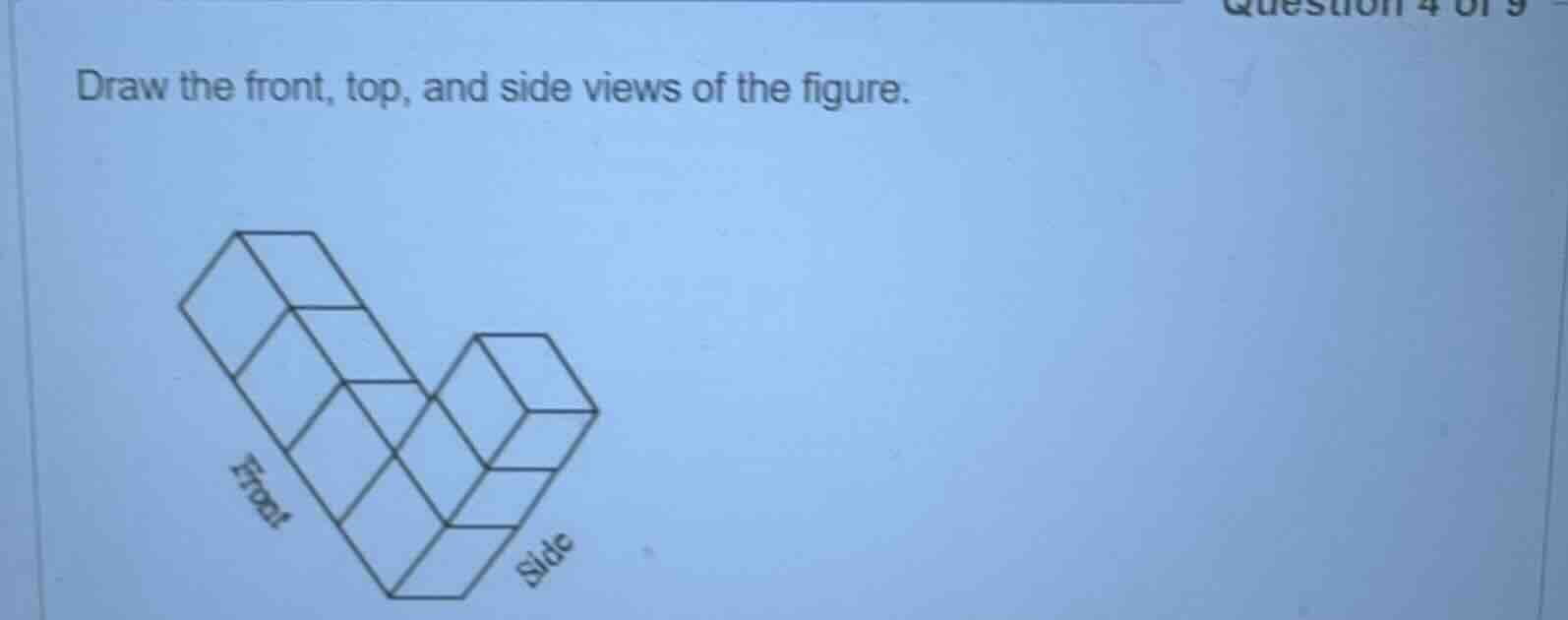
draw the front, top, and side views of the figure.
Step1: Analyze Front View
The front view looks at the figure from the direction labeled "Front". Count the number of cubes in each column. From left to right, the columns have 4, 3, and 2 cubes (or as per the stacking). So the front view will have three columns with heights 4, 3, 2 (or adjusted based on perspective, but typically, when looking front, we see the layers). Wait, actually, looking at the figure, the front - facing part: let's visualize. The leftmost part has a vertical stack of 4 cubes? Wait, no, the figure is made of cubes connected. Let's re - examine: the main structure on the left has a sort of diagonal (but in 3D, front view is 2D projection). Let's consider the front view: when we look from the front, we see the number of cubes in each vertical column. Let's assume the front view has two main parts? Wait, maybe a better approach: the front view (also called the front elevation) shows the number of cubes in each column as seen from the front. Let's say the front view has three columns: the left column has 4 cubes (stacked vertically), the middle column has 3, and the right column has 2? Wait, no, maybe the front view is a 2D shape where we see the number of squares in each row. Wait, perhaps the front view is: when looking from the front, we see a shape with three columns. The left column has 4 squares (stacked), the middle column has 3, and the right column has 2. But maybe I'm overcomplicating. Alternatively, the front view: the figure, when viewed from the front, has a sort of stepped shape. Let's draw it as a set of squares. The front view will have, for example, in the first (left) column, 4 squares (top to bottom), middle column 3, right column 2.
Step2: Analyze Top View
The top view is looking from above. So we see the arrangement of cubes in the horizontal plane. The top view will show the number of cubes in each row (horizontal). From the figure, the top view: the left - most part has a single cube (in the top - most layer), then a row with two cubes, etc. Wait, maybe the top view is a shape with a sort of L - like or other shape. Let's think: when looking from the top, the cubes are arranged such that we see the number of cubes in each horizontal position. Let's say the top view has three rows. The first row (front - most in top view) has 1 cube, the second row has 2, the third row has 3? No, maybe better to visualize the 3D figure. The figure is made of cubes connected in a way that when viewed from the top, we see the projection of the cubes onto the horizontal plane. Let's assume the top view has a shape with, for example, a column of 4 cubes (but in top view, it's a single square for each cube in the top layer? No, top view is the plan view, showing the number of cubes in each x - y position (horizontal). So if we have cubes stacked vertically, in top view, each vertical stack is represented by a single square (the top - most cube of the stack). Wait, no: top view shows the number of cubes in each horizontal (x - y) cell. So if there are multiple cubes stacked vertically in a cell, in top view, we just see one square (representing that cell has cubes). So for the given figure, the top view: let's see the horizontal arrangement. The left - most part has a cell with a cube, then adjacent cells. Maybe the top view is a shape with a row of 4 cubes (but no, in 3D, the top view is the projection from above. Let's try to sketch mentally: the figure has a main part on the left with a diagonal (but in top view, it's a horizontal/vertical arrangement). Let's say the top view has three columns: left column…

Snap & solve any problem in the app
Get step-by-step solutions on Sovi AI
Photo-based solutions with guided steps
Explore more problems and detailed explanations
To draw the views:
Front View:
Draw three vertical columns of squares. The left column has 4 squares, the middle column has 3 squares, and the right column has 2 squares (stacked vertically).
Top View:
Draw a horizontal arrangement (or a shape) that represents the top - down projection. For example, a single row (or a stepped row) with 4 squares (adjusted based on the actual 3D layout, but generally, it shows the horizontal placement of the cubes' top - most faces).
Side View:
Draw two (or more) vertical columns of squares. For example, one column with 3 squares and one column with 2 squares (stacked vertically) to represent the side - facing cubes.
(Note: Since this is a text - based answer, the actual drawing would be done on paper with squares representing cubes in the respective views. The key is to project the 3D cube - based figure onto 2D planes for front, top, and side views, showing the number of cubes in each column/row for each view.)