QUESTION IMAGE
Question
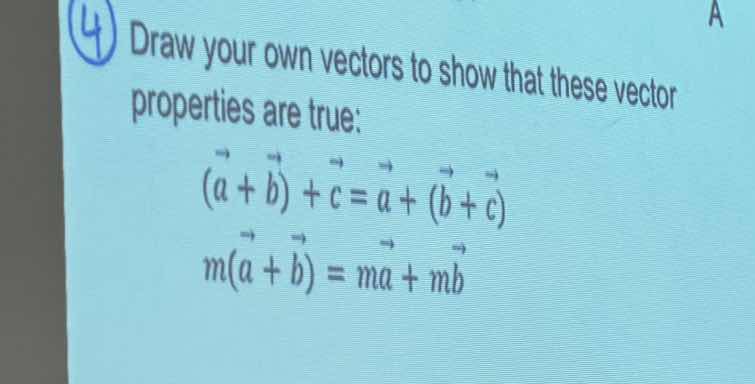
4 draw your own vectors to show that these vector properties are true: \\((\vec{a} + \vec{b}) + \vec{c} = \vec{a} + (\vec{b} + \vec{c})\\) \\(m(\vec{a} + \vec{b}) = m\vec{a} + m\vec{b}\\)
Response
Part 1: Associative Property of Vector Addition \((\vec{a}+\vec{b})+\vec{c}=\vec{a}+(\vec{b}+\vec{c})\)
Step 1: Represent \(\vec{a}\), \(\vec{b}\), and \(\vec{c}\)
- Draw vector \(\vec{a}\) as an arrow from point \(O\) to point \(A\) (so \(\vec{a}=\overrightarrow{OA}\)).
- Draw vector \(\vec{b}\) as an arrow from point \(A\) to point \(B\) (so \(\vec{b}=\overrightarrow{AB}\)).
- By the triangle law of vector addition, \(\vec{a}+\vec{b}=\overrightarrow{OA}+\overrightarrow{AB}=\overrightarrow{OB}\).
Step 2: Add \(\vec{c}\) to \((\vec{a}+\vec{b})\)
- Draw vector \(\vec{c}\) as an arrow from point \(B\) to point \(C\) (so \(\vec{c}=\overrightarrow{BC}\)).
- Then \((\vec{a}+\vec{b})+\vec{c}=\overrightarrow{OB}+\overrightarrow{BC}=\overrightarrow{OC}\).
Step 3: Represent \(\vec{b}+\vec{c}\) first
- Alternatively, start with \(\vec{b}\) (from \(O\) to \(B_1\)) and \(\vec{c}\) (from \(B_1\) to \(C_1\)), so \(\vec{b}+\vec{c}=\overrightarrow{OB_1}+\overrightarrow{B_1C_1}=\overrightarrow{OC_1}\).
- Now add \(\vec{a}\) to \(\vec{b}+\vec{c}\): draw \(\vec{a}\) from \(O\) to \(A_1\), then \(\vec{a}+(\vec{b}+\vec{c})=\overrightarrow{OA_1}+\overrightarrow{A_1C_1}=\overrightarrow{OC_1}\) (by triangle law).
Step 4: Compare the Results
- In both cases, the resultant vector is from the origin \(O\) to the final point \(C\) (or \(C_1\), which coincides with \(C\) when vectors are translated). Thus, \((\vec{a}+\vec{b})+\vec{c}\) and \(\vec{a}+(\vec{b}+\vec{c})\) have the same magnitude and direction, proving the associative property.
Part 2: Distributive Property of Scalar Multiplication \(m(\vec{a}+\vec{b}) = m\vec{a}+m\vec{b}\) (for a scalar \(m>0\))
Step 1: Represent \(\vec{a}\) and \(\vec{b}\)
- Draw vector \(\vec{a}\) from \(O\) to \(A\) (\(\vec{a}=\overrightarrow{OA}\)) and vector \(\vec{b}\) from \(O\) to \(B\) (\(\vec{b}=\overrightarrow{OB}\)).
- By the parallelogram law, \(\vec{a}+\vec{b}\) is the diagonal of the parallelogram \(OACB\), so \(\vec{a}+\vec{b}=\overrightarrow{OC}\) (where \(C\) is the opposite vertex of \(O\) in the parallelogram).
Step 2: Scale \(\vec{a}+\vec{b}\) by \(m\)
- Multiply \(\vec{a}+\vec{b}\) by scalar \(m\): the vector \(m(\vec{a}+\vec{b})\) has magnitude \(m\) times the magnitude of \(\vec{a}+\vec{b}\) and the same direction. So \(m(\vec{a}+\vec{b})=\overrightarrow{OC'}\), where \(OC' = m \cdot OC\) and \(C'\) lies on the line \(OC\).
Step 3: Scale \(\vec{a}\) and \(\vec{b}\) by \(m\)
- Multiply \(\vec{a}\) by \(m\): \(m\vec{a}\) is a vector from \(O\) to \(A'\) where \(OA' = m \cdot OA\) and \(A'\) is on \(OA\) (if \(m>0\)).
- Multiply \(\vec{b}\) by \(m\): \(m\vec{b}\) is a vector from \(O\) to \(B'\) where \(OB' = m \cdot OB\) and \(B'\) is on \(OB\).
- By the parallelogram law, \(m\vec{a}+m\vec{b}\) is the diagonal of the parallelogram \(OA'C'B'\), so \(m\vec{a}+m\vec{b}=\overrightarrow{OC'}\) (since \(OA'C'B'\) is similar to \(OACB\), and the diagonal scales by \(m\)).
Step 4: Compare the Results
- The vector \(m(\vec{a}+\vec{b})\) and \(m\vec{a}+m\vec{b}\) both equal \(\overrightarrow{OC'}\), so \(m(\vec{a}+\vec{b}) = m\vec{a}+m\vec{b}\).
Visual Summary (Textual Description of Drawings)
- Associative Addition: Two different paths to add three vectors (\(\vec{a}\to\vec{b}\to\vec{c}\) vs. \(\vec{b}\to\vec{c}\to\vec{a}\)) result in the same final vector.
- Distributive Multiplication: Scaling the sum of two vectors is the same as summing their scaled versions.
(Note: For actual drawings, use graph paper or a coordinate system. Label all vectors and…

Snap & solve any problem in the app
Get step-by-step solutions on Sovi AI
Photo-based solutions with guided steps
Explore more problems and detailed explanations
Part 1: Associative Property of Vector Addition \((\vec{a}+\vec{b})+\vec{c}=\vec{a}+(\vec{b}+\vec{c})\)
Step 1: Represent \(\vec{a}\), \(\vec{b}\), and \(\vec{c}\)
- Draw vector \(\vec{a}\) as an arrow from point \(O\) to point \(A\) (so \(\vec{a}=\overrightarrow{OA}\)).
- Draw vector \(\vec{b}\) as an arrow from point \(A\) to point \(B\) (so \(\vec{b}=\overrightarrow{AB}\)).
- By the triangle law of vector addition, \(\vec{a}+\vec{b}=\overrightarrow{OA}+\overrightarrow{AB}=\overrightarrow{OB}\).
Step 2: Add \(\vec{c}\) to \((\vec{a}+\vec{b})\)
- Draw vector \(\vec{c}\) as an arrow from point \(B\) to point \(C\) (so \(\vec{c}=\overrightarrow{BC}\)).
- Then \((\vec{a}+\vec{b})+\vec{c}=\overrightarrow{OB}+\overrightarrow{BC}=\overrightarrow{OC}\).
Step 3: Represent \(\vec{b}+\vec{c}\) first
- Alternatively, start with \(\vec{b}\) (from \(O\) to \(B_1\)) and \(\vec{c}\) (from \(B_1\) to \(C_1\)), so \(\vec{b}+\vec{c}=\overrightarrow{OB_1}+\overrightarrow{B_1C_1}=\overrightarrow{OC_1}\).
- Now add \(\vec{a}\) to \(\vec{b}+\vec{c}\): draw \(\vec{a}\) from \(O\) to \(A_1\), then \(\vec{a}+(\vec{b}+\vec{c})=\overrightarrow{OA_1}+\overrightarrow{A_1C_1}=\overrightarrow{OC_1}\) (by triangle law).
Step 4: Compare the Results
- In both cases, the resultant vector is from the origin \(O\) to the final point \(C\) (or \(C_1\), which coincides with \(C\) when vectors are translated). Thus, \((\vec{a}+\vec{b})+\vec{c}\) and \(\vec{a}+(\vec{b}+\vec{c})\) have the same magnitude and direction, proving the associative property.
Part 2: Distributive Property of Scalar Multiplication \(m(\vec{a}+\vec{b}) = m\vec{a}+m\vec{b}\) (for a scalar \(m>0\))
Step 1: Represent \(\vec{a}\) and \(\vec{b}\)
- Draw vector \(\vec{a}\) from \(O\) to \(A\) (\(\vec{a}=\overrightarrow{OA}\)) and vector \(\vec{b}\) from \(O\) to \(B\) (\(\vec{b}=\overrightarrow{OB}\)).
- By the parallelogram law, \(\vec{a}+\vec{b}\) is the diagonal of the parallelogram \(OACB\), so \(\vec{a}+\vec{b}=\overrightarrow{OC}\) (where \(C\) is the opposite vertex of \(O\) in the parallelogram).
Step 2: Scale \(\vec{a}+\vec{b}\) by \(m\)
- Multiply \(\vec{a}+\vec{b}\) by scalar \(m\): the vector \(m(\vec{a}+\vec{b})\) has magnitude \(m\) times the magnitude of \(\vec{a}+\vec{b}\) and the same direction. So \(m(\vec{a}+\vec{b})=\overrightarrow{OC'}\), where \(OC' = m \cdot OC\) and \(C'\) lies on the line \(OC\).
Step 3: Scale \(\vec{a}\) and \(\vec{b}\) by \(m\)
- Multiply \(\vec{a}\) by \(m\): \(m\vec{a}\) is a vector from \(O\) to \(A'\) where \(OA' = m \cdot OA\) and \(A'\) is on \(OA\) (if \(m>0\)).
- Multiply \(\vec{b}\) by \(m\): \(m\vec{b}\) is a vector from \(O\) to \(B'\) where \(OB' = m \cdot OB\) and \(B'\) is on \(OB\).
- By the parallelogram law, \(m\vec{a}+m\vec{b}\) is the diagonal of the parallelogram \(OA'C'B'\), so \(m\vec{a}+m\vec{b}=\overrightarrow{OC'}\) (since \(OA'C'B'\) is similar to \(OACB\), and the diagonal scales by \(m\)).
Step 4: Compare the Results
- The vector \(m(\vec{a}+\vec{b})\) and \(m\vec{a}+m\vec{b}\) both equal \(\overrightarrow{OC'}\), so \(m(\vec{a}+\vec{b}) = m\vec{a}+m\vec{b}\).
Visual Summary (Textual Description of Drawings)
- Associative Addition: Two different paths to add three vectors (\(\vec{a}\to\vec{b}\to\vec{c}\) vs. \(\vec{b}\to\vec{c}\to\vec{a}\)) result in the same final vector.
- Distributive Multiplication: Scaling the sum of two vectors is the same as summing their scaled versions.
(Note: For actual drawings, use graph paper or a coordinate system. Label all vectors and points clearly. The key is to show that the resultant vectors for both sides of the equations are identical in magnitude and direction.)