QUESTION IMAGE
Question
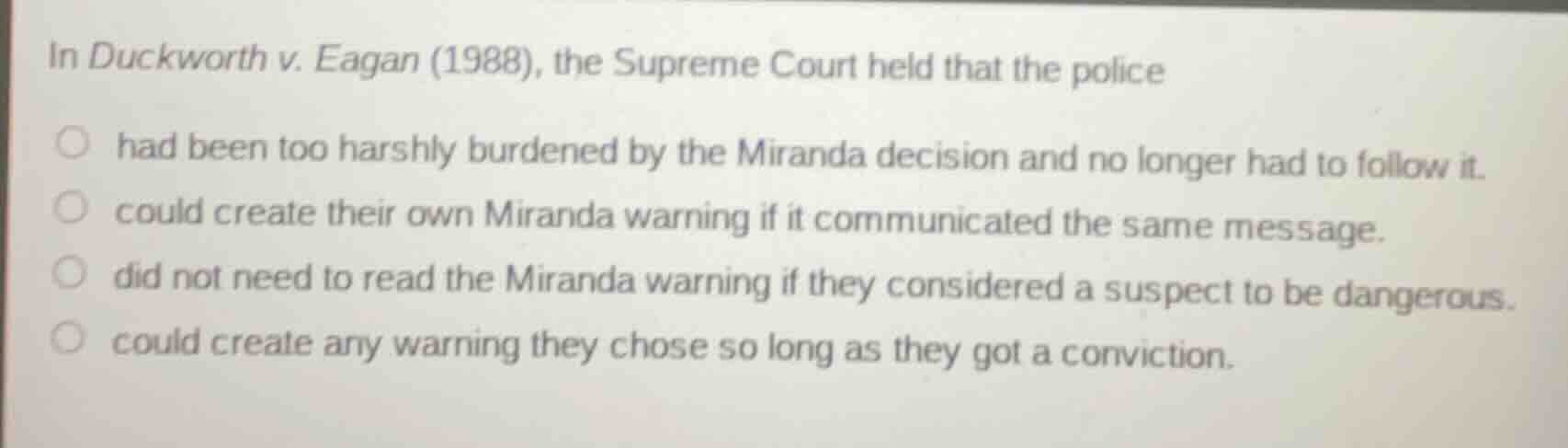
in duckworth v. eagan (1988), the supreme court held that the police
had been too harshly burdened by the miranda decision and no longer had to follow it.
could create their own miranda warning if it communicated the same message.
did not need to read the miranda warning if they considered a suspect to be dangerous.
could create any warning they chose so long as they got a conviction.
Duckworth v. Eagan (1988) centered on the flexibility of Miranda warnings. The Supreme Court ruled that law enforcement does not have to use an exact, standardized Miranda warning, as long as the core information (right to silence, right to an attorney, including court-appointed counsel if indigent) is clearly communicated to the suspect. The other options are incorrect: the Court did not abandon Miranda, did not exempt dangerous suspects from warnings, and did not allow unregulated warnings solely for convictions.

Snap & solve any problem in the app
Get step-by-step solutions on Sovi AI
Photo-based solutions with guided steps
Explore more problems and detailed explanations
could create their own Miranda warning if it communicated the same message.