QUESTION IMAGE
Question
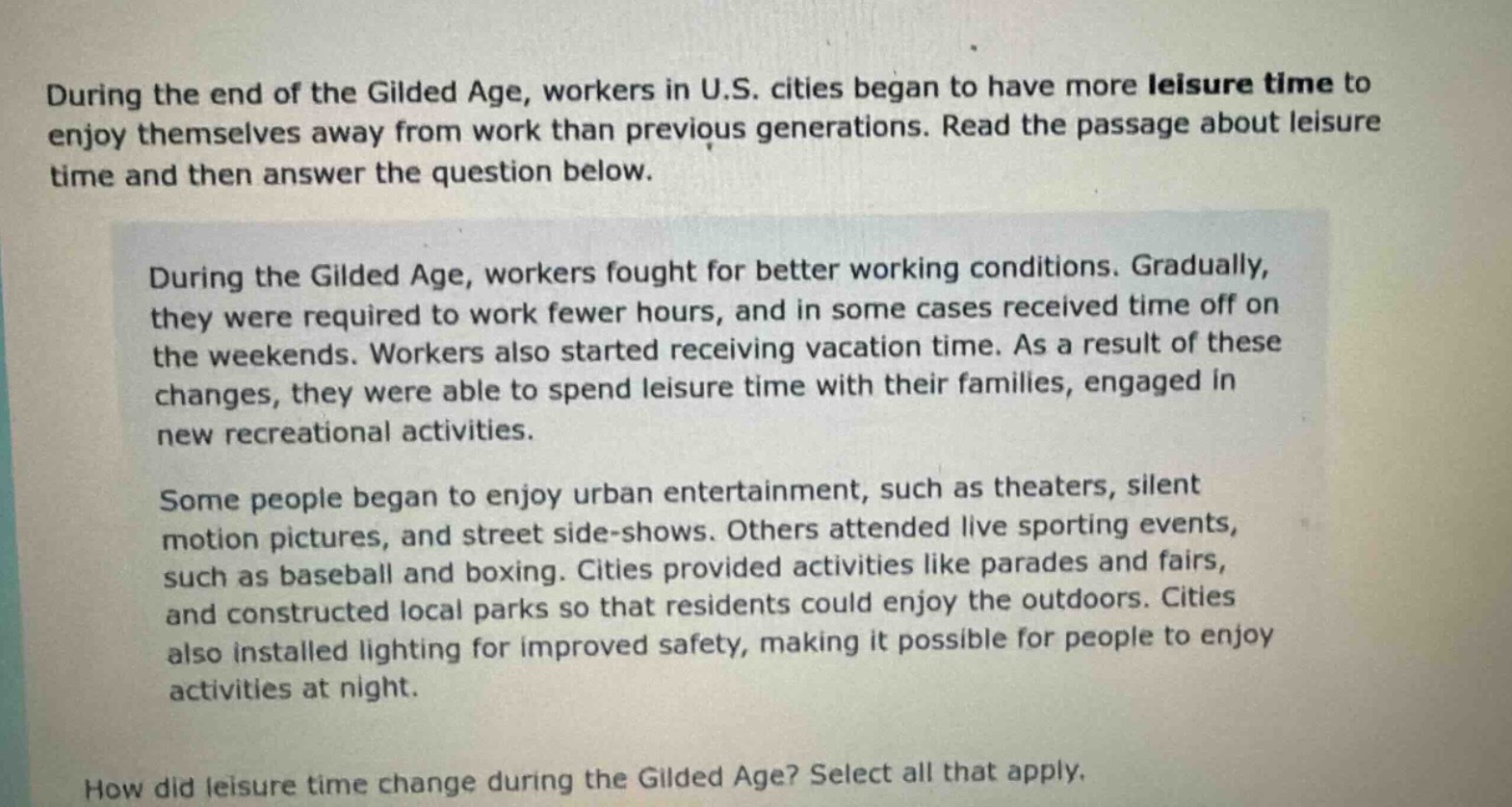
during the end of the gilded age, workers in u.s. cities began to have more leisure time to enjoy themselves away from work than previous generations. read the passage about leisure time and then answer the question below.
during the gilded age, workers fought for better working conditions. gradually, they were required to work fewer hours, and in some cases received time off on the weekends. workers also started receiving vacation time. as a result of these changes, they were able to spend leisure time with their families, engaged in new recreational activities.
some people began to enjoy urban entertainment, such as theaters, silent motion pictures, and street side - shows. others attended live sporting events, such as baseball and boxing. cities provided activities like parades and fairs, and constructed local parks so that residents could enjoy the outdoors. cities also installed lighting for improved safety, making it possible for people to enjoy activities at night.
how did leisure time change during the gilded age? select all that apply.
Since the specific options for the multiple - choice question are not provided, we can analyze the changes in leisure time during the Gilded Age based on the passage:
- From the passage, we know that workers gradually worked fewer hours and in some cases got weekends off and vacation time. This meant they had more time for leisure.
- New recreational activities emerged. For example, people started enjoying urban entertainment like theaters, silent motion pictures, and street side - shows. They also attended live sporting events such as baseball and boxing.
- Cities provided more opportunities for leisure. Cities organized activities like parades and fairs, built local parks for residents to enjoy the outdoors, and installed lighting to enable people to participate in activities at night.
If we assume the common options (which are usually derived from the above - mentioned points) for this question, the correct options would be related to:
- Workers had more time for leisure (due to fewer working hours, weekends off, vacation time).
- New recreational activities became available (urban entertainment, sporting events).
- Cities offered more leisure - related facilities and activities (parks, parades, fairs, night - time activity support through lighting).
Since the original question is a "select all that apply" type and the options are not given, we can't provide the final answer in the required multiple - choice format. But the above analysis shows the key aspects of how leisure time changed during the Gilded Age.

Snap & solve any problem in the app
Get step-by-step solutions on Sovi AI
Photo-based solutions with guided steps
Explore more problems and detailed explanations
- From the passage, we know that workers gradually worked fewer hours and in some cases got weekends off and vacation time. This meant they had more time for leisure.
- New recreational activities emerged. For example, people started enjoying urban entertainment like theaters, silent motion pictures, and street side - shows. They also attended live sporting events such as baseball and boxing.
- Cities provided more opportunities for leisure. Cities organized activities like parades and fairs, built local parks for residents to enjoy the outdoors, and installed lighting to enable people to participate in activities at night.
If we assume the common options (which are usually derived from the above - mentioned points) for this question, the correct options would be related to:
- Workers had more time for leisure (due to fewer working hours, weekends off, vacation time).
- New recreational activities became available (urban entertainment, sporting events).
- Cities offered more leisure - related facilities and activities (parks, parades, fairs, night - time activity support through lighting).
Since the original question is a "select all that apply" type and the options are not given, we can't provide the final answer in the required multiple - choice format. But the above analysis shows the key aspects of how leisure time changed during the Gilded Age.