QUESTION IMAGE
Question
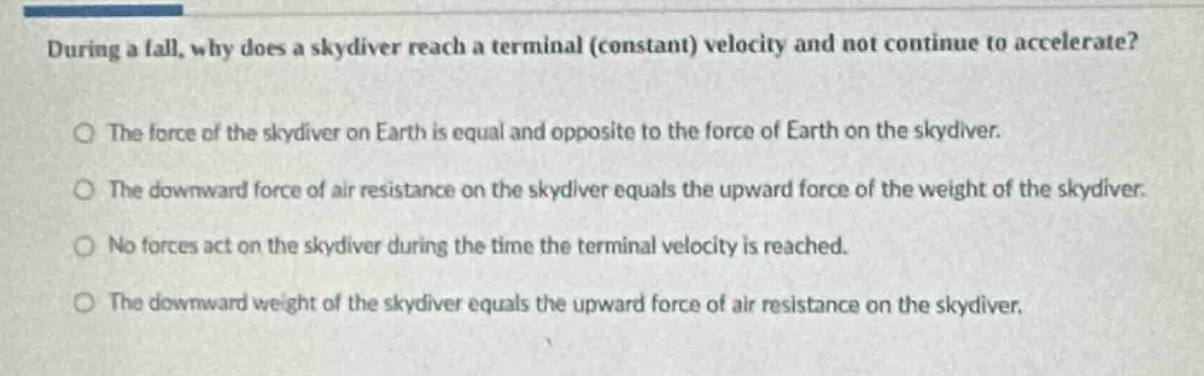
during a fall, why does a skydiver reach a terminal (constant) velocity and not continue to accelerate?
the force of the skydiver on earth is equal and opposite to the force of earth on the skydiver.
the downward force of air resistance on the skydiver equals the upward force of the weight of the skydiver.
no forces act on the skydiver during the time the terminal velocity is reached.
the downward weight of the skydiver equals the upward force of air resistance on the skydiver.
Terminal velocity occurs when the net force on a falling object is zero, so acceleration stops. A skydiver's downward force is their weight, and the upward opposing force is air resistance. When these two forces are equal in magnitude and opposite in direction, net force is zero, and velocity becomes constant.
- The first option describes Newton's third law, which applies to forces between two objects but does not explain terminal velocity.
- The second option reverses the direction of the forces (air resistance acts upward, weight acts downward).
- The third option is incorrect, as forces do act on the skydiver at terminal velocity.

Snap & solve any problem in the app
Get step-by-step solutions on Sovi AI
Photo-based solutions with guided steps
Explore more problems and detailed explanations
The downward weight of the skydiver equals the upward force of air resistance on the skydiver.