QUESTION IMAGE
Question
during the gilded age, industrialization created new, higher - paying jobs that helped to expand the middle class. this class consisted of people who were neither wealthy nor impoverished.
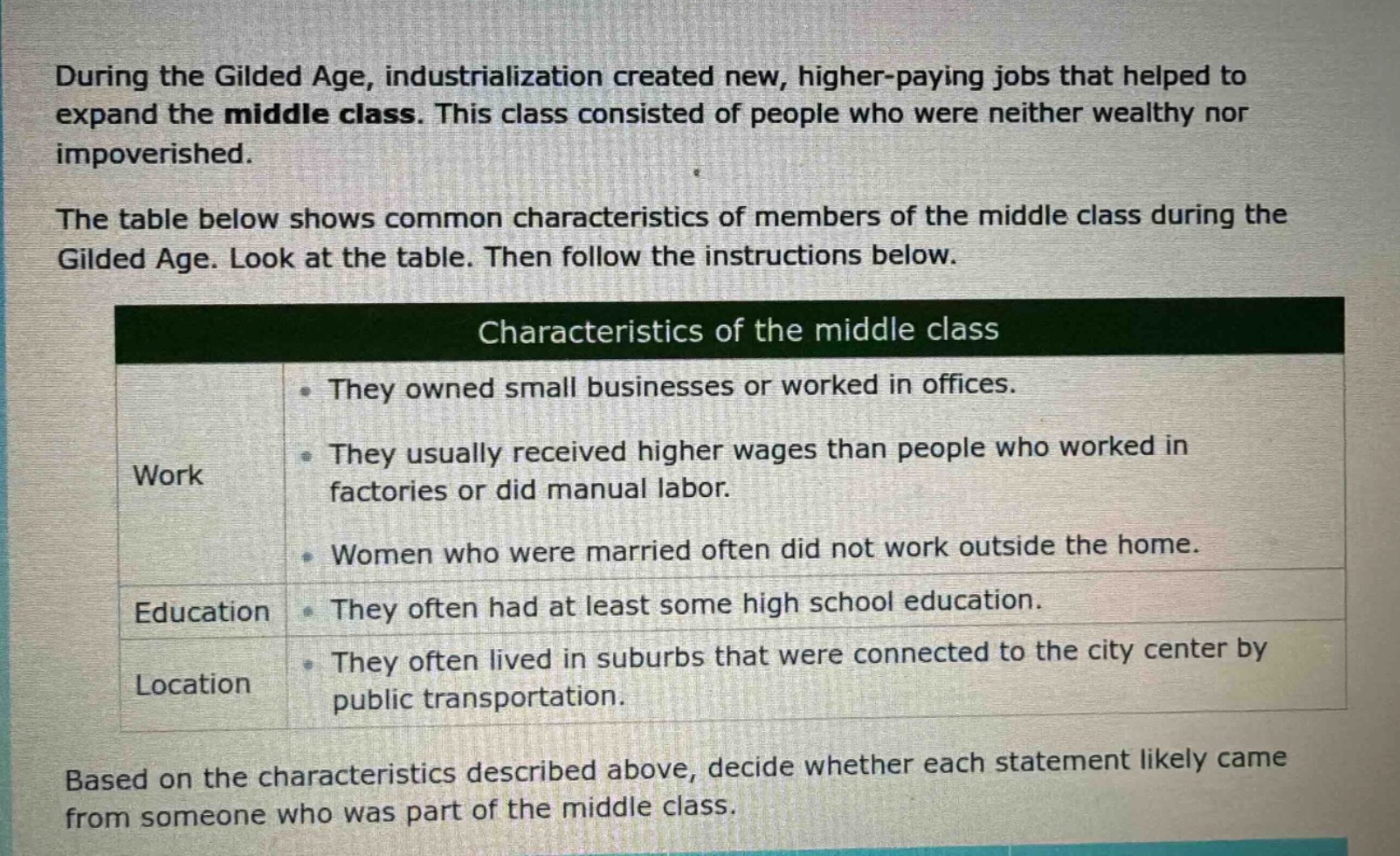
the table below shows common characteristics of members of the middle class during the gilded age. look at the table. then follow the instructions below.
characteristics of the middle class
work - they owned small businesses or worked in offices. - they usually received higher wages than people who worked in factories or did manual labor. - women who were married often did not work outside the home.
education - they often had at least some high school education.
location - they often lived in suburbs that were connected to the city center by public transportation.
based on the characteristics described above, decide whether each statement likely came from someone who was part of the middle class.
Since the specific statements to evaluate are not provided, we can't proceed with the analysis. However, here's how you would approach it once the statements are given:
For each statement:
- Compare with "Work" characteristics: Check if the statement's details about employment (type of job, wages, women's work status) match the middle - class work traits (own small business/office job, higher wages than factory/manual labor, married women not working outside home).
- Compare with "Education" characteristics: See if the educational claim aligns with having at least some high - school education.
- Compare with "Location" characteristics: Verify if the location - related statement matches living in suburbs connected to the city by public transport.
For example, if a statement was "I own a small tailor shop and take the train to my shop from the suburbs", you would:
- For work: Owning a small business (tailor shop) matches the "own small businesses" trait.
- For location: Taking the train from suburbs to the city (where the shop is likely) matches the "lived in suburbs connected to city by public transport" trait. So this statement would likely come from a middle - class person.
If you provide the specific statements, we can analyze each one in detail.

Snap & solve any problem in the app
Get step-by-step solutions on Sovi AI
Photo-based solutions with guided steps
Explore more problems and detailed explanations
Since the specific statements to evaluate are not provided, we can't proceed with the analysis. However, here's how you would approach it once the statements are given:
For each statement:
- Compare with "Work" characteristics: Check if the statement's details about employment (type of job, wages, women's work status) match the middle - class work traits (own small business/office job, higher wages than factory/manual labor, married women not working outside home).
- Compare with "Education" characteristics: See if the educational claim aligns with having at least some high - school education.
- Compare with "Location" characteristics: Verify if the location - related statement matches living in suburbs connected to the city by public transport.
For example, if a statement was "I own a small tailor shop and take the train to my shop from the suburbs", you would:
- For work: Owning a small business (tailor shop) matches the "own small businesses" trait.
- For location: Taking the train from suburbs to the city (where the shop is likely) matches the "lived in suburbs connected to city by public transport" trait. So this statement would likely come from a middle - class person.
If you provide the specific statements, we can analyze each one in detail.