QUESTION IMAGE
Question
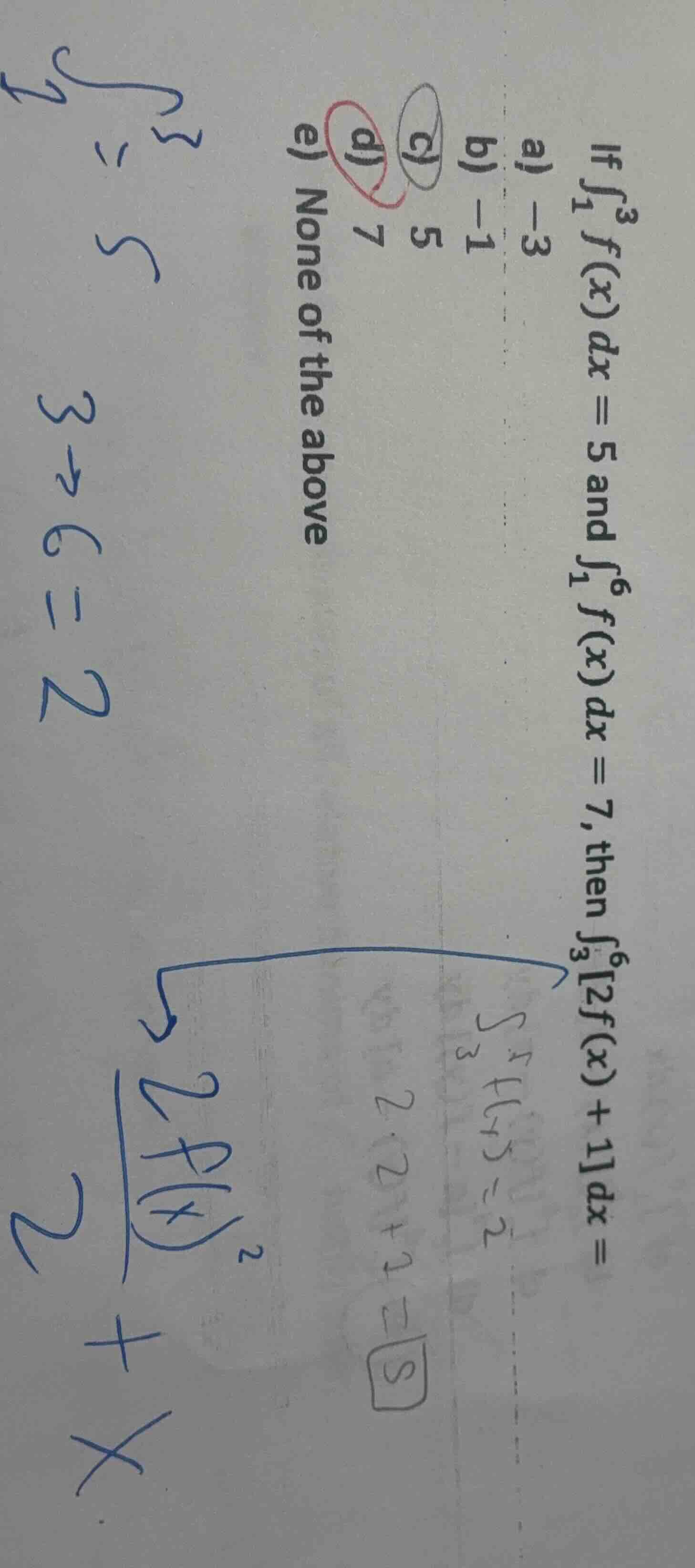
if \\(\int_{1}^{3} f(x) dx = 5\\) and \\(\int_{1}^{6} f(x) dx = 7\\), then \\(\int_{3}^{6} 2f(x) + 1 dx = \\)
a) \\(-3\\)
b) \\(-1\\)
c) \\(5\\)
d) \\(7\\)
e) none of the above
Step1: Recall the property of definite integrals: \(\int_{a}^{c} f(x)dx=\int_{a}^{b} f(x)dx+\int_{b}^{c} f(x)dx\), so \(\int_{3}^{6} f(x)dx=\int_{1}^{6} f(x)dx - \int_{1}^{3} f(x)dx\)
Given \(\int_{1}^{3} f(x)dx = 5\) and \(\int_{1}^{6} f(x)dx = 7\), then \(\int_{3}^{6} f(x)dx=7 - 5 = 2\)
Step2: Use the linearity of definite integrals: \(\int_{a}^{b}[kf(x)+g(x)]dx=k\int_{a}^{b}f(x)dx+\int_{a}^{b}g(x)dx\)
For \(\int_{3}^{6}[2f(x)+1]dx\), we have \(2\int_{3}^{6}f(x)dx+\int_{3}^{6}1dx\)
Step3: Calculate \(\int_{3}^{6}1dx\)
The integral of 1 with respect to \(x\) from 3 to 6 is \(x\big|_{3}^{6}=6 - 3 = 3\)
Step4: Substitute \(\int_{3}^{6}f(x)dx = 2\) into the expression
\(2\times2+3 = 4 + 3 = 7\)

Snap & solve any problem in the app
Get step-by-step solutions on Sovi AI
Photo-based solutions with guided steps
Explore more problems and detailed explanations
d) 7