QUESTION IMAGE
Question
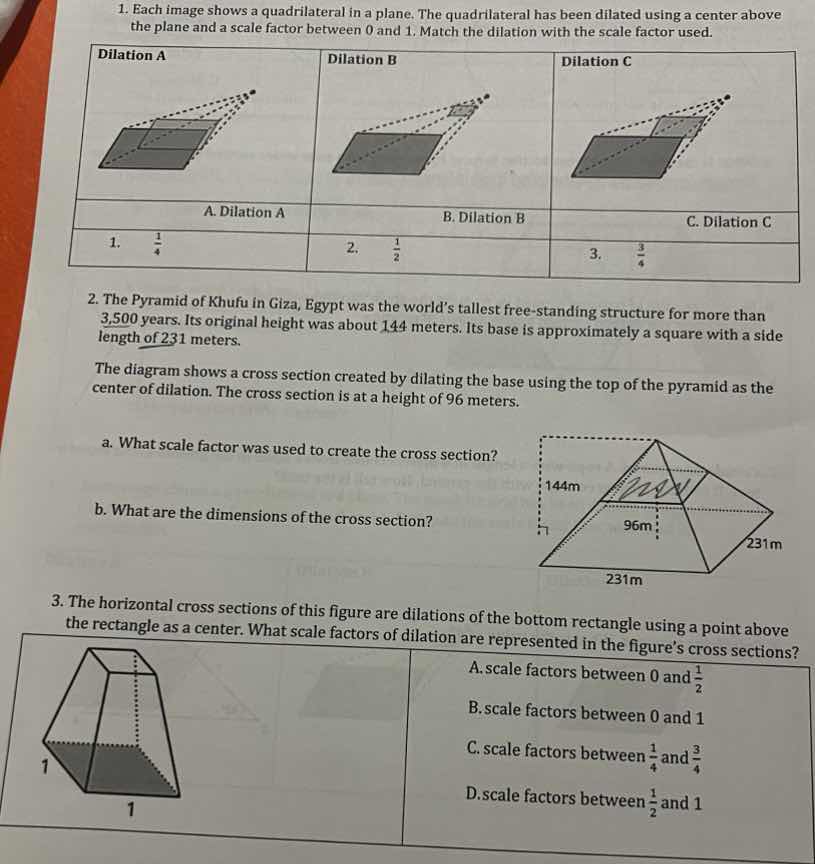
- each image shows a quadrilateral in a plane. the quadrilateral has been dilated using a center above the plane and a scale factor between 0 and 1. match the dilation with the scale factor used.
dilation a dilation b dilation c
- $\frac{1}{4}$ 2. $\frac{1}{2}$ 3. $\frac{3}{4}$
a. dilation a b. dilation b c. dilation c
- the pyramid of khufu in giza, egypt was the worlds tallest free-standing structure for more than 3,500 years. its original height was about 144 meters. its base is approximately a square with a side length of 231 meters.
the diagram shows a cross section created by dilating the base using the top of the pyramid as the center of dilation. the cross section is at a height of 96 meters.
a. what scale factor was used to create the cross section?
b. what are the dimensions of the cross section?
- the horizontal cross sections of this figure are dilations of the bottom rectangle using a point above the rectangle as a center. what scale factors of dilation are represented in the figures cross sections?
a. scale factors between 0 and $\frac{1}{2}$
b. scale factors between 0 and 1
c. scale factors between $\frac{1}{4}$ and $\frac{3}{4}$
d. scale factors between $\frac{1}{2}$ and 1
Problem 1
Step1: Relate size to scale factor
Smaller image = smaller scale factor.
Step2: Match dilations to factors
Dilation B (smallest) → $\frac{1}{4}$; Dilation C → $\frac{1}{2}$; Dilation A (largest) → $\frac{3}{4}$.
Part a:
Step1: Use height ratio for scale
Scale factor = $\frac{\text{Cross section height}}{\text{Total pyramid height}}$
$\text{Scale factor} = \frac{96}{144}$
Step2: Simplify the fraction
$\frac{96}{144} = \frac{2}{3}$
Part b:
Step1: Scale base side length
Cross section side = $\text{Base length} \times \text{Scale factor}$
$\text{Cross section side} = 231 \times \frac{2}{3}$
Step2: Calculate the dimension
$231 \times \frac{2}{3} = 154$
The cross sections are dilations of the bottom rectangle (scale factor = 1 at the base) and shrink as they move up toward the top (scale factor > $\frac{1}{2}$, since the top is narrower than the base but not less than half its width).

Snap & solve any problem in the app
Get step-by-step solutions on Sovi AI
Photo-based solutions with guided steps
Explore more problems and detailed explanations
- A Dilation A: $\boldsymbol{\frac{3}{4}}$
- B Dilation B: $\boldsymbol{\frac{1}{4}}$
- C Dilation C: $\boldsymbol{\frac{1}{2}}$
---