QUESTION IMAGE
Question
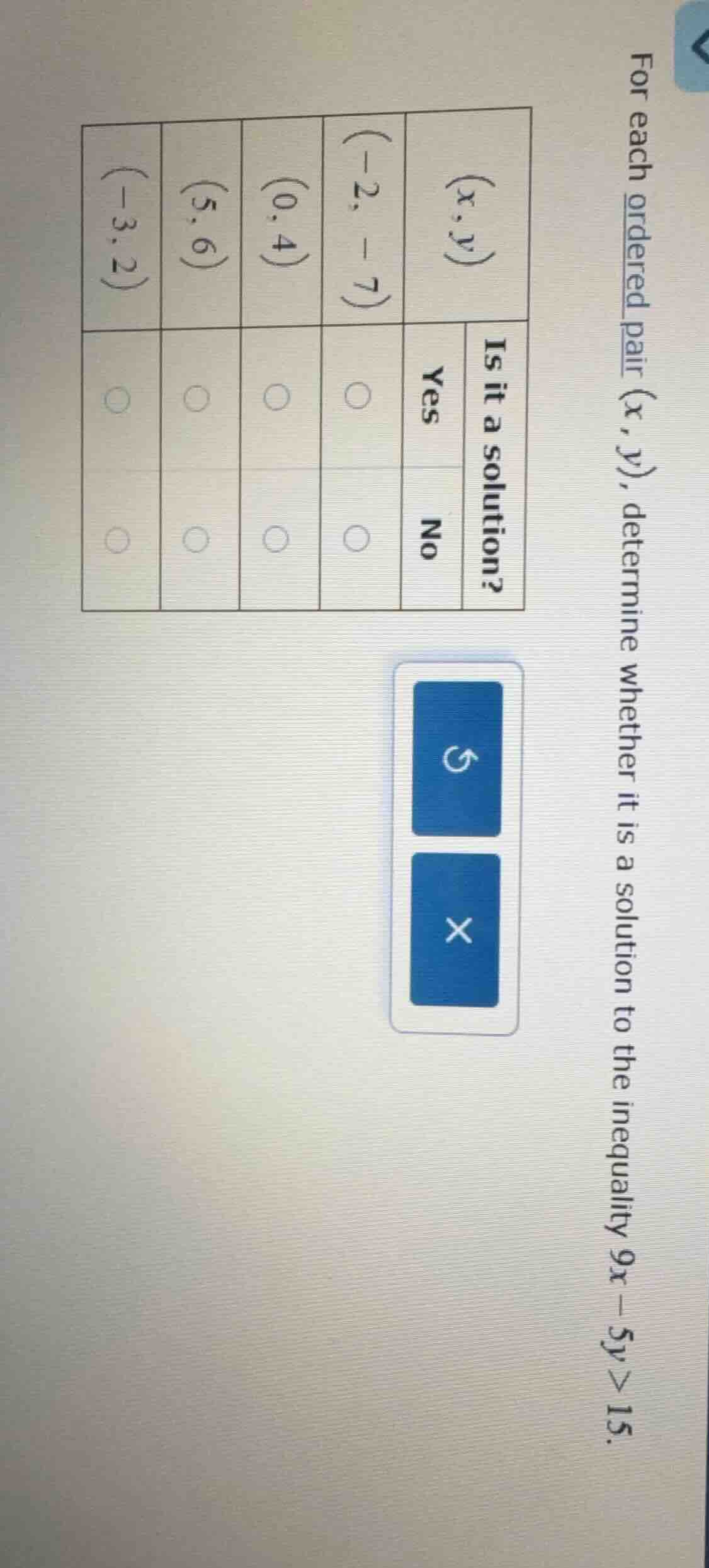
for each ordered pair (x,y), determine whether it is a solution to the inequality 9x - 5y > 15.
| (x,y) | is it a solution? | yes | no |
| (-2, -7) | ○ | ○ | |
| (0,4) | ○ | ○ | |
| (5,6) | ○ | ○ | |
| (-3,2) | ○ | ○ |
To determine if an ordered pair \((x, y)\) is a solution to the inequality \(9x - 5y>15\), we substitute the values of \(x\) and \(y\) from each ordered pair into the inequality and check if the inequality holds true.
For \((-2, -7)\):
Step 1: Substitute \(x = -2\) and \(y=-7\) into the left - hand side of the inequality.
The left - hand side of the inequality is \(9x-5y\). Substituting the values, we get:
\(9\times(-2)-5\times(-7)\)
First, calculate \(9\times(-2)=- 18\) and \(5\times(-7)=-35\), so \(-5\times(-7) = 35\)
Then, \(-18 + 35=17\)
Step 2: Check the inequality.
We need to check if \(17>15\). Since \(17\) is greater than \(15\), the ordered pair \((-2,-7)\) is a solution. So we mark "Yes" for \((-2,-7)\).
For \((0,4)\):
Step 1: Substitute \(x = 0\) and \(y = 4\) into \(9x-5y\).
\(9\times0-5\times4=0 - 20=-20\)
Step 2: Check the inequality.
We check if \(-20>15\). Since \(-20\) is less than \(15\), the ordered pair \((0,4)\) is not a solution. So we mark "No" for \((0,4)\).
For \((5,6)\):
Step 1: Substitute \(x = 5\) and \(y = 6\) into \(9x-5y\).
\(9\times5-5\times6=45-30 = 15\)
Step 2: Check the inequality.
We check if \(15>15\). Since \(15\) is not greater than \(15\) (it is equal), the ordered pair \((5,6)\) is not a solution. So we mark "No" for \((5,6)\).
For \((-3,2)\):
Step 1: Substitute \(x=-3\) and \(y = 2\) into \(9x-5y\).
\(9\times(-3)-5\times2=-27 - 10=-37\)
Step 2: Check the inequality.
We check if \(-37>15\). Since \(-37\) is less than \(15\), the ordered pair \((-3,2)\) is not a solution. So we mark "No" for \((-3,2)\).
Final Answers for each ordered pair:
- \((-2,-7)\): Yes
- \((0,4)\): No
- \((5,6)\): No
- \((-3,2)\): No

Snap & solve any problem in the app
Get step-by-step solutions on Sovi AI
Photo-based solutions with guided steps
Explore more problems and detailed explanations
To determine if an ordered pair \((x, y)\) is a solution to the inequality \(9x - 5y>15\), we substitute the values of \(x\) and \(y\) from each ordered pair into the inequality and check if the inequality holds true.
For \((-2, -7)\):
Step 1: Substitute \(x = -2\) and \(y=-7\) into the left - hand side of the inequality.
The left - hand side of the inequality is \(9x-5y\). Substituting the values, we get:
\(9\times(-2)-5\times(-7)\)
First, calculate \(9\times(-2)=- 18\) and \(5\times(-7)=-35\), so \(-5\times(-7) = 35\)
Then, \(-18 + 35=17\)
Step 2: Check the inequality.
We need to check if \(17>15\). Since \(17\) is greater than \(15\), the ordered pair \((-2,-7)\) is a solution. So we mark "Yes" for \((-2,-7)\).
For \((0,4)\):
Step 1: Substitute \(x = 0\) and \(y = 4\) into \(9x-5y\).
\(9\times0-5\times4=0 - 20=-20\)
Step 2: Check the inequality.
We check if \(-20>15\). Since \(-20\) is less than \(15\), the ordered pair \((0,4)\) is not a solution. So we mark "No" for \((0,4)\).
For \((5,6)\):
Step 1: Substitute \(x = 5\) and \(y = 6\) into \(9x-5y\).
\(9\times5-5\times6=45-30 = 15\)
Step 2: Check the inequality.
We check if \(15>15\). Since \(15\) is not greater than \(15\) (it is equal), the ordered pair \((5,6)\) is not a solution. So we mark "No" for \((5,6)\).
For \((-3,2)\):
Step 1: Substitute \(x=-3\) and \(y = 2\) into \(9x-5y\).
\(9\times(-3)-5\times2=-27 - 10=-37\)
Step 2: Check the inequality.
We check if \(-37>15\). Since \(-37\) is less than \(15\), the ordered pair \((-3,2)\) is not a solution. So we mark "No" for \((-3,2)\).
Final Answers for each ordered pair:
- \((-2,-7)\): Yes
- \((0,4)\): No
- \((5,6)\): No
- \((-3,2)\): No