QUESTION IMAGE
Question
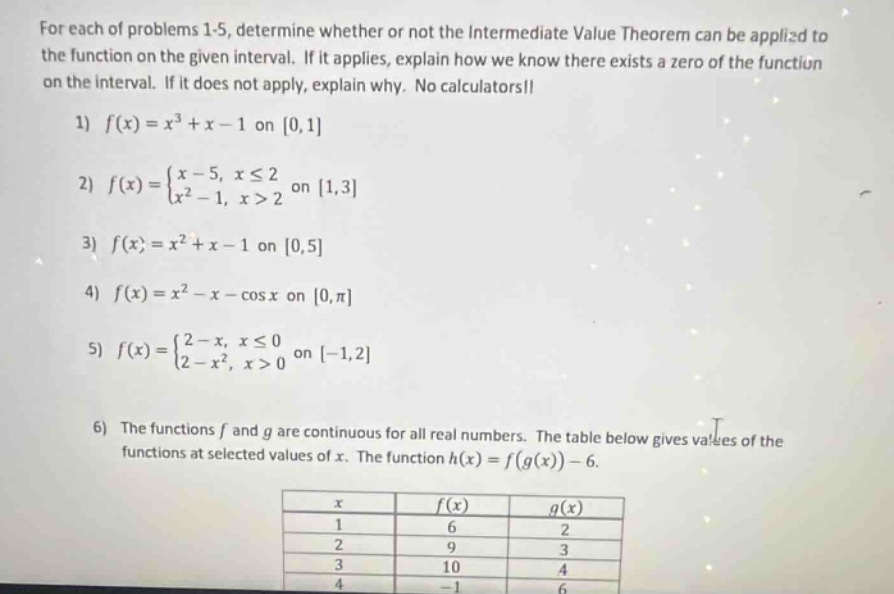
for each of problems 1-5, determine whether or not the intermediate value theorem can be applied to the function on the given interval. if it applies, explain how we know there exists a zero of the function on the interval. if it does not apply, explain why. no calculators!!
- $f(x)=x^3 + x - 1$ on $0,1$
- $f(x)=\
$ on $1,3$
- $f(x)=x^2 + x - 1$ on $0,5$
- $f(x)=x^2 - x - \cos x$ on $0,\pi$
- $f(x)=\
$ on $-1,2$
- the functions $f$ and $g$ are continuous for all real numbers. the table below gives values of the functions at selected values of $x$. the function $h(x)=f(g(x)) - 6$.
\
Problem 1
Step1: Check continuity on [0,1]
Polynomials are continuous everywhere, so $f(x)=x^3+x-1$ is continuous on $[0,1]$.
Step2: Compute f(0) and f(1)
$f(0)=0^3+0-1=-1$
$f(1)=1^3+1-1=1$
Step3: Apply IVT criteria
Since $f(0)=-1<0$ and $f(1)=1>0$, by IVT, there exists a $c\in(0,1)$ where $f(c)=0$.
Step1: Check continuity at x=2
Left-hand limit: $\lim_{x\to2^-}f(x)=2-5=-3$
Right-hand limit: $\lim_{x\to2^+}f(x)=2^2-1=3$
Step2: Verify continuity failure
$\lim_{x\to2^-}f(x)
eq\lim_{x\to2^+}f(x)$, so $f(x)$ is discontinuous at $x=2\in[1,3]$.
Step1: Check continuity on [0,5]
Polynomials are continuous everywhere, so $f(x)=x^2+x-1$ is continuous on $[0,5]$.
Step2: Compute f(0) and f(5)
$f(0)=0^2+0-1=-1$
$f(5)=5^2+5-1=29$
Step3: Apply IVT criteria
Since $f(0)=-1<0$ and $f(5)=29>0$, by IVT, there exists a $c\in(0,5)$ where $f(c)=0$.

Snap & solve any problem in the app
Get step-by-step solutions on Sovi AI
Photo-based solutions with guided steps
Explore more problems and detailed explanations
The Intermediate Value Theorem applies. $f(x)$ is continuous on $[0,1]$, $f(0)=-1<0$, and $f(1)=1>0$, so there is a zero in $(0,1)$.
---