QUESTION IMAGE
Question
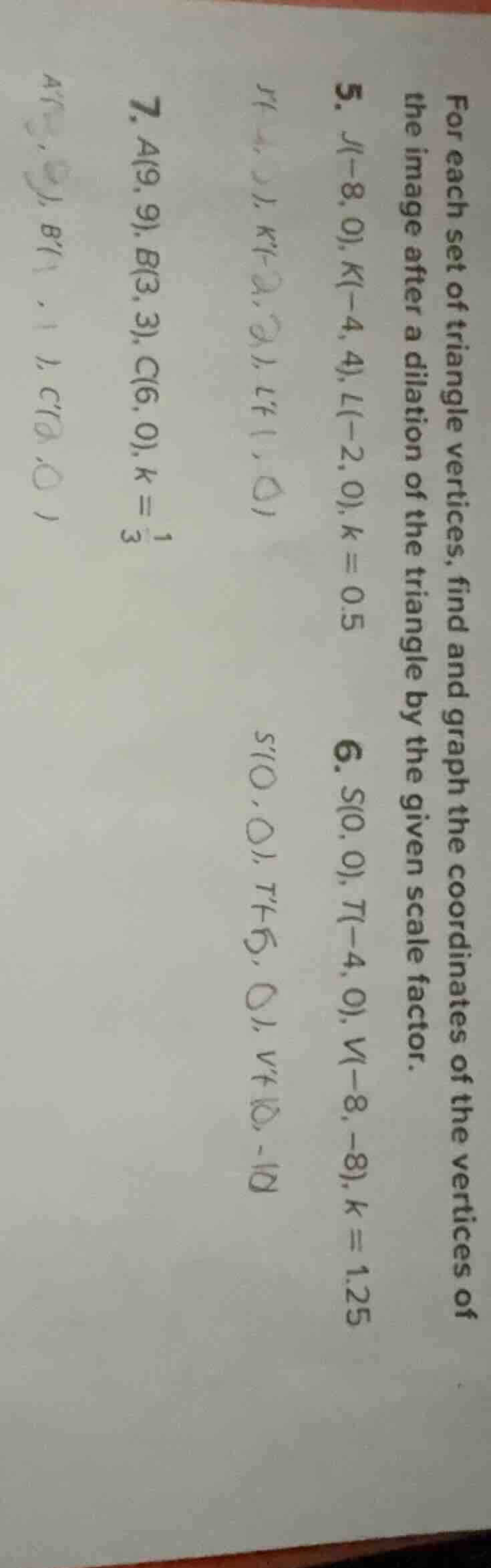
for each set of triangle vertices, find and graph the coordinates of the vertices of the image after a dilation of the triangle by the given scale factor.
- j(-8, 0), k(-4, 4), l(-2, 0), k = 0.5
- s(0, 0), t(-4, 0), v(-8, -8), k = 1.25
- a(9, 9), b(3, 3), c(6, 0), k = \\(\frac{1}{3}\\)
Problem 5:
Step1: Recall dilation rule
To dilate a point \((x,y)\) with scale factor \(k\), the new point \((x',y')\) is given by \((x',y')=(k\cdot x,k\cdot y)\). Here, \(k = 0.5=\frac{1}{2}\), and the points are \(J(-8,0)\), \(K(-4,4)\), \(L(-2,0)\).
Step2: Dilate point \(J\)
For \(J(-8,0)\):
\(x'=0.5\times(-8)= - 4\)
\(y'=0.5\times0 = 0\)
So \(J'(-4,0)\)
Step3: Dilate point \(K\)
For \(K(-4,4)\):
\(x'=0.5\times(-4)=-2\)
\(y'=0.5\times4 = 2\)
So \(K'(-2,2)\)
Step4: Dilate point \(L\)
For \(L(-2,0)\):
\(x'=0.5\times(-2)=-1\)
\(y'=0.5\times0 = 0\)
So \(L'(-1,0)\)
Step1: Recall dilation rule
To dilate a point \((x,y)\) with scale factor \(k\), the new point \((x',y')\) is \((k\cdot x,k\cdot y)\). Here, \(k = 1.25=\frac{5}{4}\), and the points are \(S(0,0)\), \(T(-4,0)\), \(V(-8,-8)\).
Step2: Dilate point \(S\)
For \(S(0,0)\):
\(x'=1.25\times0 = 0\)
\(y'=1.25\times0 = 0\)
So \(S'(0,0)\)
Step3: Dilate point \(T\)
For \(T(-4,0)\):
\(x'=1.25\times(-4)=-5\)
\(y'=1.25\times0 = 0\)
So \(T'(-5,0)\)
Step4: Dilate point \(V\)
For \(V(-8,-8)\):
\(x'=1.25\times(-8)=-10\)
\(y'=1.25\times(-8)=-10\)
So \(V'(-10,-10)\)
Step1: Recall dilation rule
To dilate a point \((x,y)\) with scale factor \(k\), the new point \((x',y')\) is \((k\cdot x,k\cdot y)\). Here, \(k=\frac{1}{3}\), and the points are \(A(9,9)\), \(B(3,3)\), \(C(6,0)\).
Step2: Dilate point \(A\)
For \(A(9,9)\):
\(x'=\frac{1}{3}\times9 = 3\)
\(y'=\frac{1}{3}\times9 = 3\)
So \(A'(3,3)\)
Step3: Dilate point \(B\)
For \(B(3,3)\):
\(x'=\frac{1}{3}\times3 = 1\)
\(y'=\frac{1}{3}\times3 = 1\)
So \(B'(1,1)\)
Step4: Dilate point \(C\)
For \(C(6,0)\):
\(x'=\frac{1}{3}\times6 = 2\)
\(y'=\frac{1}{3}\times0 = 0\)
So \(C'(2,0)\)

Snap & solve any problem in the app
Get step-by-step solutions on Sovi AI
Photo-based solutions with guided steps
Explore more problems and detailed explanations
\(J'(-4,0)\), \(K'(-2,2)\), \(L'(-1,0)\)